
Best DTF Film Comparison: How to Choose the Right One
Choosing the best DTF film by brand name or price alone is a production mistake. A film that peels quickly may be wrong for a detailed logo, a stretchy polyester garment, or a workflow where rework costs more than a few seconds saved at the press.
The practical decision starts with three variables: peel behavior, film thickness, and material compatibility. Coating uniformity, ink absorption, powder adhesion, dimensional stability, and wash performance then determine whether that choice remains reliable beyond a single successful test.
The scale of DTF printing makes those distinctions more important. One industry estimate valued the global DTF printing market at USD 2.72 billion in 2024 and projected USD 3.92 billion by 2030, with a 6.0% CAGR from 2025 to 2030. The same estimate placed Europe at 36.0% of the global market in 2024, evidence that film standards are being tested in internationally scaled production, not only in small local shops. Grand View Research's DTF printing market analysis
Why the Best DTF Film Depends on Your Production Constraints
A film that performs well on one job can create failures on the next. Film performance is process-dependent. Fast-release material may suit a high-volume cotton run, yet lift fine details, distort on stretch fabric, or create extra handling when the transfer needs more control.
Start by defining the production conditions:
- Peel timing: Must operators remove the carrier at the press, or can transfers cool before peeling?
- Garment behavior: Is the order printed on stable cotton, heat-sensitive polyester, or a stretchy blend?
- Artwork structure: Does the design contain solid blocks, small text, fine lines, gradients, or detailed labels?
- Production rhythm: Does the shop value rapid press-side handoff, or fewer incomplete transfers and less rework?
- Handling demand: Will the printed film run through a long production batch where stiffness and dimensional stability affect feeding?
The market is expanding quickly. A separate industry review reported that more than 7.2 billion DTF prints were produced globally in 2024, nearly 30% more than the previous year. WTiN's 2025 DTF printing market review At that scale, a small variation in coating, release behavior, or powder coverage can affect a large batch of transfers. A film should therefore be judged by repeatable production results, not by a feature list or a single successful test.
Compare the decision variables
| Production constraint | Film characteristic to prioritize | Why it matters |
|---|---|---|
| Immediate press-side turnaround | Hot peel behavior | The carrier can release without waiting for full cooling |
| Detailed designs or stretchy garments | Cold peel behavior | Cooling can reduce distortion during release |
| Predictable feeding and handling | Controlled caliper | Consistent thickness supports stable movement and pressing |
| Fine lines and small lettering | Uniform functional coating | Ink needs to sit cleanly and release without carrying away detail |
| Repeated production | Powder and heat compatibility | Adhesive coverage and curing must remain consistent across jobs |
Thickness still matters, but it should be treated as a process constraint rather than a universal quality score. A thicker film may handle more predictably in feeding, while a thinner option can change how the material flexes, heats, and releases. Compare the film's stated caliper with actual behavior on the printer, shaker, curing unit, and press.
Run the same artwork across the fabrics and peel conditions your team uses most. Record incomplete releases, edge lift, distortion, feeding problems, and rework. That production record gives a more useful definition of the best DTF film than brand reputation alone.
Practical rule: Choose the film that produces the fewest failures across your normal garment, artwork, and press sequence.
Cold Peel vs Hot Peel DTF Film Explained
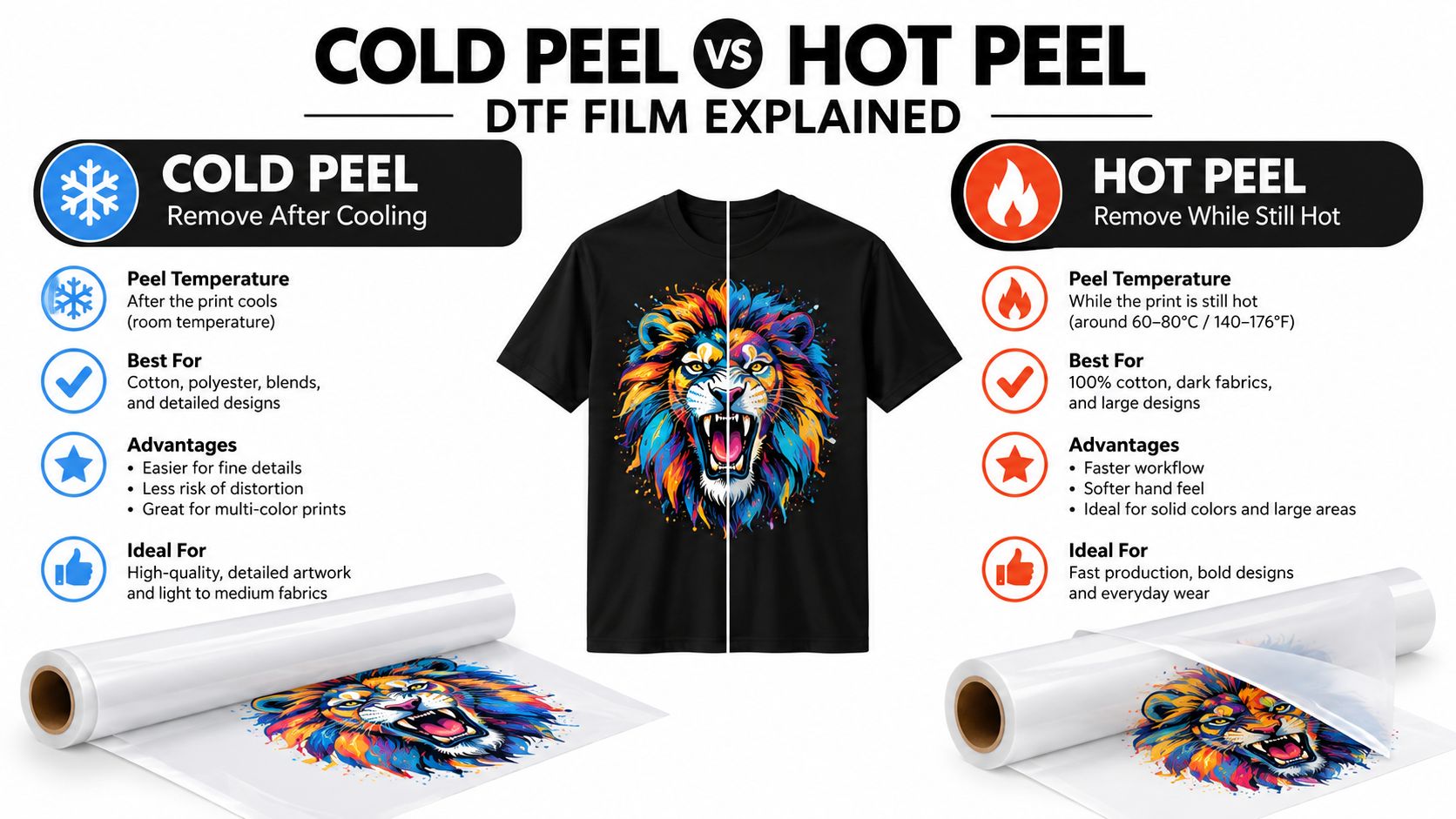
Peel type changes the production sequence, not just the operator's preference. Hot peel film releases immediately after pressing, while cold peel film requires the transfer to cool before removal. That difference affects throughput, handling, edge definition, and the feel of the finished print.
Where cold peel earns its place
Cold peel is often the safer choice when the design or garment can't tolerate much movement during release. Recent guidance identifies polyester, nylon, and stretchy apparel as applications that often perform better with cold peel, while large or highly detailed designs may also benefit from the added control. DTF Database's film type guide
Cooling gives the adhesive and printed layer time to stabilize before the carrier is removed. That can help protect fine edges, dense artwork, and designs that span a flexible or heat-sensitive surface. The trade-off is workflow speed. Operators need a cooling step, and the transfer may require a staging area or a controlled handoff between pressing and peeling.
Cold peel can also be a better fit when the garment itself is the risk. Polyester and other synthetics may react poorly to excessive heat, so the production team needs to balance cure and press settings with the film's release behavior. The film won't solve scorching, migration, or poor temperature control by itself, but a cold-peel workflow can give the operator more control over the release stage.
Where hot peel makes sense
Hot peel is designed for speed. When the transfer releases cleanly while still warm, the operator can move directly from pressing to peeling without waiting for complete cooling. That makes it useful for straightforward designs, tight turnaround requirements, and workflows where every station follows a rapid rhythm.
The softer hand feel often associated with hot peel can also be valuable on apparel. However, faster release doesn't automatically mean stronger or more durable transfers. If the film is removed before the adhesive has bonded correctly, or if the press settings don't match the ink and powder system, the result can include lifted edges, incomplete details, or inconsistent wash performance.
The right choice depends on the order profile:
| Typical job | More suitable starting point | Main caution |
|---|---|---|
| Bold graphic on stable cotton | Hot peel | Confirm complete release without pulling edges |
| Detailed logo or small lettering | Cold peel | Build cooling time into the workflow |
| Stretchy blend or synthetic garment | Cold peel | Validate cure and press conditions on the actual blank |
| High-speed repeat work with simple art | Hot peel | Watch for premature release and incomplete adhesion |
Raccoon Transfers' Custom DTF Transfer by Size: Perfect Prints for Every Project is a ready-to-press transfer option described for cotton, polyester, blends, leather, and other materials, with sizing options for different projects. For any supplied transfer, the film and peel behavior still need to match the garment and the application instructions.
DTF Film Thickness and Coating Quality Standards
Film thickness affects more than how a roll feels in the hand. It changes stiffness, feeding, heat response, dimensional stability, and transfer handling. A thinner film can support a lighter transfer feel and may be easier to manage, while a thicker film can provide more stability during printing, curing, and movement through production. Neither option is automatically better. The correct choice depends on how the film behaves in the full workflow.
A common high-quality range is 75 to 125 microns, with 75 µm often used as a practical benchmark. A specification such as 75 µm ± 2 µm gives production staff more useful information than a label such as “premium.” Across a 500-print run, that tolerance means the film may vary by up to 2 µm from its stated caliper. That difference can affect feeding and heat response when the process is already operating near its limits. DTF Film MFR's technical quality guide
Why caliper control matters
Two rolls with the same nominal thickness can still behave differently if the actual caliper changes across the sheet. Uneven thickness may alter feeding, drying response, heating, and the consistency of the coating that receives ink and powder.
Long runs expose these differences quickly. Variation across the roll can shift print sharpness, powder distribution, or release timing. Operators may then adjust printer, dryer, or press settings to correct one area, only to create inconsistency elsewhere. Record caliper and process results by roll so the team can separate a film problem from a machine-setting problem.
Coating quality deserves the same attention as thickness. Check coating uniformity, ink absorbency, dimensional stability under heat, and clean peel behavior. The process also needs predictable peel strength, resistance to heat at 130°C during drying and 160°C during heating, sharp printed detail, even powder adhesion, and wash fastness across multiple cycles. Saillage's DTF transfer film wholesale guide
Read the specification, not the slogan
Ask suppliers for measurable information about:
- Caliper tolerance: A nominal thickness without a tolerance says little about roll consistency.
- Heat stability: The film should remain dimensionally predictable through drying and pressing.
- Coating behavior: Ink should sit cleanly without excessive spreading or weak absorption.
- Release performance: The carrier should separate without leaving small details behind.
- Wash testing: Evaluate the complete transfer system, not only its dry appearance.
Raccoon Transfers' guide to DTF transfer film explains how PET thickness, coating, and release fit into the broader workflow. Treat the stated thickness as a starting point, then test the film with your own printer, ink, powder, dryer, press, and garments.
How to Choose DTF Film for Apparel and Hard Surfaces
Material selection should come before film selection. The same adhesive and release behavior won't perform identically on a stable cotton shirt, a heat-sensitive synthetic, flexible leather, and a rigid surface. Start with the substrate, then account for design detail, heat tolerance, and the way the finished item will be used.
Step 1, classify the surface
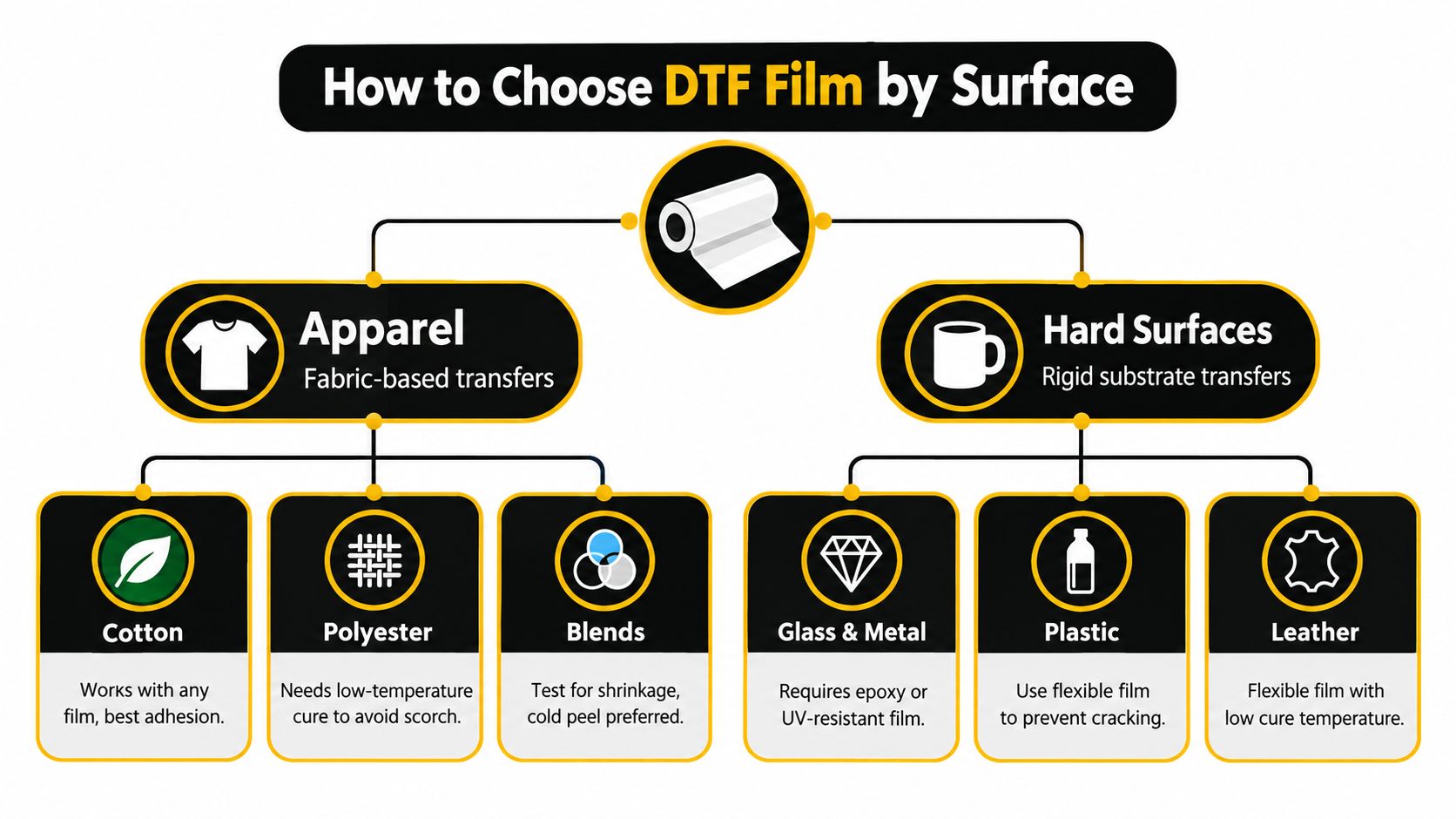
Cotton is usually the forgiving starting point. It generally provides a stable textile base, so the team can select hot or cold peel according to artwork and throughput. Bold graphics and straightforward orders may suit hot peel, while fine detail can justify cold peel.
Polyester needs temperature discipline. Synthetic fabric can be more sensitive to heat and dye migration, so test the actual garment instead of assuming that a film rated for cotton will behave the same way. Cold peel is often preferred for polyester applications, especially when the design is detailed or the garment has a performance finish.
Blends require testing for movement. Cotton-polyester and stretchy blends can shrink, flex, or respond unevenly during pressing. Cold peel is often the safer starting point when dimensional change or stretch creates release risk.
For broader material planning, the material compatibility chart can help organize tests by substrate rather than by supplier marketing category.
Step 2, match film behavior to the design
Use hot peel when fast handoff matters and the design is structurally simple enough to tolerate immediate release. Choose cold peel when the job includes small text, thin lines, large detailed artwork, or a garment that stretches during peeling.
Film thickness adds another decision. A thicker film can be easier to handle and more stable during a demanding run, but it may contribute to a firmer transfer feel. A thinner film can reduce handling bulk and support comfort, yet it may require more care during movement and alignment.
Step 3, separate apparel from rigid substrates
Traditional DTF film decisions mainly concern apparel. For glass, metal, plastic, and leather, the bonding system and end-use demands become more important than merely choosing hot or cold peel. Rigid surfaces may require a different transfer technology, adhesive design, or protective finish, especially where moisture, abrasion, or outdoor exposure is involved.
Leather and flexible plastic need a film and adhesive layer that can move with the surface rather than crack under bending. Smooth glass and metal require clean surface preparation and a bond designed for that substrate. When evaluating support materials for decorated goods, the same structured approach used for choosing the right stabilizer is useful: identify the material's movement and stress before choosing the consumable.
DTF Film Compatibility, Adhesive Powder, and Ink Performance
A DTF film doesn't work alone. The transfer is a stack of PET carrier, functional coating, ink, adhesive powder, cured layer, and substrate. A failure blamed on film may come from unstable white ink, uneven powder coverage, incorrect curing, or a press setting that doesn't suit the garment.
Start with the coating. It needs to accept the ink without uncontrolled spreading, hold the printed image through powdering and curing, and release the finished layer cleanly. Poor coating uniformity can show up as rough edges, weak fine detail, irregular powder adhesion, or sections that stay on the carrier.
Compare the system, not one component
| Observation | Likely area to investigate | Practical response |
|---|---|---|
| Ink spreads or edges look soft | Film coating or ink laydown | Test a controlled artwork file and compare coating behavior |
| Powder sticks unevenly | Powder application or surface condition | Check coverage, particle consistency, and film handling |
| Edges lift after pressing | Cure, powder, press, or substrate | Verify the full bond sequence before changing film |
| Small details remain on the carrier | Release behavior or incomplete bonding | Test cold and hot peel timing with the same design |
| Wash performance varies | Adhesive, cure, press, or fabric | Run a repeatable wash test on the actual garment |
Independent guidance highlights powder adhesion uniformity, heat resistance, print sharpness, peel strength, and wash fastness as useful quality checks. Those checks are more informative than a product description that only promises bright color.
Build a controlled test
Use one artwork file that includes a solid shape, small lettering, fine lines, and a gradient. Print it on the candidate film, apply the same powder, and keep drying and pressing conditions constant. Change one variable at a time, then inspect the transfer before and after washing.
Ink compatibility deserves special attention during extended production. The film may release correctly in a short test while the ink system behaves differently during a longer run. White ink stability, color density, and the interaction between ink, coating, and powder can all affect the final result.
Raccoon Transfers' guide to DTF transfer powder provides a relevant reference for evaluating powder as part of the transfer system. The key operational point is simple: don't approve a film until it has passed with your actual ink and powder combination.
Cost, Rework Risk, and Long-Term Transfer Value
A low-cost film saves money only when it produces an accepted transfer. Failed prints, extra handling, press downtime, replacement garments, and complaints can erase the difference in purchase price. Compare cost per accepted transfer, not just cost per sheet or roll.
Release consistency affects production speed. If one transfer peels cleanly while the next needs different temperature or cooling conditions, operators slow down and quality checks become less predictable. Uneven powder adhesion creates another hidden cost because the defect may appear during pressing or washing.
Track the costs that invoices hide
Record these outcomes for each film:
- Accepted transfers: Pieces that reach the next stage without correction.
- Reprints: Defects that force another print.
- Operator time: Minutes spent peeling, inspecting, and correcting.
- Garment loss: Failures that damage or consume the blank.
- Customer-facing defects: Problems reported after delivery or laundering.
Film thickness belongs in the same calculation. Thicker material can improve stability and reduce handling damage during long runs, but it may reduce flexibility or change hand feel. A thinner film can suit lightweight apparel while requiring more careful handling.
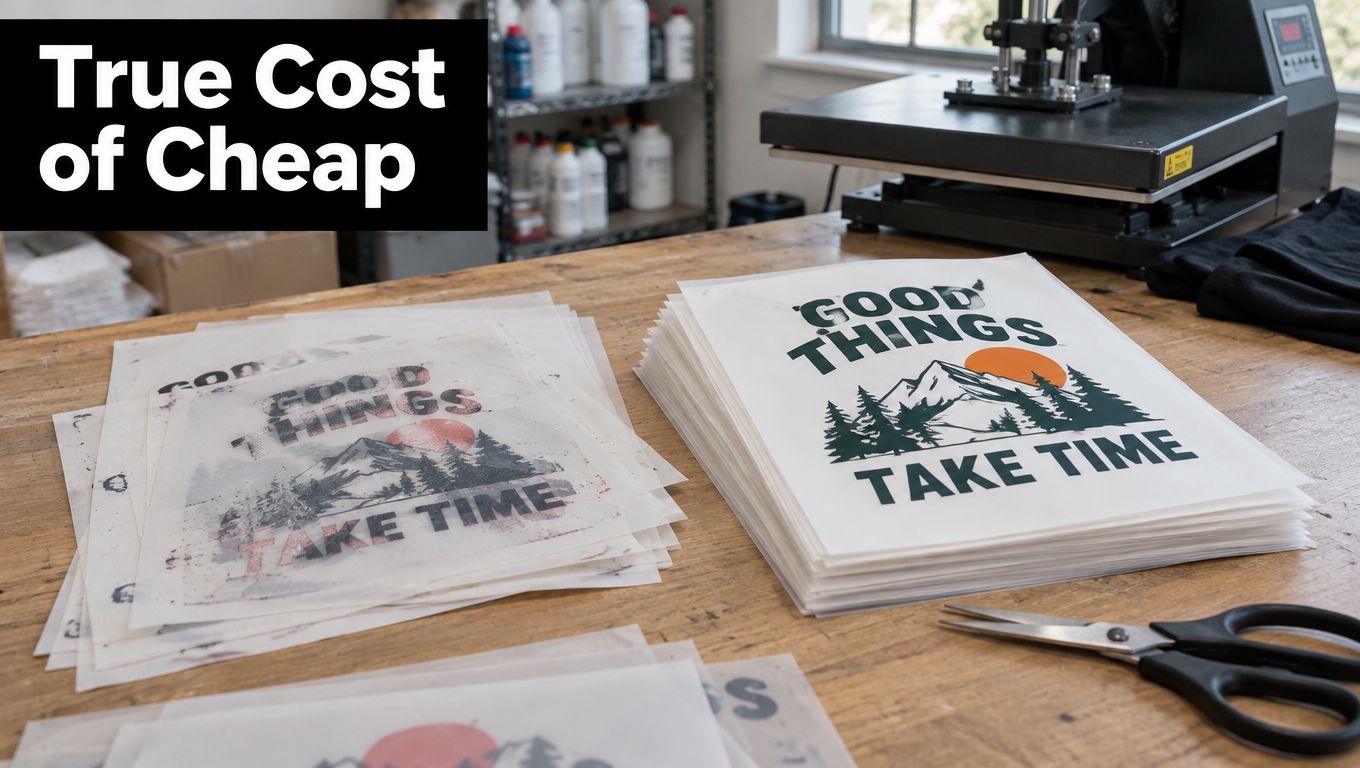
A failure blamed on film often comes from unstable white ink, uneven powder coverage, incorrect curing, or press settings that do not suit the garment. Keep those variables controlled before changing the film. Otherwise, the team may pay for a new consumable without addressing the actual source of rework.
The broader market data shows why repeatability matters. One report estimated the DTF film market at USD 583 million in 2024, projecting USD 1.34 billion by 2031 and a 12.5% CAGR, with cold peel identified as the leading film type. Grand View Research's market report These figures do not establish one universally superior film. They reinforce the need for consistent consumables that reduce waste across the actual production workflow.
Final Checklist for Selecting the Best DTF Film
Approve a film only after it has passed the jobs, fabrics, and press conditions your team handles.
- Confirm peel timing. Use hot peel when immediate release supports throughput. Choose cold peel when controlled release protects detail, stretch, or synthetic fabrics.
- Verify thickness and tolerance. Ask for the caliper tolerance in writing. A nominal figure without tolerance says little about roll-to-roll consistency. DTF Film MFR's quality testing information
- Inspect the coating. Print fine text, narrow lines, gradients, and solid fills. Check edge definition, ink laydown, powder coverage, and complete release.
- Test the full system. Run your printer, ink, powder, dryer, press, and production garments together. A carrier-only test cannot approve the film.
- Check heat response. Confirm that the film stays flat and stable during the drying, curing, and pressing conditions used in your shop.
- Review adhesion and wash performance. Supplier test data should cover peel strength, powder uniformity, heat resistance, and wash fastness, rather than appearance alone.
- Measure accepted output. Compare reprints, handling time, failed presses, and customer-facing defects with the film's purchase cost.
The best film fits the process and produces repeatable transfers. Brand reputation can narrow the shortlist, but peel behavior, thickness control, coating quality, and material compatibility should make the final decision.
Raccoon Transfers produces ready-to-press DTF transfers for cotton, synthetics, blends, and leather, with custom sizing and artwork support for small-batch and branded projects. Review the garment, artwork, and turnaround requirements, then visit Raccoon Transfers for a format suited to the job.