
10 Custom Shirt Ideas for DTF Transfers
The most popular advice about custom shirts is also the least useful: start with an attractive graphic and figure out the rest later. A shirt succeeds because it performs a job for someone, whether that job is honoring a family member, identifying a volunteer crew, celebrating a trip, or giving a small brand something people want to wear.
That changes how you choose artwork. Before opening a design tool, decide who will wear the garment, where they'll wear it, what color blank fits the use case, and whether the design must work as a single sample or a repeatable product. DTF transfers give you room for full-color art, fine lines, gradients, and personalized variations, but those advantages don't remove production decisions. You still need to check image quality, coverage, placement, sizing, gang-sheet planning, mockups, and sample results.
The strongest AI shirt maker for creators concept isn't always the most elaborate one. It's the idea that stays legible on the intended garment, looks convincing in a realistic preview, and can be produced without creating avoidable fulfillment problems.
1. Full-Color Photorealistic Portraits
Portrait shirts have a clear buyer and an emotional purpose. A customer may want a custom pet portrait, a memorial garment, a family reunion shirt, or fan apparel built around a recognizable face. In each case, the image carries most of the meaning, so weak source photography creates a bigger problem than a slightly imperfect typeface.
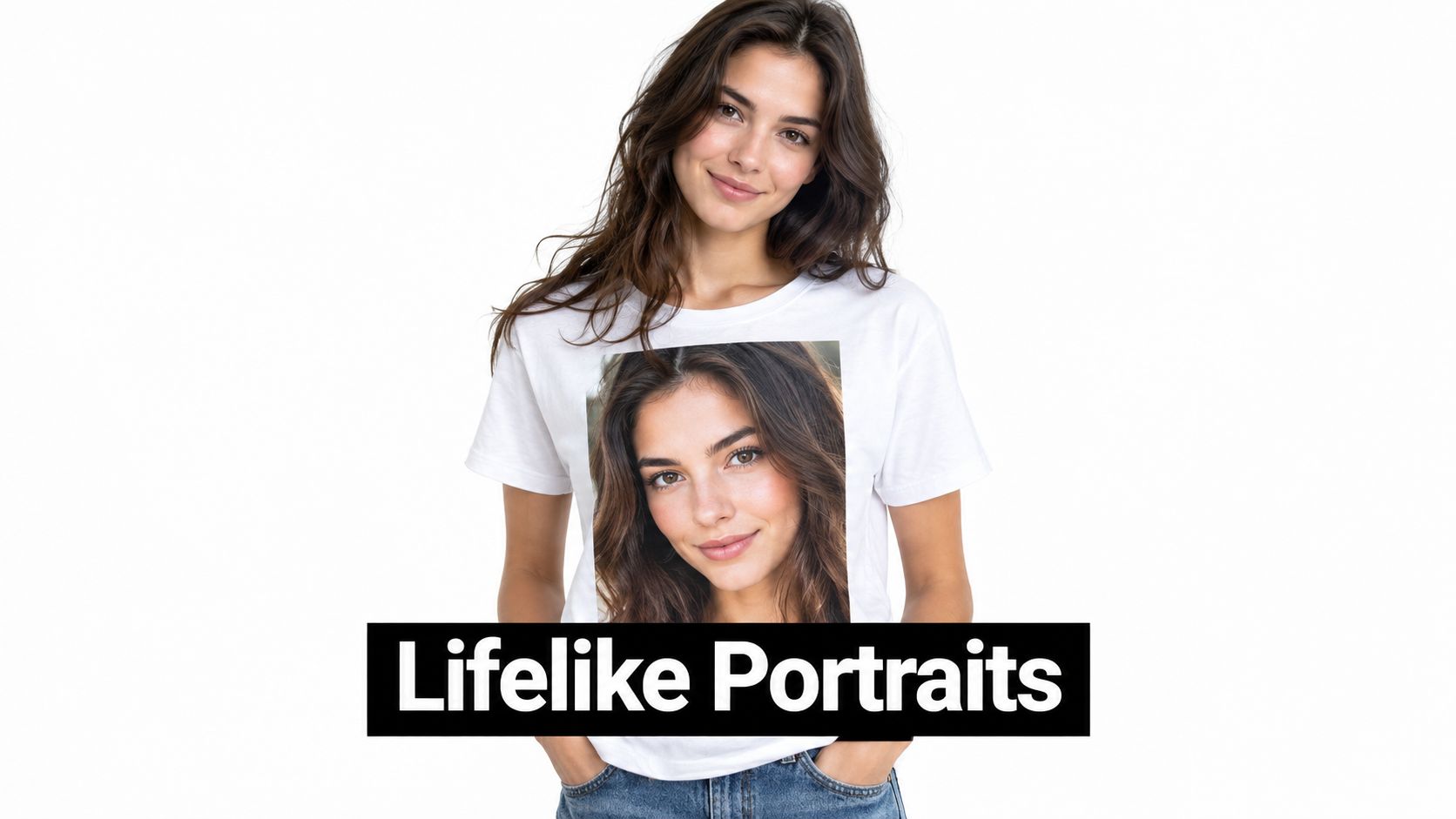
Ask the customer for the clearest original image available, not a compressed screenshot copied from social media. Good lighting, visible facial features, and separation between the subject and background give the artwork more usable information. High contrast also helps the portrait retain its shape when printed on a colored garment.
Make the portrait wearable
A large centered face can feel like a novelty product. An off-center portrait with supporting text, a date, or a small location mark often feels more intentional. For memorial shirts, keep the hierarchy respectful. The portrait should lead, while names and dates remain readable without competing with the image.
Garment color matters. A white or light blank can make the image feel clean and photographic, while a dark blank creates stronger contrast but requires careful review of shadow areas and the printed underbase. Use a realistic mockup to check whether the portrait still looks natural at the actual print size.
For projects where each shirt needs a different image or print dimension, Custom DTF Transfer by Size: Perfect Prints for Every Project can fit the workflow because the catalog describes custom transfers for full-color artwork, gradients, fine lines, and different garment materials. Order a sample before committing to a larger run, especially when the source images vary in lighting or resolution.
2. Vintage Distressed and Grunge Effects
A distressed shirt sells a feeling of age, nostalgia, or belonging to a scene. That makes it useful for a vintage coffee shop, a brewery, a throwback sports event, an artist project, or a band-inspired design. The buyer isn't only purchasing a logo. They're buying the suggestion that the garment already has a history.
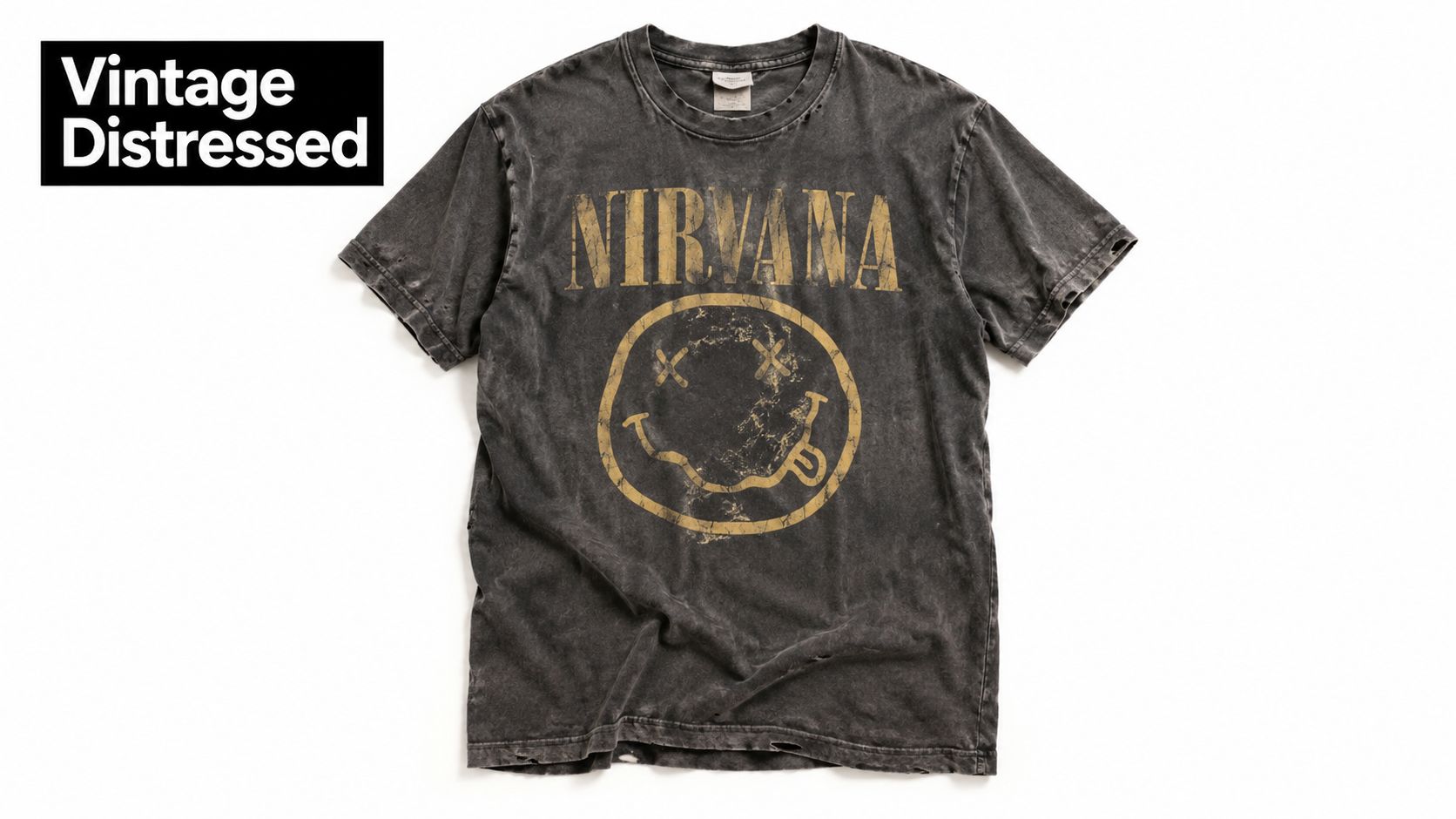
Distressing works best when it's controlled. Add worn edges, broken ink areas, faded color blocks, or a lightly weathered texture, but preserve the core message. If the texture destroys thin lettering or makes a logo look dirty rather than aged, the design has gone too far.
Match the blank to the mood
A cream, washed, or heather-colored blank usually supports a vintage direction more naturally than a bright, perfectly even shirt color. That doesn't mean black garments are wrong. A black blank can create a stronger concert or streetwear feel, especially when the artwork uses muted yellow, red, gray, or off-white accents.
Chest placement is often a practical choice because the larger, flatter area gives the distressed texture room to show. Sleeve prints can work for a small secondary mark, but they don't give a complex weathered composition much space. Keep the main graphic readable from a normal viewing distance.
Practical rule: Distress the artwork, not the message. A buyer should notice the concept before noticing the texture.
Create several versions with different levels of wear and review them on the actual garment color. A texture that looks subtle on a white design canvas may become overpowering once the blank shows through the distressed areas. Sample testing is especially useful for designs that depend on faded edges or partial transparency.
3. Multi-Piece Gang Sheet Custom Collections
A gang sheet turns one print file into a small collection of coordinated transfers. That makes it useful for a creator launching several related designs, an event with different participant roles, a seasonal apparel drop, or a business testing multiple graphics without preparing every transfer as a separate project.
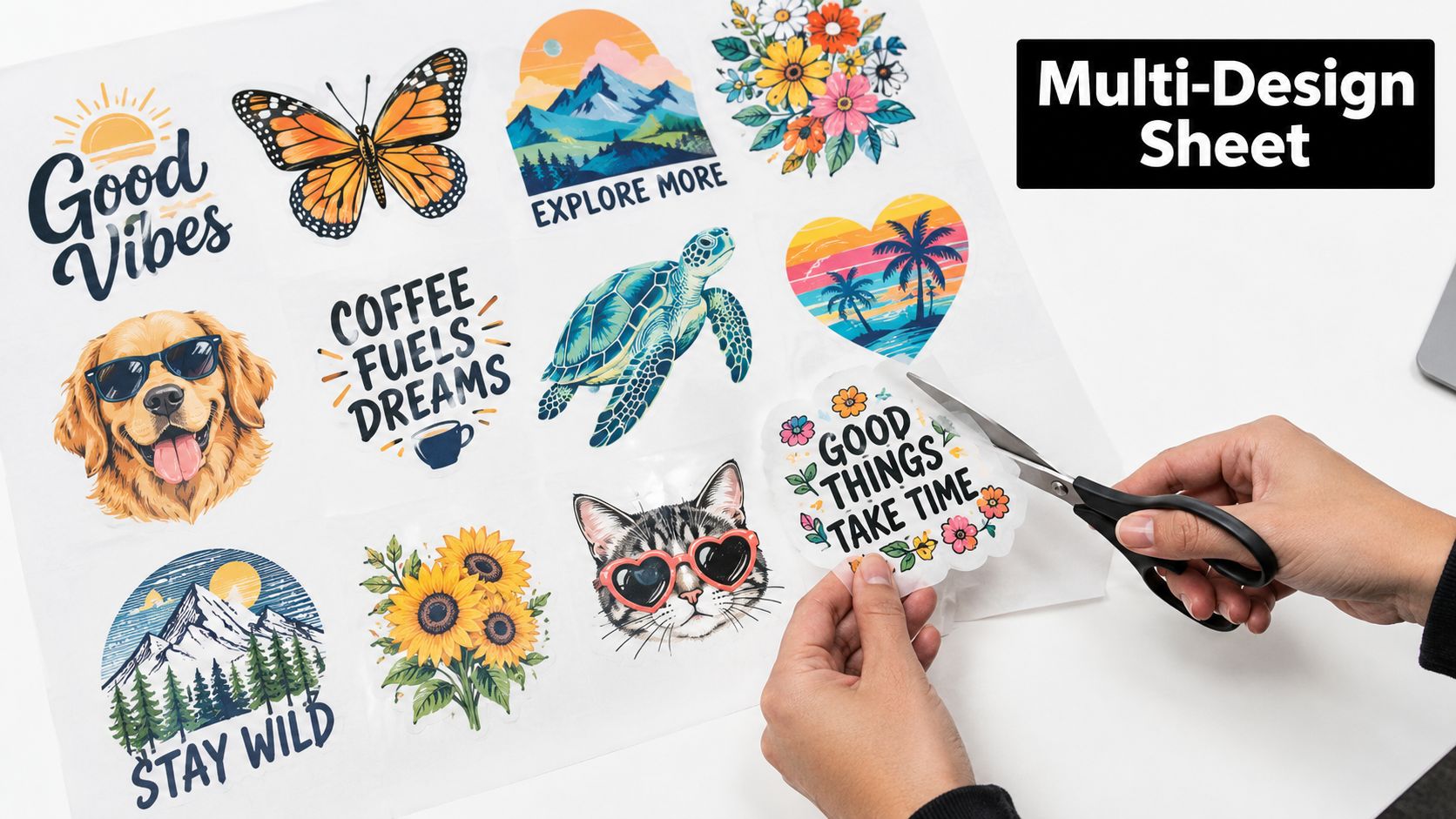
The best gang sheets are planned around production, not just filled until no space remains. Group artwork with similar dimensions, leave enough separation for clean cutting, and give every design a clear file name. A sheet containing front graphics, sleeve marks, and back prints needs a labeling system that someone can follow quickly during pressing and fulfillment.
Build collections that share a visual system
A collection can use one type family, a limited color palette, or a recurring illustration style while changing the subject. For example, a local event might use one badge layout for staff, volunteers, and attendees. A small brand might use the same wordmark placement while rotating seasonal artwork.
The customer experience improves when each variation is easy to understand. Show the finished shirt, not only the transfer sheet. A mockup can reveal that one design feels too small beside another or that a color combination disappears on the chosen blank.
For practical planning guidance, use the DTF gang sheets guide while arranging related artwork. Keep a digital master of the sheet so a popular design can be reordered without rebuilding the entire collection. Track which variations receive the most attention or repeat orders, then refine the next sheet around that response.
Avoid mixing radically different print sizes unless the sheet layout benefits from it. Tiny graphics may be efficient to place, but they can become difficult to cut, identify, or position consistently. A gang sheet saves material and handling time only when the designs remain organized.
4. Dark Garment Full Coverage Front and Back Designs
A dark shirt with substantial front and back artwork is a natural fit for concert merchandise, festival apparel, gaming collections, esports identity, and limited artist collaborations. The front can establish the mark or image, while the back carries the larger story, lineup, scenery, character scene, or community message.
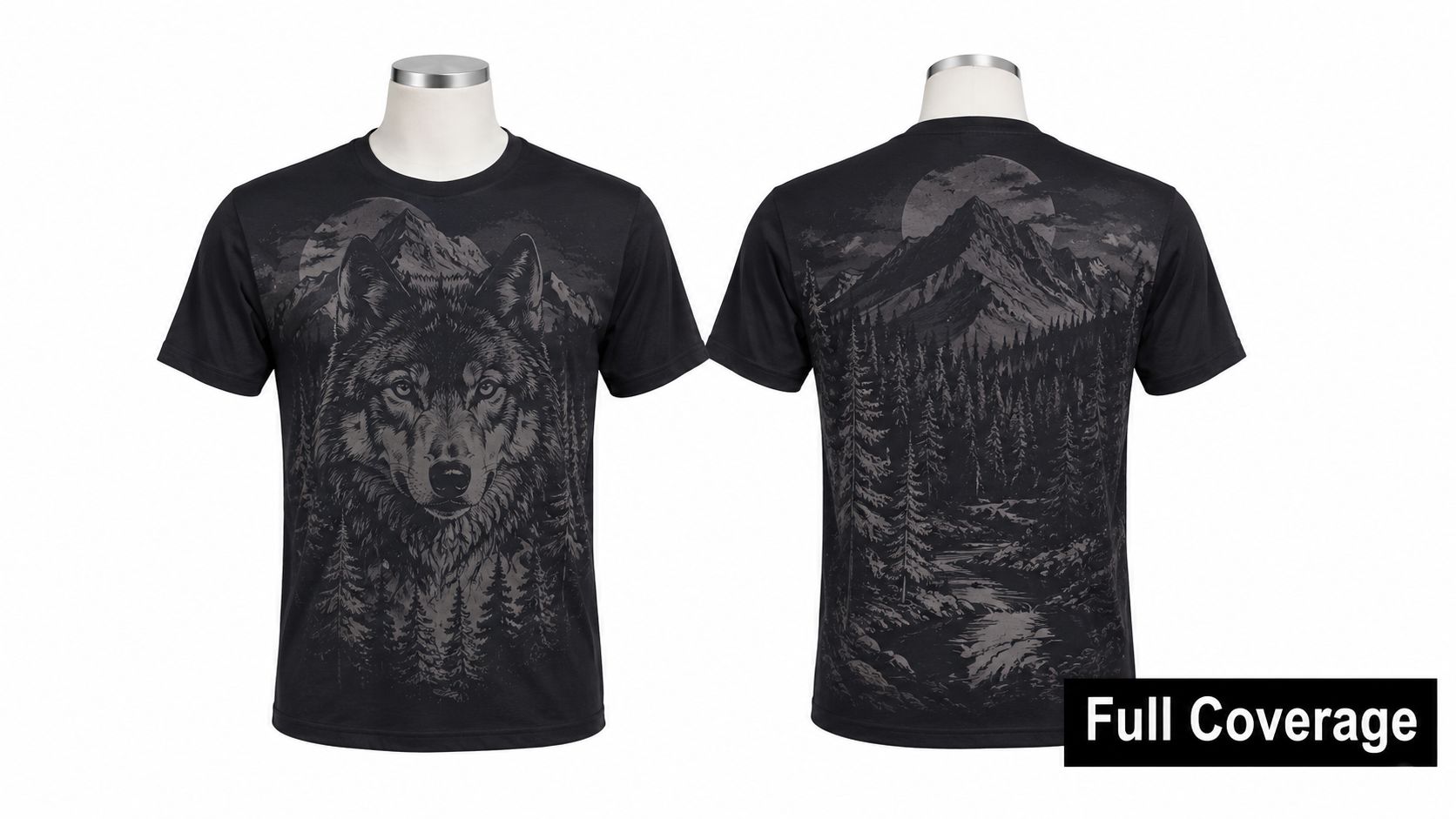
Dark garments demand a careful preview because the blank becomes part of the composition. DTF's white underbase helps preserve color visibility on dark fabric, but the artwork still needs sufficient contrast and a deliberate color relationship with the shirt. Deep shadows, dark green, navy, and black details can merge if the file doesn't separate them clearly.
Design around the garment, not a flat rectangle
Keep critical faces, logos, and text away from collar curves, armholes, and side seams. A wide or abstract composition can tolerate some interruption, but a name or character shouldn't land where the garment folds or where the press has difficulty reaching.
Front and back coverage also changes perceived value. A restrained left-chest mark paired with a large back print feels different from two equally large graphics. Decide which side carries the main message, then let the secondary placement support it rather than compete.
Use a mockup that shows the shirt from multiple angles. Check whether the back design looks balanced when the model's shoulders curve forward, and confirm that the front print doesn't feel oversized on smaller garment sizes. One master design may need adjusted placement across the size range.
A sample on the intended blank is essential for large coverage. Review color, edge definition, hand feel, and alignment before pressing a full run. The visually boldest version isn't automatically the best one if it becomes uncomfortable, difficult to position, or hard to reproduce consistently.
5. Transparent and Layered Color Effects
Layered color artwork can give a shirt a more editorial or premium appearance. This direction suits streetwear labels, art collaborations, designer merchandise, and signature brand pieces where the design should reward a closer look rather than announce itself with a single bold block.
Use transparent PNG artwork when the file depends on separated elements, soft overlays, or controlled areas of opacity. A subtle color wash behind a line illustration can create depth. A second graphic sitting lightly over a photograph can make the design feel assembled rather than pasted onto the garment.
Treat transparency as a tested effect
Semi-transparent artwork behaves differently across garment colors. The same overlay may feel delicate on a pale blank and muddy on a dark one. Test the design on the actual shirt color, especially when the artwork uses gradual opacity changes, muted neutrals, or several overlapping elements.
Placement can add another layer of sophistication. A small mark near the left chest can act as a quiet entry point, while a larger layered composition across the front creates a fashion-led statement. A sleeve detail or upper-back accent can repeat one color from the main design without adding another large print area.
Transparent elements should support contrast, not replace it. If the viewer has to squint to find the message, reduce the layers before increasing the print size.
Keep the palette intentional. Too many transparent colors can make the result look gray or indistinct, particularly when the garment itself contributes a strong color. A designer should review both the artwork file and the mockup because the file may appear attractive on a white canvas while the finished garment feels much heavier.
For complex layering, ask the transfer provider whether the artwork needs technical preparation. The important question isn't whether the design can contain many effects. It's whether those effects remain visible, repeatable, and worth the extra proofing time.
6. Small-Batch Custom Merchandise for Personal Brands
A creator's first shirt shouldn't try to summarize an entire business. It needs to give an existing audience a clear way to identify with the creator. That could be a podcast phrase, a streamer emblem, a recurring character, a community nickname, or a seasonal design tied to a particular release.
Start with a simple anchor graphic. A recognizable logo or phrase is easier to show in social posts, easier for buyers to describe, and easier to adapt from a T-shirt to a hoodie or other product. Once that anchor proves useful, add more detailed artwork as a limited design rather than making every product equally complex.
Use interest to shape the first run
Show a mockup before production and ask the audience which garment color, placement, or variation they would likely wear. This is not a substitute for a sale, but it can expose weak combinations early. A design that looks impressive in a close-up may have poor readability when viewed as a small product image.
Online customization research reported that 66.66% of respondents were willing to participate in designing customized apparel, while 59.26% said they would purchase customized apparel if an online or mobile system could scan body measurements. The sample included 162 respondents, so the findings are directional rather than representative of the entire apparel market, but they support immediate previews and clear fit guidance as part of the buying experience. Read the academic study on online apparel customization.
For a small creator drop, a small-batch T-shirt printing guide can help frame the operational questions before artwork is finalized. Decide which elements stay fixed and which can change. Names, dates, locations, accent colors, and edition marks are easier to manage than unlimited customer edits.
Use 10 content ideas to boost engagement to plan the launch around the design process, not only the final product. Behind-the-scenes sketches, mockup comparisons, and garment-color polls can make the audience part of the release without forcing the brand to offer an unmanageable number of options.
7. Niche Community and Subculture Apparel
A niche shirt works because the buyer recognizes the reference quickly. Speedrunners, tabletop players, gym communities, photographers, woodworkers, data professionals, and game-specific groups all have language and visual cues that outsiders may miss. That insider quality can make a simple design feel more valuable than a technically complex graphic aimed at everyone.
Research the community before designing. Read how members describe their own activity, notice which jokes have become tired, and learn which symbols carry unwanted meanings. A designer who arrives only to sell often produces a shirt that feels like an advertisement. A designer who understands the context can create something the community wants to claim.
Choose the right level of insider detail
A reference can be explicit, such as a phrase or object understood by experienced members, or subtle, such as a visual combination that only regular participants recognize. Use the level that matches the buyer. A shirt intended for a public event may need broader readability, while an online community drop can support a more obscure joke.
Placement changes the tone. A small left-chest symbol can feel like membership identification. A large back graphic can feel like merch for a specific event or collaboration. A sleeve detail can reward people who notice it without turning the front into a crowded poster.
Ask community members to react before producing inventory, but don't request so many opinions that the design loses its point. A focused test with a few clear variations usually produces better information than an open-ended request for everyone to redesign the shirt.
DTF is useful here because the artwork can be adjusted between iterations without forcing a niche seller to commit to a broad, permanent line. Keep a record of the exact blank color, print placement, and artwork version for each test so feedback connects to a reproducible product.
8. Corporate Branded Promotional Products and Employee Uniforms
Corporate shirts have two audiences: the organization approving the design and the people expected to wear it. A logo can satisfy the first audience while still producing a shirt employees avoid. The better concept respects brand requirements but gives the garment enough visual restraint, comfort, and everyday usefulness to earn repeat wear.
Start with the brand system. Use the approved logo file, preserve clear space, and define how the mark should appear on light and dark blanks. If the organization has exact color specifications, include them in the artwork brief rather than relying on an approximate screen color.
Separate identity from information
A trade show shirt may need a readable company name from a distance. An employee event shirt can be more relaxed, using a small logo with a graphic connected to the team or occasion. A uniform usually benefits from consistent placement, while a promotional giveaway may need a design that feels less formal and more wearable outside work.
A front-chest logo is usually easier to standardize across sizes. A back print offers more room for a campaign message, event name, or sponsor arrangement, but it creates a larger visual commitment. Sleeve marks can work for departments or event roles when the main front remains clean.
Order and review a sample before approving a larger batch. Check logo size on the smallest intended garment, inspect the contrast on every planned garment color, and confirm that the design sits where people expect it to sit. A mockup helps stakeholders agree on the direction, but a physical sample reveals fabric texture, actual scale, and pressing results.
Avoid adding every department, partner, slogan, and event detail to one shirt. If the garment needs a key for people to understand it, the design probably needs editing. A strong corporate shirt makes the organization identifiable without looking like a document printed on fabric.
9. Heat-Pressed UV-DTF Hard Surface Merchandise
An apparel concept can become a broader gift or merchandise line when its visual system works on hard surfaces. A creator logo, event emblem, pet illustration, or community symbol can move from a shirt to a tumbler, laptop case, phone case, wood sign, glass item, or acrylic award.
UV-DTF is different from standard fabric DTF because it's designed for smooth hard surfaces. That changes the design brief. A transfer that relies on fabric texture, stretch, or a soft distressed edge may not translate well to a rigid product. Clean shapes, controlled outlines, and an obvious application area usually make better starting points.
Design for the object's shape
Measure the usable surface, not only the product's overall dimensions. A drinkware design may need to avoid a tapered section, a handle, or a seam. A laptop graphic should account for corners and opening movement. A small phone case graphic needs enough contrast to remain recognizable at a reduced size.
Clean the surface thoroughly before application and test on the exact blank material. Glass, plastic, metal, wood, and ceramic can differ in texture and coating, so a successful result on one object doesn't automatically prove that another will behave the same way. Product-specific care instructions also matter, particularly for items that will be washed or handled frequently.
The UV-DTF transfer application guide is useful when adapting a shirt design to a rigid product. Use it alongside a sample process that checks adhesion, edge lifting, color appearance, and packaging.
A coordinated bundle can feel more intentional than unrelated add-ons. Pair a community shirt with a matching bottle decal, or combine a personalized garment with a hard-surface gift item using the same name, illustration, and accent color. The value comes from consistency, not from placing the same oversized graphic on every object.
10. Educational Institution and Classroom Fundraising Projects
School shirts have to serve several groups at once. Students want something expressive, families need a clear purchase decision, staff need approval control, and the school needs a product that represents the institution appropriately. A useful design system gives students room to participate without turning every order into a new production problem.
Start with a fixed template. Keep the school name, mascot treatment, event information, and core placement consistent, then allow limited changes such as class name, graduation year, house color, club title, or student-created accent art. Constrained personalization preserves identity while making each group feel represented.
Make the order easy to validate
A preorder model reduces the risk of guessing how many garments to produce. Show the design on the actual garment colors, publish garment measurements alongside size labels, and collect approvals before the artwork is sent to production. Fit guidance matters because clothing returns are reported around 25%, and 53% of apparel sellers cite fit as the leading cause of returns. See the discussion of clothing return causes.
A school can use one restrained front design for everyday wear and a larger back design for a field trip, competition, reunion, or graduation event. Science, robotics, theater, and arts groups may benefit from a more illustrative concept, while a general spirit shirt often needs a simpler mark that remains readable across ages and garment sizes.
Gang-sheet planning can help consolidate multiple approved class or club designs, but only if every variation has a clear label. Keep the artwork files, approval notes, garment colors, and size information together. That documentation prevents a student-created design from being altered accidentally during fulfillment.
The best fundraising shirt isn't the one with the most elements. It's the one students want to wear after the event, families can order with confidence, and organizers can reproduce without restarting the process.
Top 10 Custom Shirt Ideas Comparison
| Item | 🔄 Implementation Complexity | ⚡ Resource & Cost | 📊 Expected Outcomes | 💡 Ideal Use Cases | ⭐ Key Advantages |
|---|---|---|---|---|---|
| Full-Color Photorealistic Portraits | 🔄 Medium, needs high‑resolution photos and careful color management | ⚡ Moderate, opaque white underbase, quality images; suited to low volumes | 📊 ⭐ Photo‑real detail, smooth gradients, high perceived value | 💡 Personalized gifts, memorial shirts, high‑res fan merchandise | ⭐ Unlimited colors, single‑run production, durable adhesive |
| Vintage Distressed & Grunge Effects | 🔄 Medium, skilled distressing work to avoid accidental low quality | ⚡ Low‑Moderate, grunge assets, templates; works with cream/heather blanks | 📊 ⭐ Authentic worn aesthetic; highly photogenic and broad appeal | 💡 Retro band tees, vintage streetwear, brewery merchandise | ⭐ Hides minor flaws, premium vintage feel, photogenic marketing |
| Multi-Piece Gang Sheet Custom Collections | 🔄 Low‑Medium, requires layout planning and consolidation | ⚡ Very efficient, optimizes material use; lowers per‑unit cost for mixed runs | 📊 ⭐ Significant per‑unit cost savings (example ~40%) and flexibility | 💡 Small brands, event merch, seasonal collections, mixed SKUs | ⭐ Lower unit cost, simultaneous testing of designs, inventory simplification |
| Dark Garment Full Coverage Front & Back Designs | 🔄 High, wraparound artwork and precise heat‑press technique required | ⚡ Higher, more ink coverage, careful press timing, suitable blanks needed | 📊 ⭐ High‑impact collectible pieces; commands premium retail pricing | 💡 Premium merch, concert/tour apparel, esports and collectibles | ⭐ Full‑coverage impact, opaque underbase for vibrancy, durable wash resistance |
| Transparent & Layered Color Effects | 🔄 High, multi‑opacity layering and color profiling demand advanced design skill | ⚡ Moderate, layered PNGs, testing on garments, color management tools | 📊 ⭐ Sophisticated depth and unique visual effects not easily replicated | 💡 High‑end streetwear, artistic collaborations, fashion brands | ⭐ Unique layered visuals, single production pass, distinguishes brand |
| Small Batch Custom Merchandise for Personal Brands | 🔄 Low, minimal setup; good design still required | ⚡ Low, no minimums, rapid turnaround; higher per‑unit cost for single items | 📊 ⭐ Fast concept testing, direct fan engagement, premium perceived quality | 💡 Influencers, streamers, podcasters, creator merch drops | ⭐ No setup fees, single‑item production, quick fulfillment |
| Niche Community & Subculture Apparel | 🔄 Medium, requires deep community knowledge and authenticity | ⚡ Low‑Moderate, small batches, targeted marketing, community engagement resources | 📊 ⭐ High engagement and loyalty; willingness to pay premium | 💡 Gaming, fitness, D&D, crypto, hobby communities | ⭐ Passionate repeat customers, viral sharing potential, low direct competition |
| Corporate Branded Promotional Products & Employee Uniforms | 🔄 Low‑Medium, needs strict brand compliance and quality control | ⚡ High efficiency at scale, bulk discounts and consistent color matching | 📊 ⭐ Consistent, professional output cost‑effective for 50+ pieces | 💡 Trade shows, uniforms, corporate giveaways, conference merch | ⭐ Economies of scale, reliable color matching, fast turnaround |
| Heat-Pressed UV‑DTF Hard Surface Merchandise | 🔄 Medium, material‑specific prep and UV curing process required | ⚡ Moderate‑High, blank costs higher; equipment and surface testing needed | 📊 ⭐ Durable full‑color hard goods with higher margins | 💡 Mugs, tumblers, phone cases, plaques, gift sets complementing apparel | ⭐ Diversifies product line, higher margins, dishwasher‑safe/ durable finishes |
| Educational Institution & Classroom Fundraising Projects | 🔄 Low, straightforward production but needs coordinator oversight | ⚡ Low, no minimums, pre‑order models; cost‑effective for fundraisers | 📊 ⭐ Cost‑effective fundraising, student engagement, rapid turnaround | 💡 School spirit shirts, class trips, sports teams, club fundraising | ⭐ Keeps more proceeds for schools, fast production, educational engagement |
Turn the Strongest Concept Into a Testable Shirt
Choosing among custom shirt ideas becomes easier when you stop asking which design looks most impressive and start asking which one can survive real use. A portrait may be emotionally powerful but depend on a high-quality source image. A distressed graphic may look authentic but lose readability if the texture is too aggressive. A gang-sheet collection may create product variety but require stricter labeling. A corporate shirt may be simple to produce but fail if the garment feels too formal for employees to wear again.
Begin with the audience and occasion. Write one sentence that identifies the buyer, the wearer, and the reason the shirt exists. “A reunion shirt for relatives who want a keepsake” leads to different artwork than “a back print for a gaming community” or “a clean uniform mark for event staff.” If the audience is unclear, the design will usually accumulate unrelated text and graphics.
Next, choose the garment color and print coverage together. Light blanks can support different contrast decisions than dark blanks, while a full back print creates a different product impression than a left-chest mark. Decide whether the design needs a front print, back print, sleeve detail, or a coordinated combination. Don't choose the placement after the artwork is finished, because important details may end up too close to seams, collars, or edges.
Prepare the artwork for the way it will be used. Photographic designs need a strong original image. Fine lines and layered effects need a clean file with transparency handled deliberately. Personalized products need fixed and variable elements separated so the name, date, or location can change without rebuilding the entire composition.
Then decide between a single transfer and a gang sheet. A single transfer is straightforward for one design or a simple repeatable product. A gang sheet makes more sense when related graphics, sizes, or role variations need to be organized together. In either case, label files clearly and keep the approved version separate from experimental artwork.
Validate the design before scaling
Use a realistic mockup to review print size, placement, garment color, and the way the artwork reads on different body shapes. Don't rely only on a flat artwork preview. A design can look balanced in a square file and feel too small, too high, or too wide when placed on a shirt.
Fit guidance should be part of the product, not an afterthought. Provide garment measurements, identify the garment model clearly, and show how the print sits across the available sizes. The academic customization research found that fit confidence can influence willingness to purchase, even though its limited sample means the result should be treated as directional rather than universal. The practical lesson is still clear: a buyer needs more than a generic size label.
Finally, test the transfer on the intended blank before committing to inventory. Review color, adhesion, edge definition, hand feel, placement, and wash-care expectations. If the design includes a personalized element, test the most difficult variation rather than only the easiest one.
Raccoon Transfers can be one option for this workflow, with custom transfers by size, a gang sheet builder, mockups, and technical support described in its catalog. Use those tools to reduce uncertainty, not to skip validation. The goal isn't to order the most elaborate transfer available. It's to identify the version that looks right, presses consistently, fits the buyer, and can be repeated when demand arrives.
Start with one concept, one intended garment, and one clear buyer. Produce a sample, review it in real conditions, then decide whether the design deserves a larger run or a careful revision. That sequence protects both creative quality and cash flow, which is why the strongest custom shirt ideas are treated as testable products rather than finished fantasies.
Raccoon Transfers offers custom DTF transfers by size, gang-sheet planning, mockups, and technical support for apparel concepts ranging from portraits to coordinated small-brand collections. Visit Raccoon Transfers to prepare a transfer, review your artwork, and test the shirt idea before scaling production.