
Personalized Dopp Kit Customization with DTF
You're packing for a work trip, a weekend away, or a wedding, and the same problem appears every time. Bottles roll around, a shampoo leak reaches your clothes, and an ordinary pouch looks interchangeable with everyone else's. A personalized dopp kit solves part of that problem, but the premium result comes from more than adding initials. The blank, transfer, placement, pressing method, and intended use all determine whether the finished bag feels like durable travel gear or a disposable promotional item.
Direct-to-film, or DTF, is particularly useful for this category because it can produce full-color branding on polyester, nylon, and suitable leather surfaces without reducing the design to a single embroidered monogram. Used correctly, it gives corporate buyers, independent brands, and gift producers a practical way to combine identity with function.
The Evolution of the Custom Toiletry Bag
The dopp kit began as a compact answer to a very ordinary travel problem, keeping grooming supplies together. Its modern history is widely traced to Charles Doppelt, a German leather-goods maker in Chicago who popularized the toiletry case in the 1910s and secured a U.S. patent in 1919. Histories also commonly note the original Dopp-Kit toilet case's commercial launch in 1926 at $3.25. These details are documented in this history of the Dopp kit.
World War II changed the product's reach. The design moved from civilian travel goods into military use, and millions of U.S. soldiers received toiletry kits. After the war, the item remained familiar enough to become a mainstream personal accessory rather than a short-lived fashion product.
That background matters to anyone producing custom travel merchandise. A dopp kit already carries associations with routine, independence, travel, and personal care. Personalization adds another layer, turning a generic object into something assigned to a person, team, hotel guest, or company program.
Why the category supports premium positioning
A T-shirt depends on size, fit, style preference, and wardrobe habits. A toiletry bag avoids many of those objections. It has a clear use, travels across demographic groups, and can stay visible in a bathroom or suitcase long after an event ends. That makes the surface valuable for restrained branding, especially when the logo is placed where it can be seen without overwhelming the product.
For a leather-focused reference, a Grainmark Leather travel bag shows the kind of structured, giftable format buyers often associate with premium grooming storage. The key production question is whether the decoration respects that structure. A large, stiff transfer across a curved front can cheapen an otherwise refined case, while a compact mark with clean spacing can reinforce its quality.
What modern buyers expect
The current market signal is stronger than simple novelty. One industry summary estimates the global dopp kits market at about USD 2.1 billion in 2024 and projects USD 3.5 billion by 2033, with a projected 6.5% CAGR from 2026 to 2033. Those figures are reported in this dopp kit market overview.
The practical implication is straightforward. Buyers want a bag that survives wet environments, repeated packing, and visual scrutiny. DTF works well when the artwork, blank, and press process are selected as one system.
Selecting Base Materials and Practical Sizing
The blank decides how much room you have for error. A cotton pouch may accept decoration easily, but it can absorb moisture, lose shape, and transfer spills into luggage. A professional personalized dopp kit needs a surface that handles abrasion, bathroom residue, compression, and the heat required for transfer application.
Mid-to-premium examples commonly use 600D polyester, 1680D ballistic nylon, or full-grain leather because these materials preserve shape and tolerate demanding travel conditions. Higher-denier nylon and TPU-coated bases increase puncture and moisture protection, while DWR or waterproof linings reduce the chance that a leak reaches the contents of a suitcase. These material characteristics are summarized in Wirecutter's toiletry bag testing and recommendations.
Match the blank to the decoration
| Blank construction | What it does well | Production concern |
|---|---|---|
| 600D polyester | Balances structure, cleanability, and manageable weight | Test the coating before pressing |
| 1680D ballistic nylon | Resists abrasion and holds a substantial shape | Texture can reduce intimate film contact |
| Full-grain leather | Creates a premium tactile surface | Heat and pressure need a controlled test |
| TPU-coated base | Adds moisture and puncture resistance | Coated areas may react differently to heat |
| DWR or waterproof lining | Helps limit leak transfer inside luggage | Lining and shell may require different treatment |
The face fabric must lie flat enough for the adhesive to contact it evenly. Avoid placing the transfer directly over a zipper ridge, piping, folded seam, or heavily padded panel. Surface texture can create tiny air gaps, and those gaps become visible as incomplete adhesion or lifted edges.
Before ordering production quantities, check the supplier's heat tolerance and coating information. A material compatibility reference such as this material compatibility chart can help organize testing across synthetic fabrics and leather.
Choose dimensions for the packing context
Practical dopp kit dimensions cluster around roughly 10 x 5 x 4.5 inches to 10 x 15 x 24 cm, a range that balances bottle capacity with packing efficiency and carry-on compatibility. Some premium kits weigh about 350 g while adding structured foam or TPU layers for shape retention, as illustrated by this Carry Essentials Dopp Kit specification.
The trade-off is physical, not cosmetic. Leather and foam reinforcement improve abrasion resistance and compression recovery, but they add bulk. Nylon and polyester usually dry faster and clean more easily after liquid exposure. For frequent flyers, a slightly lighter kit with a coated base may be more useful than a heavy case with a decorative finish.
If you're comparing transfer behavior with apparel materials, the Comfort Colors 1717 (2XL - 3XL - 4XL) uses 6.1 oz/yd², 100% ring spun US cotton, but that soft, garment-dyed construction belongs to a different application. Don't assume a setting that works on cotton apparel will transfer safely to coated travel gear.
Designing Artwork for DTF Transfer Application
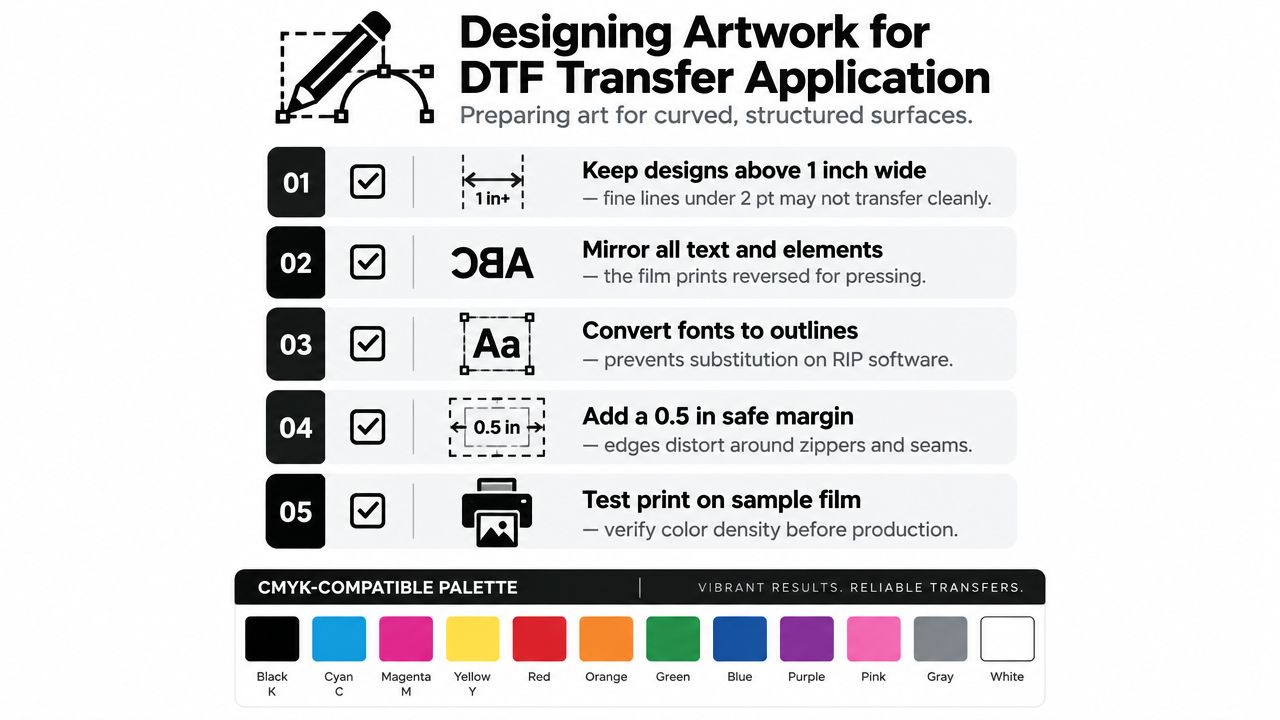
A dopp kit isn't a flat shirt panel. Its front curves, its seams interrupt the printable area, and its zipper changes the pressure profile under the platen. Artwork that looks balanced on a screen can appear crowded or distorted once it wraps around a structured case.
Start with the use case. A personal bag may suit initials, a surname, or a small emblem. A corporate order often works better with a compact logo, a subtle campaign phrase, or a color system that matches the brand without covering the entire face. Function-first personalization means the decoration supports identification and ownership while leaving the bag's materials and construction visible.
Build the design for compression
Heavy solid blocks can feel rigid after pressing and may show stress when the bag is squeezed into luggage. Negative space, moderate line weights, and small areas of visual texture usually create a more flexible result. Distressed effects can help disguise minor surface irregularities, but they shouldn't be used to hide poor adhesion or misaligned artwork.
Keep important details away from the zipper and side seams. A centered front panel is usually safer than a design that crosses the top edge, because the zipper tape and raised seam can prevent consistent pressure. On a curved case, a shorter horizontal mark often looks cleaner than a wide logo forced toward the sidewalls.
Use vector artwork where possible. Convert fonts to outlines, preserve transparent areas, and confirm that the print file retains the intended color relationships. Text must be mirrored for film printing, and the finished transfer should be checked visually before production.
Use gang sheets intelligently
A gang sheet is useful when a job contains repeated names, logos, or small supporting marks. Nest the artwork with consistent spacing, and include a few test elements if the material is unfamiliar. That makes it easier to evaluate fine detail, color density, and edge behavior before pressing every finished kit.
The Build Your Own DTF Gang Sheet format is relevant when multiple designs need to share one sheet. Its product information describes full-color printing for cotton, polyester, blends, leather, and other listed surfaces, with place-and-press application and no weeding or pretreatment. Treat those capabilities as a starting point, not a substitute for testing the specific blank.
A reliable artwork checklist looks like this:
- Protect the safe area: Keep key lettering clear of seams, corners, and zipper tracks.
- Control visual weight: Use open space and flexible forms instead of one dense ink rectangle.
- Check the film orientation: Mirror text and directional symbols before printing.
- Inspect at production size: Fine details that look clear on a monitor may disappear on textured nylon.
- Approve a physical sample: A curved, padded object exposes problems that a flat proof won't show.
Heat Press Workflow and Application Techniques
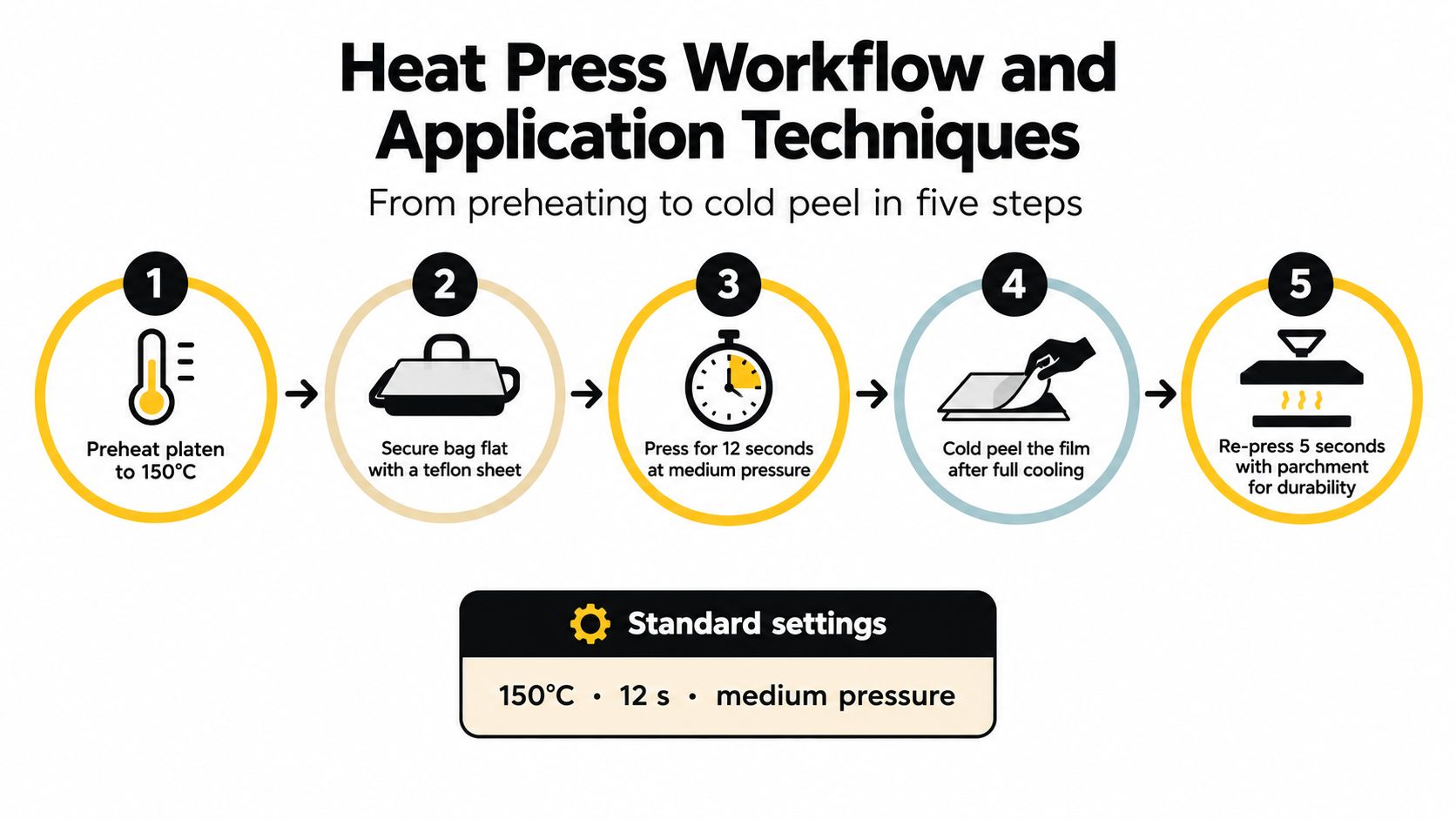
The stated working settings for the supplied workflow are 150°C, 12 seconds, and medium pressure, followed by a cold peel and a short repress with parchment. The accompanying process visual records those settings, but every blank still needs a compatibility test because coatings, foam, leather, and synthetic blends respond differently to heat.
Begin by emptying the bag completely. Remove inserts, bottles, cardboard, and loose padding so the decorated panel can sit on a stable surface. Clean dust and residue from the application area, then use a lint-free cloth to ensure the film won't trap debris under the adhesive.
Create a flat pressure zone
A pressing pillow or compact heat-resistant pad can lift the decoration area above a zipper and let the front panel flatten around it. Don't press directly across a bulky zipper coil or rigid piping. If the bag has a removable insert, take it out. If it doesn't, use a pad inside the compartment only when it creates an even surface rather than stretching the shell.
Cover the work area with a Teflon sheet or another appropriate protective layer. Position the transfer with a ruler or placement template, especially when producing a batch. Measure from stable features such as the side seams, not from the flexible edge of the bag.
Pressure rule: A lower, even pressure across the artwork is safer than forcing the platen down over a seam.
Preheat the platen to 150°C, place the protected bag flat, and press for 12 seconds at medium pressure. Keep the zipper pull outside the platen path and check that no lining, mesh pocket, or loose trim is trapped beneath the press.
Peel and repress deliberately
Let the film cool fully before peeling. A warm peel can pull at the adhesive before it has stabilized, particularly on textured polyester or a coated surface. Lift the film slowly from one corner, watching the smallest lettering and the edges nearest the zipper.
After the cold peel, cover the transfer with parchment and repress for 5 seconds. This short finishing press can improve surface contact and edge durability without exposing the entire bag to unnecessary heat. If the material shows gloss, distortion, or coating change during the sample, stop and adjust the blank, protective layer, or temperature rather than increasing pressure.
Leather needs its own protocol because finish, thickness, and surface treatment vary. Use this guide to heat pressing leather alongside a physical test swatch, and never treat a leather case as interchangeable with nylon.
The product's practical size also affects handling. Dopp kits commonly sit within roughly 10 x 5 x 4.5 inches to 10 x 15 x 24 cm, and premium structured versions can weigh about 350 g, so the press must accommodate the case without crushing its form. A small platen may be safer than trying to flatten the entire object at once.
Inspect the finished surface after cooling. Look for lifted corners, cloudy areas, edge gloss, zipper interference, and artwork that sits off-center because the shell shifted. A good press is repeatable, not merely successful once.
Targeting B2B Gifting and Function-First Markets
Corporate buyers don't need another decorative object that disappears into a desk drawer. They need a gift that feels considered, works immediately, and represents the organization without turning the recipient into a walking billboard. A personalized dopp kit fits that brief because it has a clear travel and grooming function, avoids apparel sizing, and offers a contained branding surface.
Coverage of bespoke travel accessories identifies corporate and employee-recognition use cases as largely untapped, even as personalized products expand across gifting and travel categories. That opportunity is described in this bespoke travel accessories market coverage.
Sell the use case, not the monogram
A basic monogram is decoration-first personalization. It can be attractive, but it doesn't answer why the recipient needs this specific product. Function-first personalization starts with the user:
- Frequent business travelers: Use a compact logo placement, leak-resistant construction, and a restrained palette that fits professional luggage.
- Event and incentive recipients: Add the event identity while keeping the individual's name or initials secondary.
- Boutique hotel guests: Pair a subtle property mark with a durable case that feels like a keepsake rather than a disposable amenity.
- Grooming-heavy users: Choose a taller or more structured format, then use internal labels or color coding to improve organization.
The DTF advantage is flexibility. Full-color artwork can preserve gradients, secondary brand colors, and detailed symbols that would be difficult to reproduce with a simple single-thread monogram. The process still needs disciplined placement. A logo on the lower front panel may be more useful than one on the lid if the bag is commonly stored upright.
Build a corporate offer around consistency
Corporate buyers value repeatability as much as visual appeal. Show a physical prototype, document the selected blank and press method, and define approval points for logo size, color, placement, and personalization data. A sample spreadsheet should distinguish the base bag, decoration, name variable, packaging choice, and delivery grouping.
A useful event-merchandise framework is available in this guide to promotional products for events. Apply the same discipline to dopp kits, but lead with the recipient experience. The pitch should explain how the item will be used after the event, how it avoids sizing problems, and how its material choices support repeated travel.
Premium pricing is easier to defend when the buyer sees a complete solution. Offer material tiers, logo placement options, and functional bundles such as a travel-ready kit, but don't add features that make the bag awkward or difficult to clean. The strongest proposal is often the simplest: a durable blank, a clear mark, and a finish that looks appropriate in both a hotel bathroom and a carry-on.
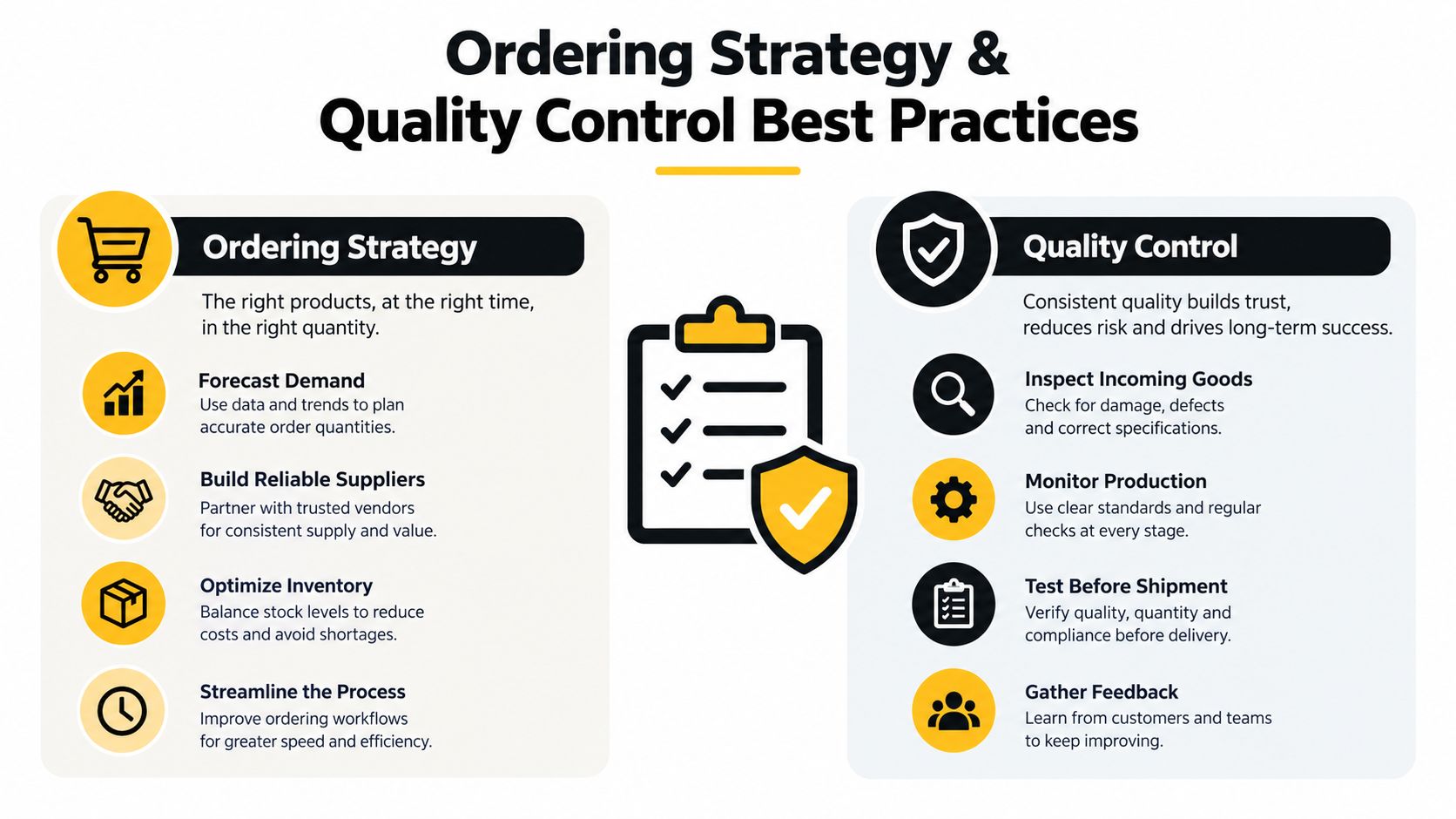
Ordering Strategy and Quality Control Best Practices
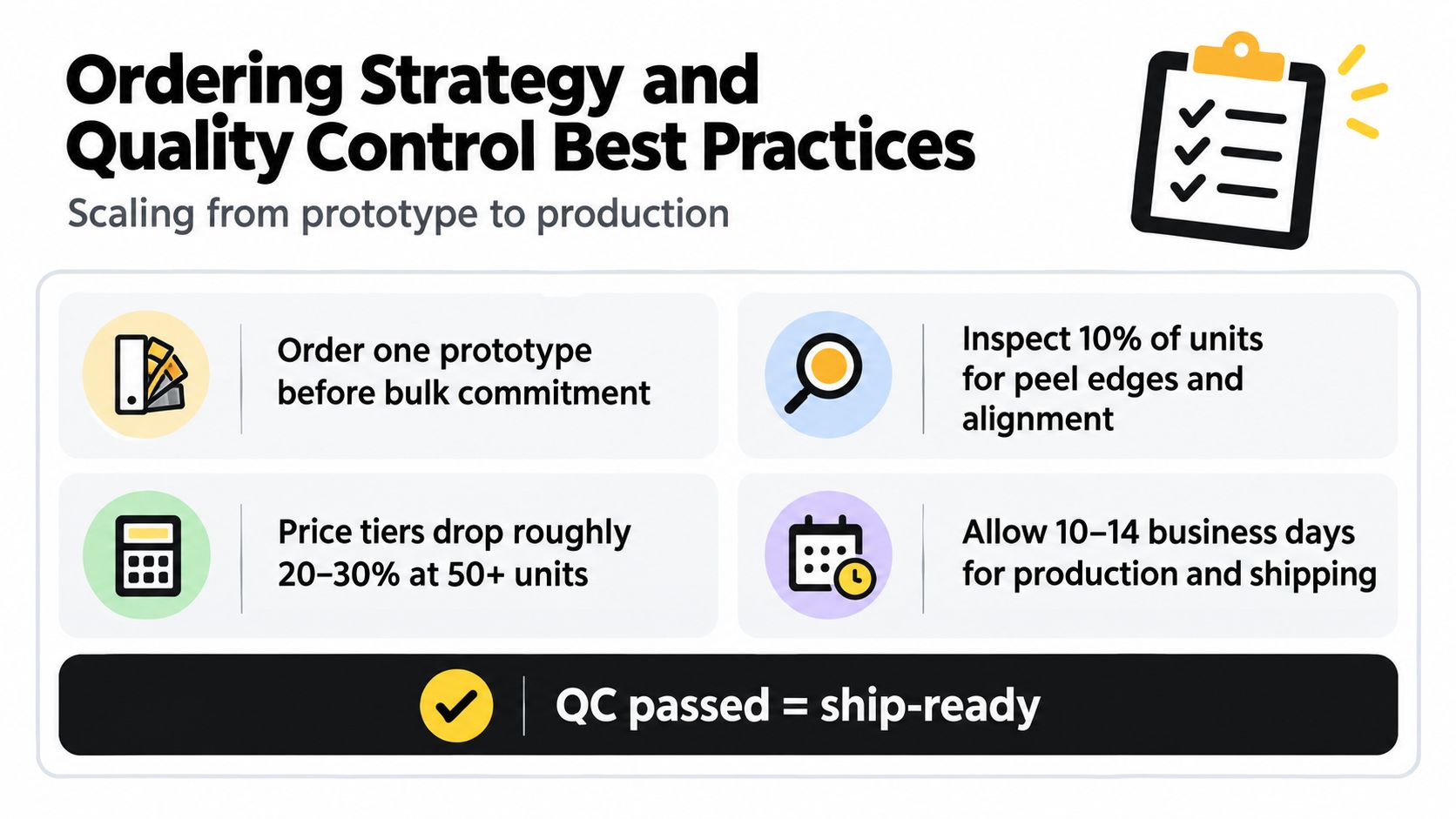
A profitable custom merchandise workflow separates design approval from production commitment. Order or make one prototype first, press it using the intended settings, and inspect it after realistic handling. The prototype should answer practical questions, such as whether the zipper blocks the platen, whether the artwork stays centered on the curved face, and whether the coating changes under heat.
Gang-sheet planning can reduce wasted film when a job includes several names, logos, or small supporting elements. Keep the layout organized by recipient or variant, and leave enough space for clean trimming. A crowded sheet may look efficient until adjacent designs become difficult to cut or identify.
Use a written inspection sequence
When transfers arrive, verify the artwork before pressing:
- Color and detail: Compare the print with the approved file, including small text and transparent areas.
- Film condition: Reject pieces with creases, contamination, or damaged edges.
- Dimensions: Check that the transfer matches the approved size and leaves the planned safe margin.
- Material test: Press one sample on the exact shell, lining configuration, and protective setup used for production.
After pressing, inspect every visible branding panel. For a larger order, a documented sampling plan can help teams spot recurring defects, but the inspection criteria must remain consistent. Check alignment against the seams, edge lift around zippers, incomplete bonding on textured panels, gloss marks, scorching, and adhesive transfer onto the protective sheet.
Package for the product's real environment
A toiletry bag should leave the studio clean, dry, and free of loose film or adhesive residue. Keep the zipper closed during packing only after the case has cooled completely. If the bag includes a coated or leather exterior, use packaging that prevents abrasion during transit without trapping moisture against the surface.
The broader category is moving toward practical features rather than decoration alone. Recent market commentary identifies carry-on-only travel, sustainable materials, antimicrobial treatments, and Bluetooth tracking among influences on toiletry-bag development, as discussed in this travel toiletry bag market commentary. That reinforces a useful production principle: personalization should help the buyer identify and use the bag, not compromise its construction.
Raccoon Transfers provides DTF and UV-DTF transfer options, custom gang-sheet building, full-color artwork handling, and application guidance for materials including cotton, synthetics, leather, glass, metal, and plastic. For a personalized dopp kit program, the important questions are whether the chosen transfer suits the exact blank, whether the artwork has been tested on the curved surface, and whether the finished batch passes the same inspection standard from the first unit to the last.
Visit Raccoon Transfers to prepare full-color DTF artwork, organize multiple personalized designs on a gang sheet, and review application guidance for travel gear. Start with one tested dopp kit prototype, then use the approved material, placement, and press workflow for your corporate or retail batch.