
How to Reduce Shipping Costs for Small Business - Quick Wins
If you're looking for the fastest way to slash your shipping costs, look no further than your packing station. The single biggest mistake I see small businesses make is overpaying for oversized packaging. By simply "right-sizing" your boxes or switching to lightweight mailers, you can immediately fight back against dimensional weight pricing—a sneaky fee carriers use to charge for bulky packages.
This one change impacts every single order you send out, putting money back in your pocket from day one.
Master Your Packaging to Minimize Shipping Costs
Before you even think about negotiating carrier rates or buying fancy software, your biggest savings are sitting right on your packing table. For anyone selling apparel, art prints, or other handmade goods, your packaging isn't just a box; it's your #1 opportunity to cut costs.
Every inch of empty space you ship is money down the drain.
The main culprit is a pricing model all the major carriers use called dimensional (DIM) weight. They charge you based on whichever is greater: the actual weight of your package or its DIM weight. Essentially, you're paying for the space your package takes up on their truck. This is why a big, light box of pillows can cost more to ship than a small, heavy box of books.
This is where a quick packaging audit becomes your secret weapon. It’s a simple process to spot and eliminate wasted space and extra weight, leading to instant savings on every label you print.
Conduct a Simple Packaging Audit
Don't let the word "audit" scare you. This is a straightforward, three-step process you can knock out in an afternoon. Just grab your top 5-10 best-selling products and the packaging you currently use for them.
-
Measure Your Products Precisely: Lay each item out and measure its length, width, and height. If you sell t-shirts or other soft goods, fold them into their most compact, shippable form first. Jot down these dimensions.
-
Assess Your Current Packaging: Now, place each product into the box or mailer you've been using. How much extra room is there? Are you looking at more than an inch of empty space on any side? Are you using heavy corrugated boxes for items that could ship safely in a feather-light poly mailer?
-
Find a Better Fit: Armed with your product measurements, it's time to find a better home for them. Hunt for boxes, mailers, or tubes that leave almost no empty space. Trust me, even a one-inch reduction in box size can make a surprising difference in cost.
Key Takeaway: You want to ship your product, not air. By matching your packaging size as closely as you can to your product dimensions, you go on the offensive against DIM weight surcharges and immediately lower your shipping costs.
This quick visual breaks down the core idea.
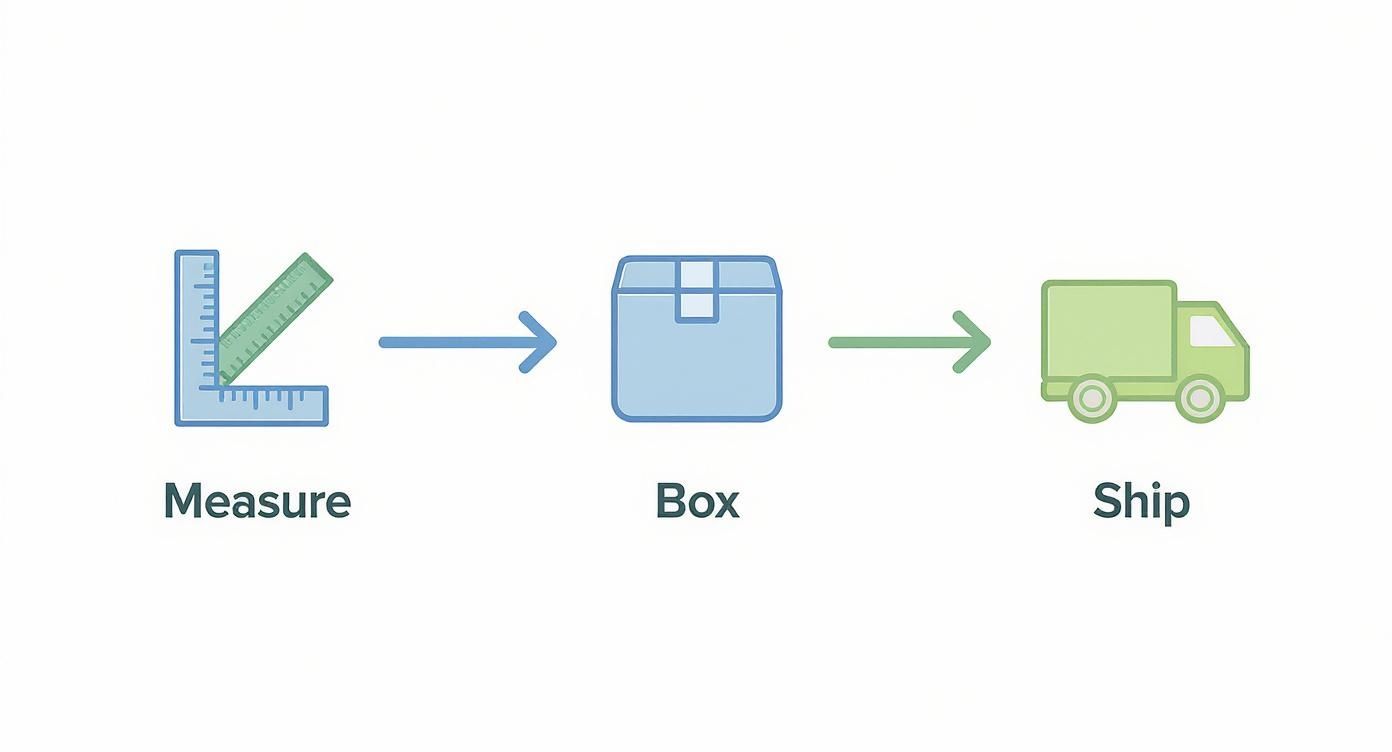
Think of this "measure, box, ship" cycle as a continuous improvement loop. As you add new products, you'll know exactly how to keep your shipping lean.
Choose the Right Materials and Packaging Types
Beyond just the size, the type of packaging you use plays a massive role in your final shipping cost. Heavy materials add to the actual weight, while bulky ones can inflate your DIM weight. Here’s a look at some common options and how they stack up.
Packaging Type vs. Cost Impact
Choosing the right packaging is a balancing act between protection and cost. Here's a quick comparison to help you decide what's best for your products.
| Packaging Type | Best For | Pros | Cons (Cost Impact) |
|---|---|---|---|
| Poly Mailers | Apparel, books, fabric, non-fragile items | Lightweight, flexible, low purchase cost, water-resistant | Offers minimal protection from crushing or bending |
| Padded/Bubble Mailers | Jewelry, cosmetics, small electronics, books | More protective than poly mailers, still lightweight | Bulkier than poly mailers, can increase thickness |
| Corrugated Boxes | Fragile items, multi-item orders, home goods | Excellent protection, stackable, widely available | Heaviest option, highest DIM weight potential, higher cost |
| Mailing Tubes | Posters, art prints, blueprints, rolled documents | Protects against creasing and bending | Can be awkward/costly if very long (non-conveyable) |
Making the right choice here is critical. A simple switch from a box to a poly mailer for a t-shirt order can save you dollars on every single shipment.
Here are a few more material-specific tips:
- Poly Mailers: For non-fragile items like clothing, accessories, or soft goods, poly mailers are a game-changer. They're incredibly lightweight, take up almost no space, and are usually much cheaper to buy than boxes.
- Corrugated Boxes: While essential for anything breakable, not all boxes are created equal. Stick with standard-weight cardboard unless your product genuinely needs the protection of a heavy-duty, thick-walled box.
- Lightweight Void Fill: If you absolutely must fill some empty space, ditch the heavy packing paper or peanuts. Modern air pillows provide fantastic cushioning with virtually zero added weight.
Getting your packaging strategy right is one of the most powerful things you can do to cut shipping costs. With carriers basing prices on dimensional weight, even small tweaks to your package volume can produce huge savings. Data shows that simply eliminating unused space can cut DIM weight fees by up to 20%. For a deeper dive, check out this guide on how to optimize packaging for shipping from Shipfusion. Those small savings add up fast, easily turning into thousands of dollars back in your business over a year.
Get Smart With Your Shipping Price Strategy
How you price your shipping is so much more than just passing on carrier costs. It's a critical marketing tool that can make or break a sale. A thoughtful strategy protects your margins and gives customers the clarity they crave at checkout, turning a potential roadblock into a reason to buy.
Your goal is to find that perfect sweet spot where you're covering your expenses without scaring away customers with last-minute fees.
Let's dive into the three most effective models I've seen small businesses use to nail their shipping pricing. Each one has its own set of pros and cons, so think about which fits your brand best.
Option 1: Offer Real-Time Calculated Rates
This is the most transparent, no-fluff approach. Your ecommerce platform connects directly with carriers like USPS or UPS to show customers the exact shipping cost for their specific order. It’s calculated on the fly based on package weight, dimensions, and where it’s headed.
The Good:
- Pinpoint Accuracy: You never overcharge or undercharge for shipping. Your costs are always covered down to the penny.
- Builds Trust: Customers see exactly what they're paying for, which leaves no room for doubt.
The Not-So-Good:
- Sticker Shock: High, unpredictable costs popping up at checkout are a notorious killer of conversions.
- No Marketing Angle: You can't really use this method to incentivize bigger purchases.
This works best if you sell heavy, oversized, or wildly different items where a simple flat rate just isn’t practical.
Option 2: Implement a Simple Flat-Rate System
A flat-rate system is all about making the checkout process smooth and predictable. You charge one fixed shipping fee for every order, or maybe create a couple of tiers—like $5 for orders under $50, and $10 for anything over that. Customers love knowing what to expect.
To pull this off, you’ll need to figure out your average shipping cost across all your orders. Some packages will cost you less to ship than your flat rate, and some will cost more. The idea is that it all balances out over time, protecting your bottom line while giving your customers a consistent, simple experience.
Offering a predictable flat rate is a game-changer. It eliminates that last-minute surprise shipping cost, which is a major reason why nearly 70% of online shopping carts get abandoned. You turn shipping from a scary variable into a simple, expected fee.
Option 3: Use Free Shipping as a Powerful Incentive
Let’s be honest: free shipping is the holy grail of ecommerce perks. But just slapping "Free Shipping on Everything!" on your site without a strategy is a fast track to killing your profit margins.
The secret is using a free shipping threshold—a minimum amount customers have to spend to unlock the deal.
This tactic is brilliant because it does two things at once: it gives customers the incentive they crave, and it encourages them to add more to their cart to hit that magic number. The result? A higher Average Order Value (AOV) for you.
Here’s a quick, real-world example of how to set a profitable threshold:
- Find Your AOV: Pull your data. Let's say your current average order value is $45.
- Calculate Your Average Shipping Cost: Look at your expenses. You find that, on average, it costs you $8 to ship an order.
- Set the Threshold: A good rule of thumb is to set the threshold 15-20% above your AOV. In this case, setting it at $55 would be a fantastic starting point.
This simple move nudges a customer who was about to spend $45 to add another $10 item to their cart. The extra profit from that upsell easily covers the $8 shipping cost you absorb. If you want to get deeper into how these numbers play out, looking at guides on print-on-demand profit margins can offer some great perspective on managing your overall financials.
Often, the best strategy is a hybrid. You could offer a flat rate for orders under $55 and free shipping for everything above it. Don't be afraid to test different thresholds and watch your AOV and conversion rates. That's how you'll find the perfect formula for your business.
Get Savvy with Carriers and Negotiate Smarter Rates
Alright, you’ve got your packaging dialed in and a smart shipping-price strategy. Now it's time to get into the nitty-gritty of the carriers themselves. This is where the real money is saved.
Choosing a shipping service isn't about blind loyalty to one company. It's about finding the best deal for each specific package you send out the door. The big names—USPS, UPS, and FedEx—are all competing for your business, and understanding their strengths is your secret weapon.
Play to Each Carrier's Strengths
Think of the major carriers as specialists. You wouldn't use a hammer to turn a screw, right? The same logic applies here. Sending a package with the wrong carrier is like leaving money on the table.
Here’s a quick rundown based on my experience:
- USPS (United States Postal Service): This is your go-to for anything light. Seriously, for packages under two pounds, especially if they fit in a poly mailer, USPS is almost always the champ. Their USPS Ground Advantage service is incredibly cost-effective.
- UPS (United States Parcel Service): When your packages start getting heavier, UPS really comes into its own for domestic ground shipping. They offer fantastic, reliable tracking and guaranteed delivery times, which gives you (and your customer) peace of mind for higher-value orders.
- FedEx: Long known for their speed with express and overnight services, FedEx is also a heavyweight contender for ground shipping. They’re often neck-and-neck with UPS on price for larger boxes, so it's always worth comparing the two.
And don't forget about the little guys! Regional carriers like OnTrac (out West) or Spee-Dee Delivery (in the Midwest) can be surprisingly cheap and fast if you're shipping within their limited zones.
Let Software Do the "Rate Shopping" For You
Nobody has time to manually punch in package details on three different carrier websites for every single order. That's a one-way ticket to wasted hours and overspending. This is where shipping software becomes an absolute game-changer.
Tools like Shopify Shipping, Pirate Ship, or Shippo are essential. They sync with your online store, pull in the order info, and then—with just one click—show you all the shipping options from every carrier, neatly sorted by price.
This process is called rate shopping. It means you’re guaranteed to pick the absolute cheapest label that meets your needs, every single time.
Without rate shopping, you're just guessing. With it, you're making a data-driven choice that saves you a little bit on every package. Those little bits add up to a lot over a year.
It’s how you stay competitive and keep your shipping costs low without bogging down your fulfillment process.
You Have More Power to Negotiate Than You Think
So many small business owners think negotiating rates is only for the big players. That’s just not true. You might not get Amazon-level discounts, but you can definitely get a better deal than the standard retail price.
Once you have a few months of consistent shipping under your belt, it's time to reach out to an account rep at UPS or FedEx. Don't just show up empty-handed. Go into that conversation armed with your data:
- Know Your Numbers: Be ready to state your average monthly package count, typical weights, and box sizes.
- Show Your Growth: Carriers love to see an upward trend. Point out that your shipping volume is growing—it shows them you're a good long-term bet.
- Get Specific: Don't just ask for "a discount." Ask for a better rate on the specific service you use most, like UPS Ground or FedEx 2-Day.
Even a small 10-15% discount can save you thousands of dollars a year as you grow. Don't be afraid to ask. The worst they can say is no, and you've lost nothing.
Ditch Carrier Insurance and Save Big
Here’s a pro tip: stop paying for insurance (or "declared value") directly through the carriers. Their rates are incredibly high, and if you ever have to file a claim, get ready for a mountain of paperwork and a major headache.
Instead, use a third-party shipping insurance company. Many shipping platforms integrate services like Shipsurance or InsureShip right into their workflow.
The rates are a fraction of what the carriers charge—we're talking savings of 50% or more. Plus, their coverage is often better, and the claims process is designed for actual small business owners, not corporate legal teams. It's an easy switch that gives you better protection for less cash.
Bring in a Fulfillment Partner
At a certain point, packing every single order yourself just isn't sustainable. When your living room is overflowing with boxes and you're spending more time at the post office than on your actual business, it’s time to call in the pros: a third-party logistics (3PL) provider.
These aren't just shipping companies. They're specialists in warehousing, packing, and getting your products to customers efficiently. Handing off fulfillment isn't giving up control—it's gaining a strategic partner to help you scale smarter.
Get Access to Big-League Shipping Rates
The single biggest win when you partner with a 3PL is immediate access to their shipping discounts. Think about it: they ship thousands of packages every day for all their clients. This massive volume gives them incredible leverage to negotiate rock-bottom rates with carriers like UPS, FedEx, and USPS.
You get to piggyback on their buying power, instantly lowering what you pay for every single label. When carriers are hiking rates by an average of 5.9% a year, this is your secret weapon. Working with a 3PL can often slash a business's shipping spend by anywhere from 7% to 15%, turning a major expense into a manageable one.
The Magic of Spreading Out Your Inventory
Here’s where a good 3PL really earns its keep. Instead of shipping everything from your one location, they allow you to use what's called a multi-node fulfillment network. It sounds complicated, but the idea is simple and brilliant: store your inventory in multiple warehouses across the country.
Let's say you're based in California, but you've got a ton of customers on the East Coast. Every time you ship a t-shirt to New York, you're paying a premium to cross multiple shipping zones. It's slow and expensive.
Now, imagine your 3PL also has a warehouse in Pennsylvania. They can stock some of your inventory there. When that New York order comes in, it ships from the local warehouse, not all the way from California. The benefits are huge:
- Shorter Trip: The package travels a much shorter distance.
- Lower Zones: You're now paying for a cheap Zone 1 or 2 shipment, not an expensive Zone 8.
- Happier Customers: The order arrives in a day or two, not a week.
This approach practically eliminates your most expensive long-distance shipments while delighting your customers with speedy delivery. It's a classic win-win.
A 3PL becomes the central hub for your entire operation, taking the complexity of inventory management and shipping off your plate so you can focus on growing your brand.
By distributing your inventory, you essentially flatten the map. You turn expensive Zone 8 shipments into cheap Zone 2 shipments, which is one of the most effective ways to slash your average shipping cost as you scale. This is especially vital for businesses looking into models like print-on-demand, where efficiency is key. To see how logistics fits into that world, check out our guide on how to start a print on demand business here: https://raccoontransfers.com/blogs/guides/how-to-start-print-on-demand-business
Don't Forget About Inbound Freight Savings
The cost-cutting doesn't just apply to orders going out to your customers. A savvy 3PL can also save you a bundle on getting inventory from your suppliers. This is done through a process called freight consolidation.
Instead of paying for a whole truckload (FTL) that's half-empty, your 3PL can combine your smaller pallet with shipments from their other clients into one full less-than-truckload (LTL) shipment. You only pay for the space your inventory actually uses, which can dramatically cut your inbound transportation costs. For those interested in next-level efficiency, exploring AI for Supply Chain Optimization can reveal even more ways to tighten up your operations.
Lowering these inbound costs directly pads your product margins, giving your business a healthier bottom line. Teaming up with a logistics expert isn't just about outsourcing a task; it's a strategic investment in building a more profitable and scalable business.
Automate Your Workflow and Master Fulfillment
If you're still manually handling your shipping, you're likely bleeding profit without even realizing it. Every minute spent copying and pasting an address, jumping between carrier websites to find the best rate, or filling out a customs form by hand is a minute you're not growing your business. It's not just the time, either—it’s a process that's practically begging for expensive human errors.
The fix isn't about bringing in an army of robots. It’s about creating a smarter, repeatable system. With some simple automation, you can turn your shipping process from a dreaded daily chore into a fast, smooth, and cost-effective part of your operation. This is how you win back hours in your day and slash those costly mistakes.
Ditch Manual Data Entry for Good
I can't tell you how many times I've seen this happen: a tiny typo in an address leads to a returned package. Suddenly, you've paid for shipping three times on a single order—once to send it, once for it to come back, and once to send it out again. Those costs will eat you alive.
The solution is connecting your ecommerce store (like Shopify, Etsy, or WooCommerce) directly to a dedicated shipping software. This is non-negotiable for a serious business. The software automatically pulls all the customer order details—name, address, what they bought—right into a central dashboard.
- No more copy-pasting: This simple change immediately kills the risk of typos and guarantees address accuracy from the moment the order comes in.
- Lightning-fast processing: Orders just show up, ready for you to print a label in a couple of clicks.
This one integration is the bedrock of an efficient fulfillment system. It saves a ton of time and directly targets the number one cause of undeliverable packages.
Use Software to Batch and Automate Everything
A good shipping software does way more than just import orders. It becomes your command center for putting all those tedious, repetitive tasks on autopilot. This is where the real magic happens for saving time and money.
Think about all the little things you do for every single package:
- Printing Labels: Instead of printing one by one, you can use batch processing. Select 50 orders and print all the labels in one go. A task that used to take an hour is now done in five minutes.
- Generating Customs Forms: If you sell internationally, you know what a nightmare these can be. The right software fills them out for you using the order data, making sure they're accurate and compliant every time.
- Sending Tracking Notifications: The moment a label is created, an automated email with the tracking link is sent to your customer. This drastically improves their experience and cuts down on all those "Where's my order?" emails.
Pro Tip: Set up shipping presets or "rules" for your most common products. For example, if you know every t-shirt order goes in a 10x8 poly mailer and weighs 8 ounces, create a rule. It'll automatically apply those settings, so all you have to do is click "print."
By systemizing these steps, you build a workflow that can handle 10 orders a day just as easily as 100. For custom apparel businesses, a smooth shipping process is just as crucial as a perfect print. You can learn more about prepping your designs efficiently in our guide on how to create a DTF gang sheet.
To really see the difference, let’s compare a manual workflow to one that’s been automated. The numbers speak for themselves.
Manual vs. Automated Shipping Workflow Comparison
This table shows just how much time and money you can save by moving from a manual system to one powered by shipping software. The savings are not just theoretical; they represent real hours you get back to focus on what matters most.
| Task | Manual Process (Time/Cost) | Automated Process (Time/Cost) | Key Benefit |
|---|---|---|---|
| Order Entry | 2-3 mins/order (copy-paste) | 0 mins (auto-import) | Eliminates typos & saves 100% of data entry time |
| Rate Shopping | 1-2 mins/order (multiple sites) | < 5 seconds (auto-comparison) | Instantly finds the cheapest rate every time |
| Label Printing | 30-60 secs/label | 5-10 secs/label (batch printing) | Reduces printing time by up to 80% |
| Tracking Updates | 1 min/order (manual email) | 0 mins (auto-notification) | Improves customer experience & reduces inquiries |
| Total per 50 Orders | ~3.5 hours | ~15 minutes | Massive time savings, allowing for business growth |
As you can see, automation doesn't just make things a little faster—it completely changes the game. That's more than three hours saved for every 50 orders, which you can reinvest into marketing, product development, or just getting your life back.
Optimize Your Physical Packing Station
Automation isn't just about software; it’s also about the physical setup of your workspace. A messy, disorganized packing station creates friction and slows you down. A few smart adjustments can make a huge difference in how fast you can get orders packed and shipped.
- Everything Within Arm's Reach: Your most-used boxes, mailers, tape, scale, and label printer should be right there, no walking required.
- Organize by Size: Stack your packaging materials logically (e.g., small to large) so you can grab the right one without thinking.
- Create a Dedicated Zone: Even if it's just a corner of your garage, have a clean, clutter-free area that is used only for packing.
Think of it like an assembly line. When you save even 30 seconds per package, that adds up to serious labor savings over hundreds or thousands of orders. It all counts.
Common Questions About Reducing Shipping Costs

Even with a solid game plan, you're bound to run into some specific questions when you're in the trenches trying to figure out how to reduce shipping costs for a small business. This is where we tackle those common hurdles with clear, straight-to-the-point answers to help you sharpen your strategy. Think of it as your quick guide for those real-world shipping dilemmas.
We'll get into the nitty-gritty of when it actually makes sense to pay for software, the real story behind "free" shipping, and how to approach international orders without your profits getting eaten alive.
What Is the Best First Step to Lower Shipping Costs Now?
The single fastest thing you can do for immediate savings is a simple packaging audit. Seriously. Before you even think about software or haggling with carriers, just measure your top-selling products. Then, find boxes or mailers that fit them like a glove, leaving almost zero empty space.
Every major carrier uses dimensional weight pricing, which means shrinking your package size—even by just an inch—directly cuts your cost per shipment. For things like t-shirts, prints, or other non-fragile goods, making the switch to lightweight poly mailers is a massive, easy win. This one change affects every single order you send out and doesn't require any new tools to get started.
Key Insight: The fastest path to lower shipping costs isn't some complex negotiation; it's eliminating the empty space you're paying to ship. By nailing your packaging first, you build a foundation of savings that makes every other cost-cutting effort even more effective.
When Should I Start Using Shipping Software?
You should be looking seriously at shipping software once you're sending out more than 5-10 orders per week. I know that sounds early, but the benefits kick in much sooner than most business owners realize.
The time you get back from not manually copying and pasting addresses is a huge plus. But the real game-changer is the instant access to discounted rates, like USPS Commercial Pricing, which are always cheaper than what you'll pay at the post office counter. The moment you find yourself spending more than an hour a day just on fulfillment, shipping software is no longer a "nice-to-have"—it's a critical tool for your efficiency and bottom line.
Is Offering Free Shipping Always a Good Idea?
Definitely not. Free shipping is a marketing tool, not a cost-saving strategy. If you don't implement it with a clear plan, it will absolutely wreck your profit margins.
It really only works well when you set a free shipping threshold that’s about 15-20% higher than your average order value (AOV). Why? Because it nudges customers to add one more item to their cart to qualify. The extra profit you make from that upsell is what actually covers the shipping cost you're absorbing. Offering unconditional free shipping on every order without raising your product prices is one of the quickest ways to damage your business's financial health.
How Can I Reduce the Cost of International Shipping?
Tackling international shipping costs means you need to attack the problem from a few different angles. Just using the standard carrier rates is almost always the most expensive option. For a bigger-picture look at optimizing your entire operation, it's worth digging into some comprehensive supply chain cost reduction strategies.
Here are three tactics you can use right away for international savings:
- Use Shipping Consolidators: Services like Pirate Ship's Simple Export Rate or carriers such as Asendia are built for this. They specialize in international shipping for small businesses and offer much lower rates than you could ever get by going directly to the major carriers for small parcels.
- Perfect Your Customs Forms: A mistake on a customs form is a recipe for disaster—it leads to delays, returned packages, and unexpected fees. Use a good shipping software to automatically and accurately fill these out based on your product info.
- Communicate Duties and Taxes Clearly: Prevent expensive returns by being upfront with your international customers. Let them know they are responsible for any import duties or taxes their country charges. A simple, clear note on your shipping policy page can save you a world of headaches and lost money.
At Raccoon Transfers, we empower your creative business with high-quality DTF prints that are as vibrant as your designs. Our streamlined process and fast, free shipping on orders over $79.90 help you keep costs low and quality high. Build your custom gang sheet today!