
Print on Demand Profit Margins: Boost POD Profits
Let's get straight to it: a good print-on-demand profit margin lands somewhere between 20% and 40%. Hitting that sweet spot is what turns a side hustle into a real, sustainable business. If there's one skill you need to master for the long haul, it's understanding your margins.
What Are Healthy Print-On-Demand Profit Margins?
Think of your POD shop like a professional kitchen. A chef doesn’t just charge you for the price of the steak and potatoes. They have to factor in the electricity for the ovens, the wages for the dishwashers, and a slice of the restaurant's rent. It's the same for your business. Your profit isn't just your selling price minus the cost of a blank t-shirt; it's what’s left after every single expense is covered.

True profitability requires looking past the obvious. So many new sellers fall into the trap of chasing sales volume, but a mountain of sales with paper-thin margins is just a fast track to burnout. Getting a firm grip on your financial health from day one is fundamental.
If you're just starting out, our guide on how to start a print-on-demand business can help you build that foundation. This knowledge helps you shift from just trying to sell stuff to strategically building a brand that actually makes money.
Why Margins Matter More Than Revenue
Here’s a hard truth: revenue is for show, but profit is for dough. A business that brings in $100,000 in revenue with a 10% margin only makes $10,000 in profit. Compare that to a smaller shop earning $50,000 with a healthy 40% margin—that’s $20,000 in profit. The second business is far more successful, and that's especially true in the exploding POD market.
The global print-on-demand market is on track to hit around $39 billion by 2031, growing at a staggering 26% each year. While the average seller nets a 20% profit margin, top performers often reach 40-45%, and some niche apparel brands can see margins as high as 30-60%.
All that growth means more customers, but it also means way more competition. The sellers who really know their numbers are the ones who will stand out and succeed.
Benchmark Profit Margins By POD Product Category
So, what can you expect to make on different products? This table gives you a ballpark idea of typical margins for some of the most popular POD items. Use it as a starting point to see what’s possible and to make sure your pricing strategy is protecting your profit from the get-go.
| Product Category | Average Cost | Average Retail Price | Estimated Profit Margin |
|---|---|---|---|
| T-Shirts | $8–$15 | $25–$35 | 30%–50% |
| Hoodies | $20–$30 | $45–$60 | 35%–55% |
| Mugs | $4–$8 | $15–$22 | 40%–60% |
| Tote Bags | $7–$12 | $20–$30 | 35%–55% |
| Phone Cases | $5–$10 | $18–$28 | 45%–65% |
As you can see, certain items like mugs and phone cases often carry higher margins because their base costs are lower. Keep these benchmarks in mind as you build out your product catalog.
The Simple Math Behind Your POD Profits
Figuring out if your print-on-demand business is actually making money isn't some secret financial wizardry. It boils down to simple, straightforward math. Once you get a handle on the core formula, you'll have a crystal-clear picture of your shop's financial health and can make sure all your hard work is paying off.
At its core, the formula for profit margin is your most powerful tool. It shows you exactly what percentage of your sticker price is left over as pure profit after you've paid for everything.
Profit Margin Formula:
((Retail Price - Total Costs) / Retail Price) * 100 = Profit Margin %
Think of this as the financial DNA for every single product you sell. Let’s walk through a quick, real-world example to see it in action.
A T-Shirt Pricing Example
Let's say you've created an awesome graphic tee and decide to sell it for $25.00. That's your Retail Price.
After adding up all your expenses—the blank shirt, the transfer, shipping materials, and platform fees—your total cost to produce and sell one shirt comes out to $15.00. This is your Total Cost.
Now, let's plug those numbers into our formula:
- Step 1: $25.00 (Retail Price) - $15.00 (Total Costs) = $10.00 (Profit)
- Step 2: $10.00 (Profit) / $25.00 (Retail Price) = 0.40
- Step 3: 0.40 * 100 = 40% Profit Margin
Boom. For every shirt you sell, 40% of that $25.00 price tag is pure profit in your pocket. That's a fantastic margin and puts you in a great position to grow.
But what really makes up that "Total Costs" number? It's easy to forget that it's more than just the blank garment and the DTF transfer. We'll dig into all the hidden costs—from shipping supplies to marketing ads—in a bit.
While a 40% margin is the dream, industry data shows that the average print-on-demand profit margin hovers around 20%. This is a solid, sustainable target that keeps you competitive while covering all your bases. Some fulfillment services even offer volume discounts that can slash production costs by 20% or more, which could push your margins well above 30% as you scale up.
Mastering this formula is your first big step. If you want to get even more granular with your numbers, you can explore detailed formulas for calculating markup and margin to fine-tune your strategy. And for a complete walkthrough on setting prices that work from day one, don't miss our guide on how to price custom shirts.
Next up, let's break down every single cost you need to account for.
Uncovering Every Cost That Drains Your Profits
To really get a handle on your print-on-demand profit margins, you have to become a bit of a cost detective. Your mission is to hunt down every single expense—not just the obvious ones, but the sneaky little costs that can quietly eat away at your bottom line.
It's tempting to just look at the price of a blank t-shirt and a DTF transfer and call it a day. Honestly, that's the number one mistake I see new sellers make, and it's why so many struggle to see any real profit. A successful business owner accounts for every single penny it takes to get that finished product into a customer's hands.
This visual gives you a great high-level look at how your retail price gets whittled down before you're left with your actual profit.
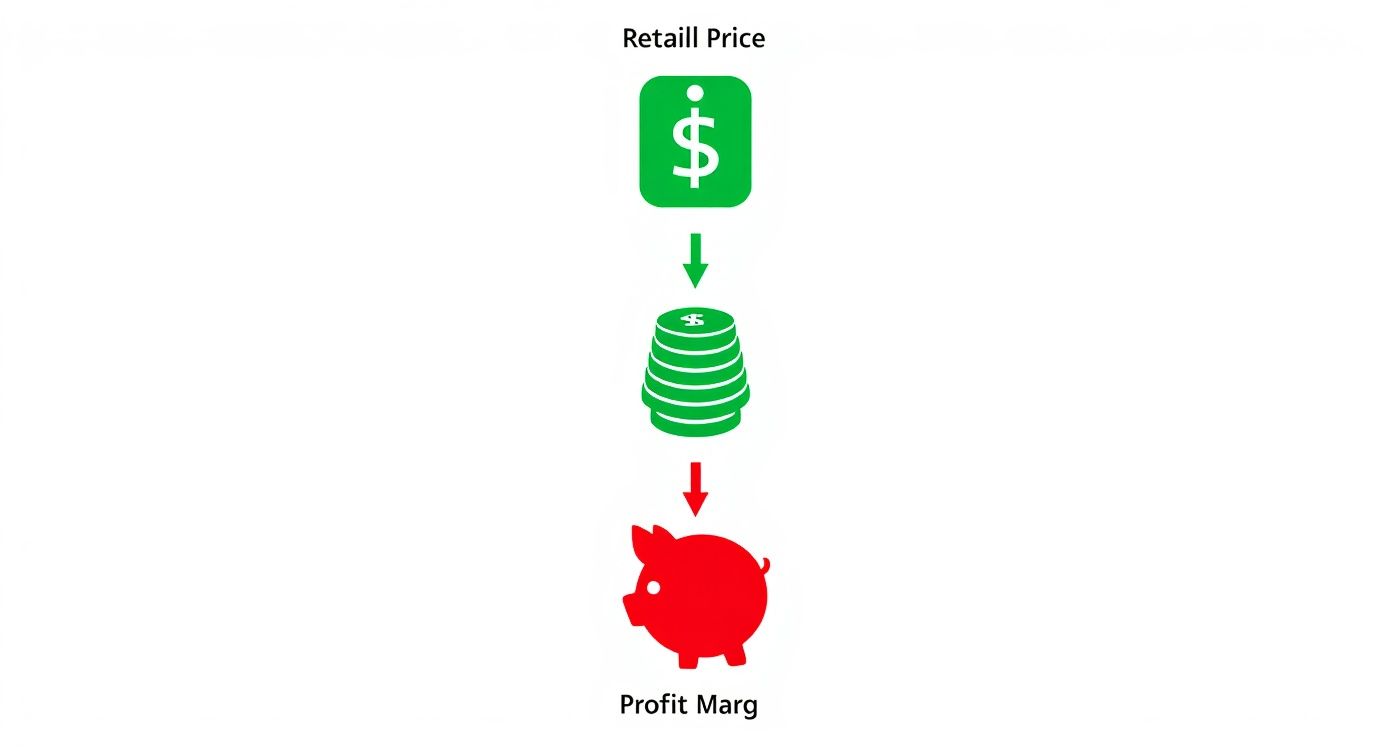
As you can see, that final profit is what’s left after a whole stack of different costs takes a slice of the pie. Let's break down exactly what those costs are.
H3: The Big Three: Production, Platform, and Shipping Costs
These are the direct, per-order expenses you’ll face with every sale. Getting these numbers right is the foundation of a healthy business.
-
Production Costs (Your COGS): This is the most straightforward part—the physical stuff needed to make your product. This includes the blank garment itself (your t-shirt, hoodie, or hat) and the DTF or UV-DTF transfers you get from us at Raccoon Transfers. Pro tip: this is where optimizing your gang sheets can make a huge difference in your per-design cost.
-
Platform & Transaction Fees: Selling online is never really free, is it? The platforms that connect you with customers, like Etsy or Shopify, take their cut. These fees hit every single sale. Etsy has listing fees, transaction fees, and payment processing fees. Shopify has its monthly subscription plus payment processing on every order.
It’s so easy to dismiss these tiny percentages. A 2.9% + $0.30 transaction fee on a single $30 shirt is only $1.17. But sell 1,000 shirts, and you've just handed over $1,170 to the payment processor. It adds up, fast.
- Shipping & Fulfillment: This category is a notorious profit-killer if you're not careful. It’s more than just the postage. Think about the poly mailers, boxes, tissue paper, and even the branded stickers or thank-you cards you include. Overlooking a $0.50 mailer or a $0.10 insert might seem trivial, but it skews your numbers and can cause you to underprice your products.
H3: The "Hidden" Costs: Overheads and Marketing
Beyond the per-order expenses, you have the costs of simply running and growing your business. These aren't tied to a single sale, but they are absolutely essential for your operation.
Think about your subscriptions for design software like Adobe Illustrator or Canva Pro. Don't forget the annual fees for your website domain and hosting. These are your operational overheads.
And then there's the big one: marketing. This covers everything from your social media ad spend to the cost of your email marketing platform. It's crucial to learn how to calculate customer acquisition costs so you know if your marketing is actually making you money. A profitable ad campaign isn't just about the sales it brings in; it's about acquiring those customers for less than the profit you make from them.
H3: Your Comprehensive POD Cost Driver Checklist
To make sure you don't miss a thing, we've put together a detailed checklist of all the potential costs that can impact your margins. Use this to audit your own business and find any expenses you might have overlooked.
| Cost Category | Specific Examples | Impact on Margin |
|---|---|---|
| Production Costs (COGS) | Blank apparel, DTF/UV-DTF transfers, sample products for testing, spoilage/misprints | Direct, per-unit cost. Higher COGS immediately reduce the profit on each item sold. |
| Platform & Transaction Fees | Shopify/Etsy monthly subscriptions, listing fees, credit card processing fees, transaction fees | A percentage-based or flat fee that nibbles away at the revenue from every single sale. |
| Shipping & Fulfillment | Poly mailers, boxes, tape, shipping labels, branded inserts, postage costs, shipping software fees | Can be a significant variable cost that directly eats into profit, especially with rising carrier rates. |
| Labor Costs | Your own time for designing, pressing, and packing; wages if you have help | Often overlooked by solo entrepreneurs but is a real cost. It reduces your "true" profit per hour. |
| Overhead & Software | Design software (Adobe, Canva), website hosting, domain fees, email marketing services | Fixed monthly or annual costs that reduce overall business profitability, regardless of sales volume. |
| Marketing & Advertising | Social media ads (Facebook, Instagram, TikTok), influencer collaborations, content creation | A crucial investment for growth, but it directly impacts your Customer Acquisition Cost (CAC) and overall margin. |
| Customer-Related Costs | Returns processing, refunds, customer service time, replacement products for shipping errors | Unpredictable costs that can completely erase the profit from a sale and damage your reputation if not handled well. |
By keeping a close eye on every category in this table, you move from just guessing at your profits to truly understanding the financial health of your business. This is the foundation for smart pricing and sustainable growth.
Calculating Profit Margins in the Real World
Alright, theory is one thing, but making it work for your business is what really matters. Let's put those formulas to the test and walk through three real-world scenarios. This is where the rubber meets the road.
Each example is built to reflect the kind of challenges and opportunities you’ll actually face—from squeezing every bit of value out of a DTF transfer sheet to navigating platform fees and building smart product bundles.
Scenario 1: The Small Apparel Brand Using DTF Gang Sheets
Picture this: you're running a small apparel brand out of your garage, focused on premium graphic tees. To keep your costs low and quality high, you order your designs from Raccoon Transfers on Direct-to-Film (DTF) gang sheets. Your mission is to figure out the true profit margin on your best-selling t-shirt.
First, you order a 22" x 60" gang sheet for $29.90. You've gotten good at planning your layouts, so you manage to fit 15 of your popular 10-inch wide designs onto that single sheet.
- Cost per design: $29.90 ÷ 15 designs = $1.99 per transfer
That’s your starting point. Now, let's tally up the other costs that go into making one shirt:
- Blank T-Shirt: You source quality blanks for $4.50 apiece.
- Shipping Supplies: The poly mailer, a thank-you card, and the shipping label add up to $1.25 per order.
- Platform Fees: You sell on Shopify, where transaction fees average out to about $1.15 for this shirt.
- Labor & Utilities: You realistically estimate about $0.75 per shirt to cover electricity for your heat press and the time it takes you to press, fold, and pack.
Your Total Cost for one finished shirt is the sum of everything: $1.99 (transfer) + $4.50 (blank) + $1.25 (shipping supplies) + $1.15 (fees) + $0.75 (labor) = $9.64.
You sell this shirt for $28.00. So, how did you do?
Margin Calculation:
(($28.00 - $9.64) / $28.00) * 100 = 65.57%Your profit margin is a very healthy 65.6%.
This is a perfect illustration of how a well-optimized gang sheet can be a game-changer for your margins. By cramming more designs onto a single sheet, you slash your cost for each individual print.
Scenario 2: The Etsy Seller and UV-DTF Mugs
Next, let's switch gears and imagine you’re an Etsy seller specializing in custom mugs. You’re using UV-DTF transfers from Raccoon Transfers because they’re a dream for hard, curved surfaces and don't require a heat press. You’re selling a personalized mug for $22.00.
Etsy's fee structure can be a bit of a maze, so it's critical to account for every single piece.
- UV-DTF Transfer: You're using a 3"x3" transfer, which costs you $1.20.
- Blank Mug: You buy your ceramic mugs in bulk, getting the price down to $2.50 each.
- Shipping Supplies: A sturdy box, bubble wrap, and the label run you about $2.00.
-
Etsy Fees: For a $22 sale, the fees break down like this:
- Listing Fee: $0.20
- Transaction Fee (6.5%): $1.43
- Payment Processing Fee (3% + $0.25): $0.91
- Total Etsy Fees: $2.54
Adding it all up, your Total Cost for one mug is: $1.20 (transfer) + $2.50 (mug) + $2.00 (supplies) + $2.54 (fees) = $8.24.
Margin Calculation:
(($22.00 - $8.24) / $22.00) * 100 = 62.54%Your profit margin on each mug shakes out to 62.5%.
This just goes to show how vital it is to track platform-specific fees with an eagle eye. If you forgot even one of Etsy’s charges, you'd be looking at an inflated, inaccurate picture of your own profitability.
Scenario 3: The Brand Boosting AOV with Bundles
For our final scenario, let's look at a brand trying to increase its Average Order Value (AOV). Instead of just selling a hoodie, you get creative and offer a "Cozy Combo" bundle: one hoodie and one matching tote bag for a single price of $65.00.
First, let's break down the costs for each item on its own.
Hoodie Costs:
- Blank Hoodie: $18.00
- Large DTF Transfer: $4.00
- Total Hoodie Cost: $22.00
Tote Bag Costs:
- Blank Tote Bag: $3.50
- Medium DTF Transfer: $1.50
- Total Tote Bag Cost: $5.00
Now, we can figure out the bundle's total cost and its margin.
- Total Production Cost: $22.00 (hoodie) + $5.00 (tote) = $27.00
- Shared Costs: Let's tack on $4.00 to cover the bigger shipping box, platform fees, and labor for packing the two items together.
- Total Bundle Cost: $27.00 + $4.00 = $31.00
You're selling this bundle for $65.00.
Margin Calculation:
(($65.00 - $31.00) / $65.00) * 100 = 52.3%The bundle's profit margin is 52.3%.
Now, hold on. While the percentage margin (52.3%) is lower than the single t-shirt or mug, look at the actual cash profit. You're making $34.00 on this one sale, compared to $18.36 for the tee or $13.76 for the mug. Bundling is a fantastic strategy for boosting your total profit per customer, even if the margin percentage takes a slight dip.
Actionable Strategies to Increase Your Profit Margins
Knowing your numbers is the first step, but taking control of them is how you build a truly successful business. If your current print-on-demand profit margins aren't where you want them, it's time to shift from calculating to acting. Think of this section as a toolbox filled with practical, high-impact strategies you can start using today to fatten up your bottom line.
These aren't complicated financial maneuvers. They're straightforward adjustments to your pricing, production, and marketing that can make a huge difference. Let's get beyond just covering costs and start building a more resilient and profitable brand.

Optimize Production Costs with Gang Sheets
One of the most direct ways to increase your profit on every single item is to slash your production cost. For anyone using DTF transfers, the single biggest lever you can pull is mastering the gang sheet. A gang sheet is simply one large transfer sheet where you arrange multiple designs to be printed at once.
Instead of ordering individual transfers for each design, you’re consolidating them. The price of the sheet is fixed, so the more designs you can intelligently cram onto it, the lower your cost-per-design plummets. This is an absolute game-changer for your margins.
Think of it like grocery shopping. Buying a single-serving snack is always more expensive per ounce than buying the family-sized bag. A gang sheet is the family-sized bag for your designs.
By strategically placing smaller logo designs, sleeve prints, and neck tags alongside your main graphics on a single sheet, you can essentially get those smaller transfers for free. This move alone can drastically lower your overall Cost of Goods Sold (COGS).
For a deep dive into maximizing your layouts, check out our complete guide on building a DTF gang sheet. This is a skill that pays for itself almost immediately.
Implement Smarter Pricing Tactics
So many sellers default to a simple "cost-plus" pricing model: figure out the total costs and add a fixed percentage on top. It’s a safe starting point, but it almost always leaves money on the table. A much more powerful approach is value-based pricing.
This strategy hinges on the perceived value of your product to the customer, not just what it cost you to make.
- Niche Appeal: Does your design speak to a passionate, underserved community? A clever t-shirt for biotech researchers or vintage car restorers has a much higher perceived value than a generic graphic tee. You can—and should—price it accordingly.
- Design Complexity and Originality: A unique, hand-drawn illustration that took you hours to create is inherently worth more than a simple text-based design. Don't be afraid to price your artistry higher.
- Product Quality: If you use premium, ultra-soft blank garments instead of basic budget options, shout it from the rooftops in your product descriptions. Customers are often willing to pay 10-20% more for superior comfort and durability.
The key is to communicate this value clearly. Use high-quality product photos, write compelling descriptions, and tell the story behind your designs. When customers understand why your product is special, they become far less sensitive to the price tag.
Increase Average Order Value with Bundles and Upsells
Sometimes, the quickest path to higher profits isn't selling more things but selling more per transaction. Bumping up your Average Order Value (AOV) means you make more money from each customer you acquire, which directly boosts your overall profitability.
Two classic, highly effective methods for this are bundling and upselling.
- Bundling: Group related items together and offer them at a slight discount compared to buying them separately. A "Summer Kickoff Kit" with a t-shirt, tote bag, and matching sticker is far more appealing and profitable than selling each item on its own. It simplifies the buying decision and inflates the cart value.
- Upselling: Offer a premium version of a product at checkout. When a customer adds a standard t-shirt to their cart, a pop-up could offer the same design on a higher-quality, tri-blend shirt for just a few dollars more. That small price jump can significantly increase the margin on that sale.
You can also use cross-selling, which is all about suggesting complementary items. For instance, when a customer buys a hoodie, your store could recommend a matching beanie or a set of stickers with similar designs. These small add-ons really make a difference to your bottom line over time.
Reduce Shipping Costs and Encourage Repeat Business
Shipping is a major expense that can quietly eat away at your margins. While you can't control what the carriers charge, you can be strategic about how you manage everything else.
First, regularly shop around for your packaging supplies. Buying poly mailers or boxes in larger quantities can often shave precious cents off your per-unit cost. Second, think about building the shipping cost directly into your retail price so you can offer "free shipping." This is a powerful psychological carrot for customers; studies consistently show that unexpected shipping fees are a top reason for abandoned carts.
Beyond that first sale, remember that your most profitable customer is a repeat customer. The cost of acquiring a new customer with ads can be steep, but getting a previous buyer to come back is far cheaper. Foster that loyalty:
- Email Marketing: Send a follow-up email a week or two after delivery with a discount code for their next purchase.
- Excellent Customer Service: A positive, human experience makes customers far more likely to return and recommend you.
- Package Inserts: Slip a small thank-you card into your package that encourages them to follow you on social media or offers a special discount for their next order.
By focusing on these areas—production efficiency, smart pricing, increasing order value, and customer retention—you can systematically improve your print-on-demand profit margins and build a much healthier, more sustainable business.
Frequently Asked Questions
It's totally normal to have a ton of questions when you're sorting out the money side of your new business. Let's break down a few of the most common things sellers ask about print-on-demand profit margins so you can set smart goals right from the get-go.
What Is a Good Profit Margin for a Beginner?
When you're just starting out, shooting for a 15% to 25% profit margin is a great place to be. You'll see established brands hitting 40% or more, but don't get discouraged. Your main job at the beginning is to build momentum and find your audience without accidentally pricing yourself out of business.
This initial range gives you enough breathing room to cover all your costs—even the sneaky ones like platform fees and ad experiments—while leaving a little extra to reinvest in your shop. As you learn the ropes and figure out what your customers love, you can start inching that percentage up.
It’s easy to get caught up comparing your day-one numbers to a brand that's been around for years. Remember, building a profitable business is a marathon, not a sprint. Focus on creating a solid foundation first.
How Can I Lower My Costs When Using DTF Transfers?
Want to know the single best trick for cutting your costs? Get really good at using gang sheets. Instead of ordering your DTF transfers one by one, a gang sheet lets you cram multiple designs onto one big sheet for a single, flat price. It’s a game-changer.
- Use every last inch: Fit your main t-shirt designs alongside smaller graphics for hats, sleeve logos, or custom neck tags. No empty space!
- Think ahead: Got ideas for future products? Add those designs to your current sheet. You’ll start building a small inventory of transfers for a fraction of the cost.
- Order smart: Bumping up to a slightly larger sheet or ordering a few more at a time often unlocks bulk pricing, which drops your per-design cost even more.
Should I Offer Free Shipping?
This is the big one, isn't it? The short answer is yes, you probably should—but you have to be strategic about it. psychologically, customers hate surprise shipping fees at checkout. It's one of the top reasons they abandon their carts. But that doesn't mean you have to eat the cost and kill your profit margin.
The trick is to roll the average shipping cost into your product's retail price. That $25 t-shirt now becomes a $30 t-shirt with "free" shipping. In the customer's mind, they’re getting a fantastic deal, and you've kept your margin intact.
Another great strategy is offering free shipping on orders above a certain amount, like $50. This nudges customers to add one more item to their cart to hit the threshold, boosting your average order value and your total profit from that sale.
Ready to take control of your production costs and see your margins climb? Build your first high-quality, cost-effective gang sheet with Raccoon Transfers and see the difference for yourself. Head over to our site to get started today