
How to start a clothing brand with no money: 7 proven steps
Think you need a mountain of cash to start a clothing brand? Think again. The old-school way of doing things—sourcing fabrics, paying for a huge inventory run, and praying it sells—is a thing of the past. Today, you can get a brand off the ground with virtually no money.
How? By flipping the business model on its head. Instead of buying inventory upfront, you only create and sell a product after a customer has already paid for it. This simple shift means your creativity and marketing hustle are your biggest investments, not your life savings.
Your Brand Idea Is Closer Than You Think
Forget the myth that you need tens of thousands of dollars to get started. The secret to a zero-investment launch is tapping into modern business models that handle all the expensive, complicated parts for you. Your job is to dream up the vision and find your audience; your partners will handle the printing, packing, and shipping.
This guide is your complete roadmap. We're skipping the fluff and focusing on the practical, actionable steps to turn that creative spark into a real, money-making business. You'll learn how to use free tools and clever strategies to build your brand from scratch, proving that your unique idea is far more valuable than a big bank account.
Finding the Right Zero-Risk Business Model
For anyone starting with empty pockets, two business models stand out: print-on-demand (POD) and dropshipping. Both are fantastic because they completely remove the need to buy products before you sell them.
- With print-on-demand, you create the designs, and a partner company prints them on blank apparel (like t-shirts or hoodies) only when an order comes in. They handle everything from there.
- Dropshipping is similar, but instead of your own designs, you sell existing clothing from a supplier's catalog.
This simple decision tree breaks it down based on your starting capital.
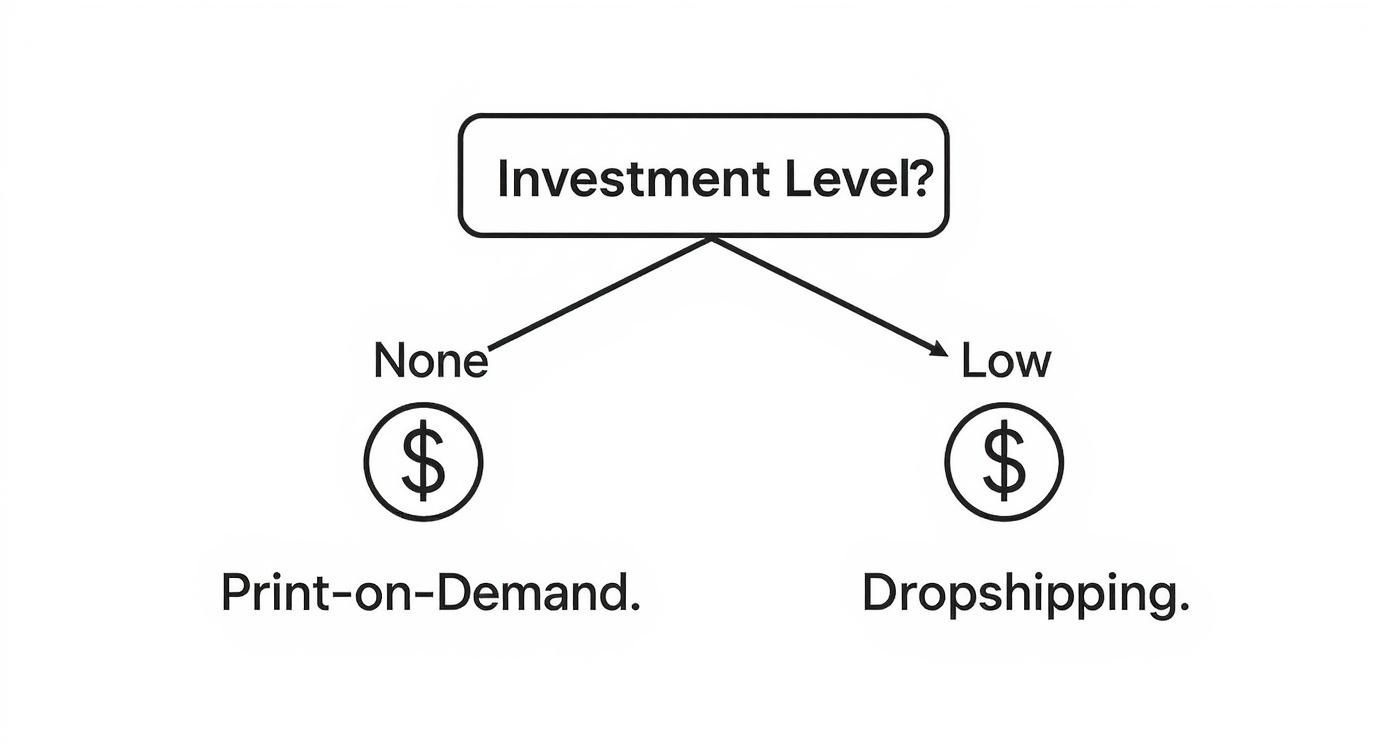
As you can see, if you're truly starting with a budget of zero, print-on-demand is your most direct path forward.
Choosing the right model is your first big decision. Here's a quick comparison to help you figure out which lane is best for you.
Low-Cost Clothing Brand Models at a Glance
| Business Model | Initial Cost | Inventory Risk | Profit Margin | Best For |
|---|---|---|---|---|
| Print-on-Demand (POD) | $0 - $50 (for samples) | Zero. Products are made only after an order is placed. | Lower (15-25%) | Creative founders who want to sell their own unique designs and build a strong brand identity. |
| Dropshipping | $0 - $100 (for platform fees) | Zero. You're selling a supplier's existing inventory. | Variable (20-40%) | Entrepreneurs who are great at marketing and want to curate a collection of existing products. |
| Direct-to-Fabric (DTF) | $100 - $500 (for transfers & a heat press) | Low. You only buy the transfers, not finished garments. | Higher (40-60%) | Hands-on creators who want more control over quality and can handle fulfilling orders themselves. |
Ultimately, each model offers a low-risk entry point. Your choice really comes down to whether you want to be the designer (POD), the curator (dropshipping), or the hands-on producer (DTF).
The Power of Print-on-Demand
The print-on-demand model has completely leveled the playing field for new clothing entrepreneurs. It single-handedly removes the biggest financial hurdle that used to stop great ideas dead in their tracks.
Not long ago, launching a brand meant shelling out $20,000 to $50,000 just to meet a manufacturer's minimum order quantity. With POD, you can launch a legitimate business for the cost of a few pizzas, maybe a hundred bucks for platform fees or some marketing experiments. If you want to dive deeper into the numbers, Printful.com has some great insights on launching costs.
Key Takeaway: The single most important rule for starting a clothing brand with no money is this: Never pay for a product until a customer has already paid you for it. This principle is the entire foundation of a risk-free launch.
This approach lets you be wildly creative. You can test a dozen t-shirt designs without spending a dime on inventory. If a design flops? No harm, no foul. But when one of them takes off, you've got a proven winner you can double down on—all while staying cash-flow positive from day one. It's the perfect lean startup strategy for the modern creator.
Build an Unforgettable Brand for Free
Before you touch a single t-shirt or even think about designs, you need to build your brand’s soul. A strong, memorable identity is what separates a real clothing brand from just another online shop slinging generic apparel. The best part? This foundational work costs you nothing but time and a bit of creativity.
When you're figuring out how to launch with no money, your brand identity is your most valuable asset. It's the story, the feeling, and the promise that connects with people on a level a cool graphic never could.
Pinpoint Your Niche with Zero Spend
The classic mistake I see new entrepreneurs make is trying to appeal to everyone. Don't do it. Instead, find a specific, passionate community that isn't being served well. You have to think smaller to eventually get bigger. Your goal is to become the absolute go-to brand for a very distinct group of people.
So, how do you find them? Put on your digital detective hat.
- Scour Reddit: Dive into subreddits where people are obsessed with a hobby, a style, or a shared worldview. What are the inside jokes? The common complaints? A community like r/skincareaddiction has its own language and trusted figures—a goldmine for understanding a niche.
- Analyze Pinterest: Search for aesthetic keywords like "dark academia" or "cottagecore." Pay close attention to the images people save the most and read the comments to understand the why behind their love for that style.
- Use Google Trends: Is there a growing interest in "retro gaming apparel" or "sustainable streetwear"? Google Trends shows you what’s gaining traction, helping you catch a wave right before it crests.
Key Insight: Your niche isn't just a demographic like "women aged 18-25." It's a psychographic—a shared set of beliefs, values, and interests. You want to be the favorite brand of the "plant-loving, book-reading introvert," not just "people who like plants."
This research costs nothing but gives you an invaluable roadmap. Once you’ve locked onto a promising niche, you can start building a brand that speaks their language fluently. Even with a zero-dollar budget, getting your name out there is crucial. You can get started with some proven strategies to build brand awareness that won’t cost you a dime.
Craft Your Visual and Verbal Identity
With your niche clearly defined, it's time to bring your brand to life. This is where you translate all that research into something people can see and feel. And yes, you can do this entire part for free, too.
Start with a simple brand mission statement. This isn't just corporate fluff; it's your North Star in a single sentence. For example, a brand targeting eco-conscious minimalists might have a mission like: "To create simple, timeless apparel that celebrates mindful living."
Next, nail down a brand name. It needs to be memorable, easy to spell, and reflect the vibe of your niche. You can use a free business name generator if you’re stuck, but always aim for something that feels authentic to the community you want to serve.
Finally, pull together the visual elements using free tools:
- Create a Mood Board: Hop on Canva or Pinterest and gather images, colors, fonts, and textures that capture your brand's personality. This becomes your visual rulebook, ensuring everything you create from here on out is consistent.
- Design a Simple Logo: Use a free tool like Canva’s logo maker to create a basic logomark or wordmark. It doesn’t have to be perfect. A clean, bold font with your brand name is often way more effective than a complex icon when you're starting out.
This entire branding process sets the stage for everything that follows. It makes sure your designs, your marketing, and your product choices all tell a clear, compelling story that will naturally attract your ideal customers—without you spending a dime.
Create Killer Designs with Zero Budget
Great designs are the absolute soul of a clothing brand. This is also the exact spot where most founders get intimidated and give up. But I’m here to tell you a secret: you don’t need a design degree or a pricey Adobe Creative Cloud subscription to make apparel people genuinely want to wear.
When you're launching a brand with no money, your ability to create a must-have graphic is your single greatest asset. It’s what turns a plain blank tee into a piece of art that your audience connects with. Let's dig into how you can do this without spending a dime.
Your Free Design Software Toolkit
First things first, ditch the idea that you need professional, thousand-dollar software. The free, browser-based tools available today are more than powerful enough to create print-ready, high-quality files for your clothing.
You can create absolutely stellar work with any of these:
- Canva: This is the undisputed king of easy-to-use design. It’s a powerhouse for typography-based designs or for arranging existing graphics into a cool layout. Its massive library of free fonts and elements is a goldmine for new designers.
- Photopea: Imagine a free, web-based version of Photoshop, and you've got Photopea. It has a bit more of a learning curve, but it unlocks so much more power for manipulating images, creating complex layers, and building detailed artwork from scratch.
- Krita: This is a free, open-source digital painting program that’s a huge favorite among illustrators. If your brand has a more artistic, hand-drawn vibe, Krita gives you all the brushes and tools you need to bring that vision to life.
My advice? Just pick one tool and commit to it. A few beginner tutorials on YouTube are all it takes to get you comfortable with the core features you’ll need for t-shirt design.
Finding High-Quality Free Assets
You don't have to draw or create every single element yourself. In fact, a go-to technique for professional designers is using high-quality, pre-made assets as the building blocks for a totally unique design.
The golden rule here is to always check the license. You absolutely must find assets that are cleared for commercial use.
Here are a few of my favorite spots for free, commercially-licensed materials:
- Unsplash and Pexels: These sites are packed with millions of professional, high-resolution photos that are free to use for any purpose. They’re fantastic for creating photographic tees or for adding cool textures to your graphics.
- Google Fonts: An incredible library of top-tier fonts, all open-source and 100% free for commercial projects. Typography is everything in apparel, and this gives you endless options.
- Vecteezy and Freepik: While they both push their premium plans, they also have a huge selection of free vector graphics, icons, and illustrations. Just make sure you filter your search for a "Free License" to find the good stuff.
Pro Tip: Never, ever just slap a stock photo on a shirt and call it a day. The best designs combine multiple elements—typography, graphics, and photos—to create something that feels entirely new. Think of these assets as ingredients, not the final meal.
Preparing Your Files for Flawless Printing
This is the non-negotiable step that so many beginners mess up. A killer design can be completely wrecked by a poorly formatted file. Both print-on-demand services and DTF transfer suppliers have very specific requirements to make sure your product looks as crisp in person as it does on your screen.
Nail these three things to avoid a printing disaster:
- File Format: Always, and I mean always, save your final design as a PNG with a transparent background. This is critical. It ensures only your design gets printed, not a big, ugly box around it. A JPEG, for example, can't handle transparency and will almost always result in a printed rectangle.
- Resolution: To avoid a blurry, pixelated mess, your file needs to be high-resolution. The industry standard is 300 DPI (dots per inch). When you create a new file in Krita or Photopea, set the DPI to 300 from the very beginning.
- Dimensions: Design at the actual size you want it to be printed. A tiny design created at 4 inches wide will look awful if it's stretched to 12 inches. A solid rule of thumb is to work on a canvas that’s at least 12 inches wide by 16 inches tall at 300 DPI. For more specifics, our guide on graphic sizing for t-shirts breaks down the ideal dimensions for different placements.
The Ultimate No-Cost Alternative: Artist Collaborations
What if design just isn't your thing? There's another incredibly powerful, zero-cost strategy: collaborating with an artist on a revenue-share model.
Find an illustrator or designer whose style perfectly matches your brand's vibe and pitch them a partnership. The deal is simple: they create the artwork, and you handle all the marketing, sales, and fulfillment. In return, they get a percentage of the profit from every single item sold with their art on it. It’s a true win-win that lets you launch with professional, jaw-dropping designs for absolutely no upfront cost.
Find the Right Production Partner
Alright, let's get to the fun part. Your designs are locked in, your brand has a pulse, and now you need to find the engine that will actually bring your ideas to life. For anyone figuring out how to launch a clothing brand on a shoestring budget, your production partner is everything. They are your factory, your warehouse, and your shipping department, all rolled into one.
You’re looking for a print-on-demand (POD) partner. This model is the absolute cornerstone of a zero-risk launch, and it works on a principle you should never forget: you only pay for a product after a customer has already paid you for it. This simple fact completely removes the terrifying financial weight of buying inventory upfront.
Getting a Feel for the Print-on-Demand World
So, how does this actually work? Print-on-demand services plug directly into your online store. When a customer buys one of your t-shirts, that order gets zapped over to your POD partner automatically. They then print your design onto a blank shirt, pack it up, and ship it straight to your customer—all with your branding. You literally don't have to do anything but collect the profit.
This hands-off approach is a total game-changer. It frees you from the logistical nightmares of managing stock, hoarding packaging supplies, and making endless runs to the post office. Your focus stays where it needs to be: creating incredible designs and getting the word out about your brand.
The difference between this and traditional retail is night and day. Launching a physical store can set you back a staggering amount—the average is around $48,000 before you even buy a single shirt or run your first ad. You can read more about the real costs of a traditional fashion business to see just how stark the contrast is. With POD, your startup cost is basically zero.
Comparing Top Production Partners
Picking the right partner is a massive decision. It will directly impact your product quality, shipping times, and ultimately, your brand's reputation. While the space is crowded, a few major players consistently rise to the top: Printful, Printify, and Gelato.
Each one operates a bit differently, and they all have their unique strengths. Understanding these nuances will help you find the perfect fit for what you’re trying to build.
To make it easier, let's break down the main contenders. This table should help you quickly see how they stack up against each other and figure out which one aligns with your goals.
Top Print-on-Demand Provider Comparison
| Provider | Key Feature | Pricing Model | Best For |
|---|---|---|---|
| Printful | In-house production and fulfillment for consistent quality control. | All-in-one pricing (product + printing). Higher base costs but simpler pricing. | Beginners who want maximum simplicity and reliable, consistent quality across all orders. |
| Printify | A network of different print providers you can choose from. | Separate product and printing costs. Lower base costs but quality can vary. | Founders who want to prioritize lower costs and are willing to vet different printers for the best deals. |
| Gelato | A global network focused on localized, eco-friendly production. | All-in-one pricing with a focus on sustainable, localized shipping. | Brands with an international audience that value sustainability and fast, localized shipping. |
As you can see, there's no single "best" choice here; it all comes down to your priorities. Printful gives you reliability, Printify gives you price competition, and Gelato gives you a global, sustainable footprint.
How to Properly Vet Your Partner
Before you even think about connecting a provider to your store, you absolutely must do your homework. Trusting the wrong partner can sink your brand with shoddy prints, ridiculously long shipping times, and a wave of angry customers.
Key Takeaway: Never, ever sell a product you haven't seen, touched, and tested yourself. Your brand's reputation is riding on every single order, and you simply can't afford to leave quality to chance.
Here’s a quick-and-dirty checklist I use to vet any potential POD partner:
- Order Samples (at a discount!): Every major platform lets you order samples at a reduced price. Do it. Test a few different garments, feel the fabric, and see how your designs actually look in person. Check the print for vibrancy, durability, and overall quality.
- Become a Review Detective: Don't just glance at the star rating. Dive deep into recent reviews on sites like Trustpilot or forums on Reddit. Are people constantly complaining about shipping delays, washed-out prints, or non-existent customer service? These are massive red flags.
- Test the Tech: Connect the provider to a test version of your store. See how easily products sync up, how intuitive their dashboard is, and whether the mockups they generate look professional.
- Check Their Footprint: If you have ambitions to sell internationally, look at where their production facilities are. A partner with fulfillment centers in Europe, for instance, will get orders to your European customers much faster and cheaper than one based only in the US.
Making this decision carefully right at the start will save you a world of pain later. It ensures the automated system you’re building is solid, efficient, and capable of delivering a product that makes your customers excited to wear your brand.
Launch Your Online Store on a Shoestring
Alright, your designs are dialed in, and you've got your production partner lined up. Now it's time to build your brand’s home online—its digital storefront. This is where your brand truly comes to life and makes that crucial first impression. A professional, trustworthy e-commerce store is absolutely non-negotiable, but that doesn't mean it has to blow up your (probably non-existent) budget.
The trick is to use platforms that pack a serious punch without the hefty price tag. Industry giants like Shopify are popular for a reason, and they almost always offer a free trial. This is your golden window—usually 3 to 14 days—to build your entire store, get your products uploaded, and have everything ready for launch before you spend a single dime.
Choosing and Customizing Your Free Theme
Think of your store's theme as its visual DNA. A clean, intuitive design builds trust instantly. On the other hand, a cluttered or cheap-looking site will send potential customers clicking away in seconds. The good news is that platforms like Shopify come loaded with excellent free themes that are surprisingly customizable.
When you're scrolling through options, keep your eyes peeled for these key elements:
- Strong Visuals: You need a theme that puts your product mockups front and center. No compromises here.
- Mobile-First Design: It’s a fact: over 58% of all web traffic comes from mobile devices. Your store has to look absolutely incredible on a phone.
- Easy Navigation: People should be able to find your products, read your story, and check out without ever feeling lost or confused.
Once you’ve found a theme that feels right, jump into the customizer. This is where you make it yours. Upload your logo, dial in your brand colors, and set your brand fonts. The goal is to take that free template and infuse it with the personality from the mood board you created earlier.
The Power of High-Quality Product Mockups
This is your secret weapon for looking like a million-dollar brand without spending a cent on a photoshoot. Your print-on-demand partner will automatically generate high-resolution mockups for every product you create. These are professional-looking images of models wearing your apparel or clean, flat-lay shots of your items.
Key Insight: Your product mockups are your single most critical sales tool. They're the only way for customers to visualize what your clothing looks and feels like in the real world. Mix it up! Use a variety of mockups—on-model, lifestyle shots, and close-up details—to create a rich, compelling product page.
These mockups are completely free and ready to go. Plaster them everywhere: on your product pages, your homepage, and all over your social media. They effectively bridge the gap between a design file on your computer and a tangible product someone can actually imagine wearing.
Crafting Compelling Product Descriptions
Your stunning mockups will grab their attention; your words will close the sale. A great product description does so much more than list features—it tells a story and sells a feeling. So instead of just writing "100% Cotton T-Shirt," try painting a picture:
For example: "Crafted from an unbelievably soft, breathable 100% ringspun cotton, this tee is your new go-to. We designed the classic fit for all-day comfort, whether you’re on the move or kicking back. Featuring our signature [Design Name] graphic, it's a wearable piece of art that says it all."
While the POD model is a fantastic way to start with zero inventory, it’s just one piece of the puzzle. For a complete overview of setting up your entire operation, check out our in-depth guide on how to start a print-on-demand business.
The traditional path to launching an online store is notoriously expensive. Just the e-commerce infrastructure can run you $500–$5,000, not even counting inventory and marketing. If you want to see a full breakdown of what a typical launch costs, you can explore the insights on clothing line startup costs on upmetrics.co. By using free platform trials and the mockups from your POD partner, you get to sidestep those massive initial costs entirely.
Market Your Brand with Zero Ad Spend
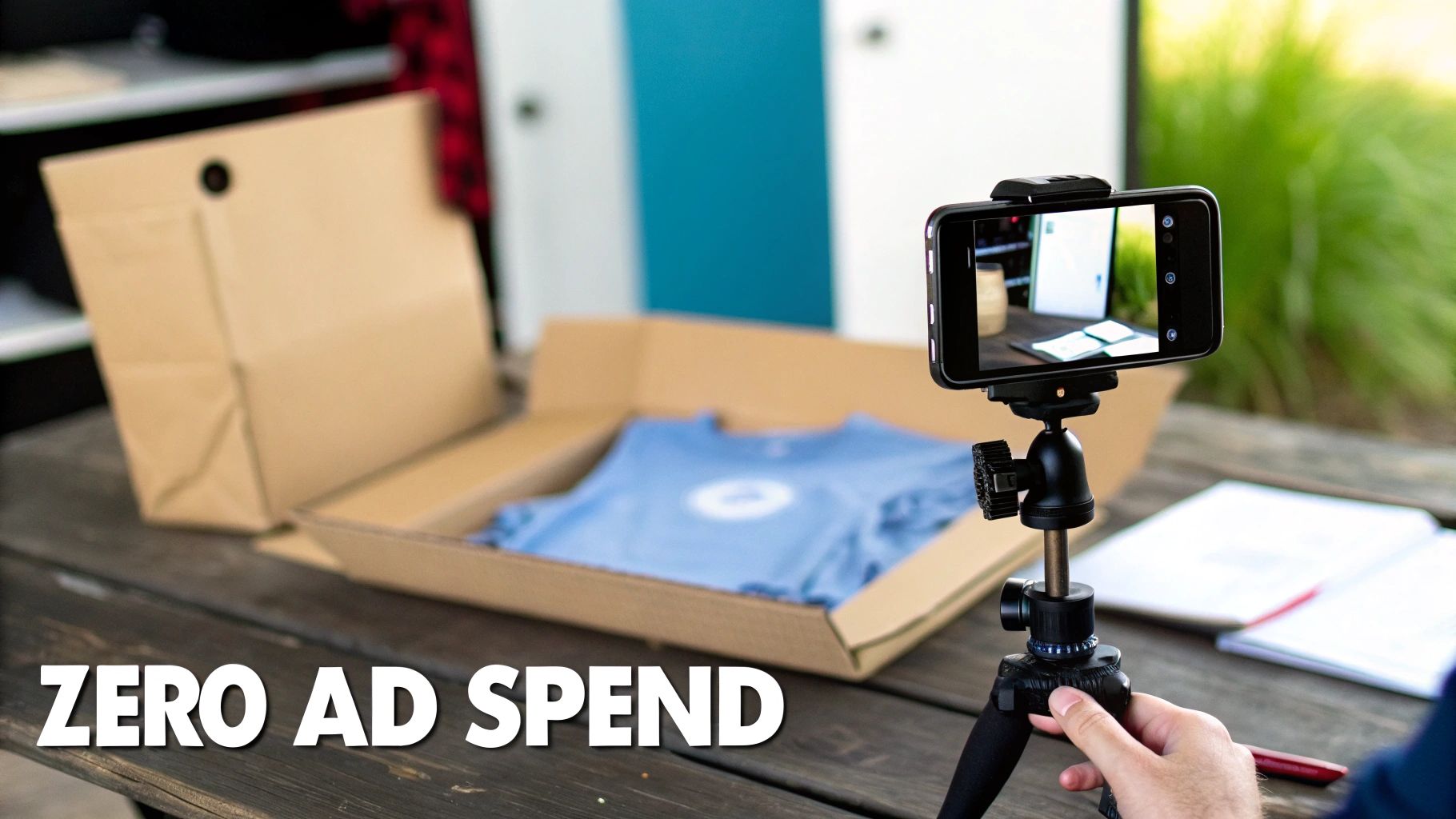
So, you've got a killer design and a sharp-looking online store. That's a huge win, but it doesn't mean a thing if no one sees it. This is where the real hustle kicks in. When you're launching a brand with practically no money, paid ads are off the table. Instead, your marketing will run on pure creativity and effort.
Your most powerful tools are platforms like TikTok and Instagram Reels. Here’s the secret: your tiny budget is actually an advantage. People are tired of slick, corporate ads; they want to see real, human stories.
Dominate with Authentic Content
Don't overcomplicate this. Just pull out your phone and start recording. Film the messy process of brainstorming a new design. Show your genuine reaction when your first batch of blanks arrives. Record a time-lapse of you packing that very first order. This is the stuff that builds a real connection.
When people see the person and the passion behind the products, they get invested. They start rooting for you. This approach doesn't just get you followers; it builds a community of people who are genuinely excited to support a small-time creator over some faceless giant. Just be consistent and show them the work.
Key Takeaway: Authenticity is your marketing superpower. People buy from people they know, like, and trust. Share your process—the wins, the struggles, and the passion—to build a loyal following that paid ads could never replicate.
Leverage Social Proof and Collaborations
As soon as you make those first few sales, the real marketing magic can happen. Ask your early customers to post photos of themselves wearing your stuff. When they do, feature that user-generated content (UGC) everywhere—on your Instagram, on your product pages, everywhere. It’s the best social proof you can get, period.
Another smart move is to team up with micro-influencers. These are creators with smaller but fiercely loyal audiences. Many are happy to show off your gear to their followers in exchange for a free shirt. It's a fantastic way to get your brand in front of a targeted audience with a genuine endorsement.
Don't forget to start an email list from day one. You can use free tools to add a simple sign-up form to your website. Having a direct line to your biggest fans is essential for announcing new drops and keeping them engaged. And while social media is your best friend for discovery, don't ignore other channels. To explore more options, check out our guide on selling tee shirts on Etsy.
Common Questions About Starting a Brand
Diving into the world of starting a clothing brand, especially with no cash upfront, naturally brings up a ton of questions. It's easy to get bogged down wondering about hidden costs, legal stuff, and whether this whole thing is even possible.
Let's cut through the noise and tackle the concerns I hear most often.
One of the first things people ask is, "Can you actually make good money with print-on-demand?" The short answer is yes, absolutely. But it’s not a race to the bottom on price.
With print-on-demand, your base costs are higher than buying in bulk, so competing on price is a losing game. Your profit comes from building a brand that resonates with people—something they genuinely want to be a part of. That connection is what allows you to charge a premium. A generic tee might only make you a few bucks, but a thoughtfully designed shirt from a brand people love can easily hit a 25-40% profit margin.
Do I Need a Business License Right Away?
This is the classic "it depends" scenario, but for most people just starting out, the answer is usually no. If you're just dipping your toes in the water and selling a few shirts through a marketplace, you can typically operate as a sole proprietor without any formal registration.
Once you start getting consistent sales and decide to get serious, forming an LLC is a great idea. It separates your personal assets from your business liabilities, which is a smart way to protect yourself. The rules change depending on where you live, so always do a quick search for your local city and state requirements.
Here's the real takeaway: Your first mission isn't drowning in legal paperwork. It's validating your idea. Focus all your energy on getting those first ten sales. Early traction is infinitely more valuable than a perfectly structured LLC with zero customers.
How Much Time Does This Realistically Take?
When you're starting with no money, your currency is time. You're trading sweat equity for startup capital. While you can technically get a store live over a weekend, the real work—the stuff that actually makes you money—is in the creative and marketing grind.
Here’s a realistic look at the time commitment:
- Initial Setup: Plan for 10-20 hours. This covers your branding, store design, and creating your first products.
- Ongoing Marketing: Budget 5-10 hours per week. This is for creating social media content, engaging with your community, and getting the word out.
The great thing about this model is that it's flexible. You can ramp your hours up or down depending on how fast you want to grow. For a wider look at the basics of getting any online store off the ground, this guide to launching an e-commerce business has some great insights on finding your niche and early marketing.
At Raccoon Transfers, we help creators bring their ideas to life without needing a huge budget. When you’re ready to graduate from print-on-demand and start holding your own inventory for much better margins, our premium DTF transfers are the logical next step. See what's possible at https://raccoontransfers.com.