
What Is a DTF Print House and How Do They Work
Ever wonder how small brands and creators produce such amazing custom apparel without owning a massive factory? The secret is often a DTF print house.
Think of a DTF print house as your personal, high-tech printing partner. They take your digital designs and turn them into vibrant, durable transfers that are ready for you to press onto almost any fabric. It’s a service that gives everyone from Etsy shop owners to DIY enthusiasts the power to create professional-quality gear.
What Is a DTF Print House
At its heart, a DTF print house is a specialized service that handles all the technical, messy parts of printing for you. Instead of you needing to buy and maintain expensive printers, inks, powders, and curing ovens, you simply upload your artwork. They become the bridge between your creative idea and a real, physical product you can sell or wear.
The process itself is pretty slick. Using highly specialized printers, your design is printed in full, vivid color onto a sheet of clear PET film. Then, a layer of brilliant white ink is printed behind the colors. This is the magic step—it ensures your design looks bold and opaque on any color garment, from a crisp white tee to a black hoodie. That incredible versatility is a huge reason why DTF has taken the custom apparel world by storm.
The Role of an Expert Partner
A good DTF print house does way more than just hit "print." They are quality control experts obsessed with consistency. They manage the entire technical workflow, which boils down to a few key steps:
- Printing: Using commercial-grade equipment that produces razor-sharp details and spot-on colors.
- Adhesive Application: The printed design is coated perfectly and evenly with a special adhesive powder. This is what will bond your design to the fabric.
- Curing: The powder is meticulously melted, creating a durable yet flexible transfer that arrives at your door ready to press.
This model lets creators do what they do best: create and sell. You focus on design and marketing, while the print house handles the manufacturing. The proof is in the numbers: the global Direct-to-Film printing market was recently valued at around USD 2.72 billion and is expected to hit USD 3.92 billion by 2030. That’s a testament to how essential this service has become.
By outsourcing your printing to a DTF house, you get access to world-class technology without the massive price tag or headache. No maintenance, no stocking up on supplies, and no steep learning curve. It’s a game-changer for businesses of any size.
Ultimately, working with a service like Raccoon Transfers means you get reliable, high-quality results, order after order. This lets you scale your business on your terms, whether you need ten shirts for a local fundraiser or a thousand for your next big drop. If you're new to all this, taking a moment to understand the basics of Direct-to-Film printing will give you an even clearer picture.
How Your Designs Become Physical Prints
Ever wonder how your digital artwork jumps from the screen to a vibrant, ready-to-press transfer? That's where a DTF print house comes in. Think of us as the production hub where your creative vision gets turned into a tangible product. It's a precise, multi-step process—less like magic and more like a high-tech kitchen, where every single ingredient and step has to be perfect.
The whole journey kicks off the second you upload your design file. Of course, getting that file ready is a crucial first step for any artist. If you're working with physical art, learning how to photograph artwork for prints is a game-changer. Once your digital file is good to go, our specialized machinery takes over.
The Printing Stage: Getting Your Design onto Film
First things first, we use a sophisticated DTF printer that doesn't print on paper or fabric. Instead, it prints directly onto a special translucent sheet called PET film. The printer carefully lays down the colored inks (cyan, magenta, yellow, and black) to recreate your design with stunning detail. Right after that, it lays down a solid layer of brilliant white ink directly on top of the colors.
This white base is the secret sauce behind DTF's incredible versatility. It acts like a primer, guaranteeing your design’s colors pop, whether you press it onto a bright white tee or a deep black hoodie.
This simple flow chart breaks down the three-step journey your design takes with us.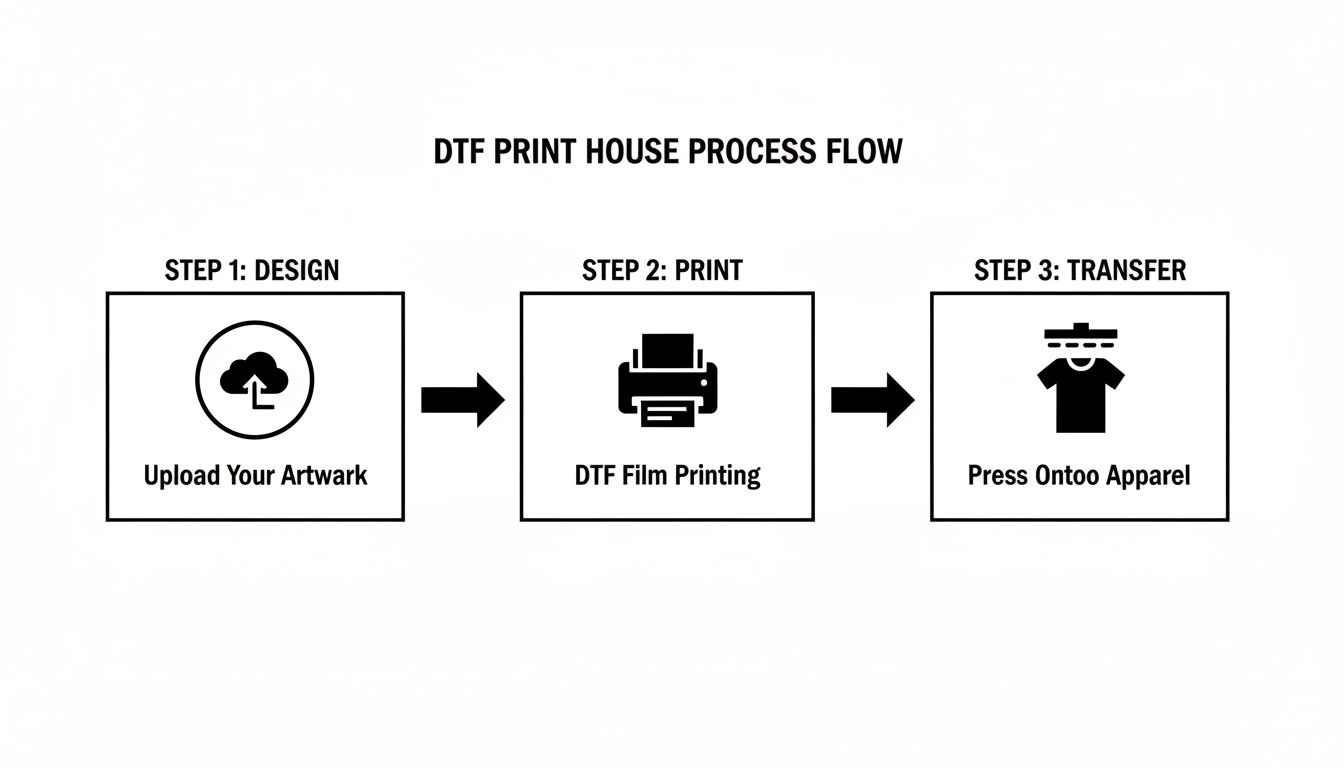
As you can see, the process is designed to move your digital file to a physical, press-ready transfer as efficiently as possible.
The Adhesive Power: Powder and Curing
While the ink is still wet on the film, the sheet is immediately coated with a fine, granulated adhesive powder. This stuff might look like simple dust, but it’s actually a powerful thermoplastic polyurethane (TPU) that acts as the bonding agent, permanently fusing your design to the fabric.
Think of this adhesive powder as the invisible glue that’s activated by heat. Without it, the ink would just be a pretty picture on a plastic sheet. With it, the design becomes a durable part of the garment.
Once powdered, the film passes through a curing oven. The heat melts the powder, bonding it securely to the ink layer without smudging the design. After a quick cool-down, what comes out is the finished DTF transfer—a flexible, durable, and ready-to-ship product that brings your artwork to life. You can get an even closer look at https://raccoontransfers.com/blogs/guides/our-process.
The Technology Behind the Precision
The quality of your final transfer really comes down to the equipment we use. Professional print houses rely on commercial-grade printers built for consistency and high-volume output. There's a reason the dedicated DTF printer market now accounts for 45.0% of the industry—these machines offer incredible precision on everything from cotton and polyester to leather.
At Raccoon Transfers, our machinery is dialed in to meet strict quality standards on every single order. This includes:
- Spot-On Color: Our advanced ink systems and software ensure the colors in your digital file are what you see on the final transfer.
- Even Powdering: Automated shakers distribute the adhesive powder perfectly, which is key to preventing peeling or cracking after pressing.
- Controlled Curing: Precise temperature controls in our curing tunnels melt the adhesive just right, guaranteeing a strong bond without scorching the ink.
This technology-driven process ensures that every order, whether it's for one transfer or one thousand, is produced with the same professional quality. Your creative vision is in good hands.
Understanding Your DTF Product Options
When you start working with a DTF print house, you’ll quickly find you have a few powerful tools at your disposal. Knowing what they are and when to use them is the key to making every project a success, whether you're creating a one-off custom t-shirt or launching an entire apparel collection.
Think of it like a workshop—you wouldn't use a sledgehammer for a finishing nail. Choosing the right product saves you time, money, and ensures you get the crisp, professional results your customers are looking for.
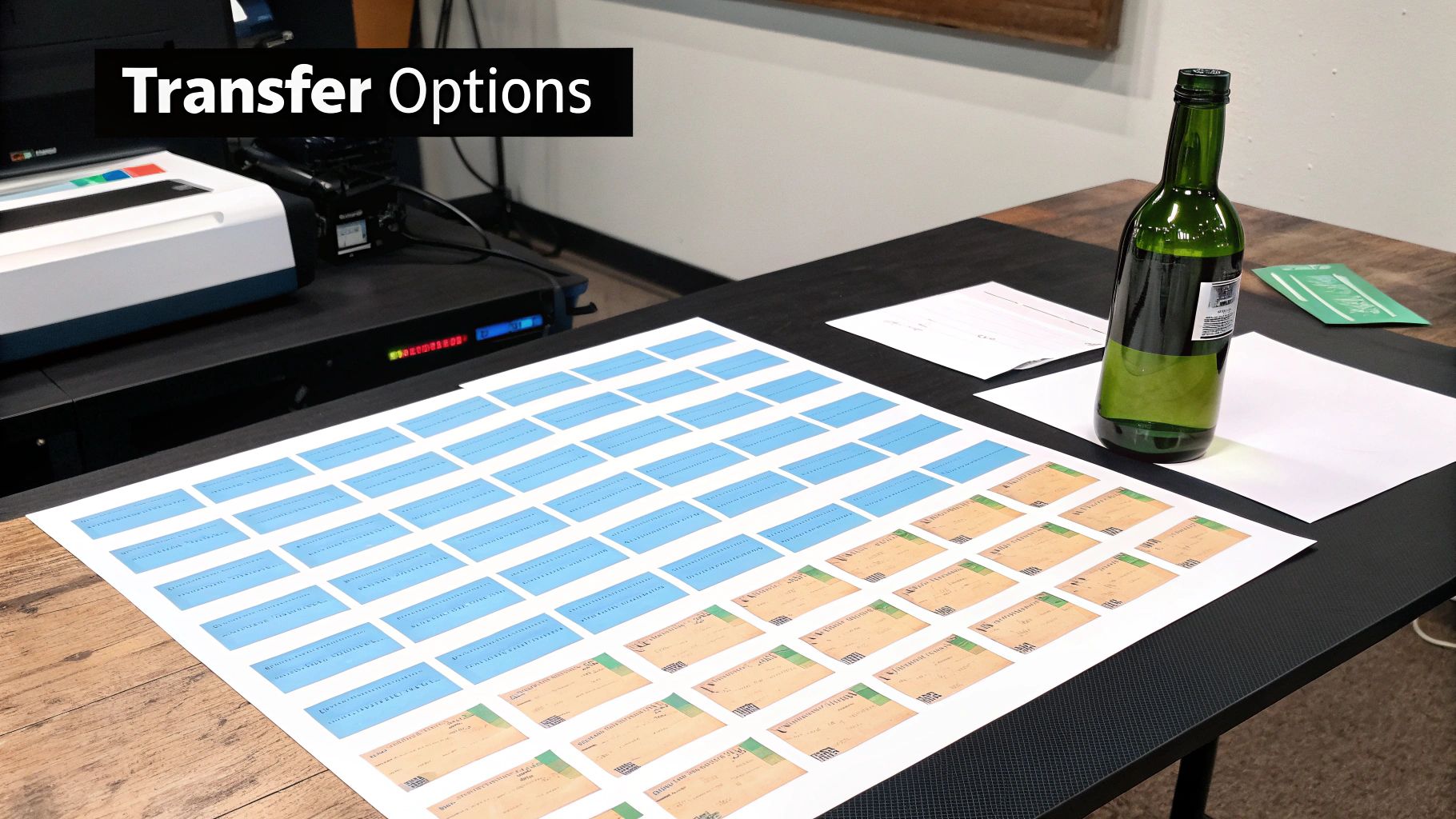
Let's break down the main options you'll come across and figure out which one fits your needs.
The Power of Gang Sheets
By far, the most common and cost-effective product you'll find at any DTF print house is the gang sheet. The concept is simple but brilliant. Imagine you have a big sheet of cookie dough; instead of cutting out just one giant cookie, you use different cutters to fill the entire space, leaving almost no dough behind. A gang sheet applies that exact logic to your designs.
You can take all your different graphics—logos in various sizes, sleeve art, neck tag labels, or even designs for totally separate jobs—and arrange them onto one large sheet of transfer film. You pay for the sheet, not for each individual design. This is a game-changer for getting the most bang for your buck.
This method is perfect for:
- Apparel Brands: Combine your main chest graphic, sleeve hits, and custom neck tags into a single, efficient print run.
- Etsy Sellers: Group your best-selling designs together to restock inventory without placing multiple small orders.
- Event Organizers: Fit logos for staff uniforms, volunteer shirts, and promo tote bags all on one sheet.
Many print houses offer tools to make this easy. For example, the online gang sheet builder from Raccoon Transfers lets you upload, drag, and resize your artwork right on the screen, so you can see exactly how to fill every inch of space.
A well-planned gang sheet is the ultimate money-saver. By consolidating your printing needs, you reduce your cost per design, which directly boosts your profit margins on every item you sell.
UV-DTF Transfers: The "Super Sticker" for Hard Goods
So, standard DTF has textiles covered. But what if you want to put a permanent, high-quality logo on a tumbler, a phone case, or a metal toolbox? That's where UV-DTF transfers come into play. These are not for fabric. They're basically industrial-strength decals made for hard, non-porous surfaces.
Think of them as super-powered stickers. They’re printed with UV-cured inks and backed with a powerful adhesive, creating a vibrant, slightly raised design that’s waterproof and scratch-resistant. The best part? No heat press needed. Just peel, stick, and press firmly. It’s that simple.
This makes them perfect for branding all sorts of things:
- Glassware and mugs
- Laptops and other electronics
- Acrylic keychains and plastic goods
- Powder-coated tumblers and metal signs
UV-DTF opens up a whole new world of product customization, letting you move beyond apparel and offer a more complete branding solution to your clients.
To make it clearer, here's a quick comparison of the two main transfer types.
DTF vs UV-DTF Transfers At a Glance
This table breaks down the core differences to help you decide which transfer is right for your project.
| Feature | DTF Transfers (for Apparel) | UV-DTF Transfers (for Hard Goods) |
|---|---|---|
| Best For | Fabrics (cotton, polyester, blends, canvas) | Hard, non-porous surfaces (glass, metal, plastic, wood) |
| Application | Requires a heat press to apply | Peel-and-stick (no heat needed) |
| Feel & Finish | Soft, flexible, matte finish | Slightly raised, glossy, durable finish |
| Durability | Excellent washability (machine washable) | Waterproof and scratch-resistant |
| Common Uses | T-shirts, hoodies, hats, tote bags | Tumblers, mugs, phone cases, laptops, signage |
Ultimately, choosing between DTF and UV-DTF comes down to one simple question: what are you putting your design on?
Individual Transfers for Specific Needs
What if you don't need a mix of designs? Sometimes, you just need a lot of the same design. Let's say a local company orders 100 polos, and they all need the same left-chest logo. In that case, ordering individual, pre-cut transfers makes the most sense.
Ordering this way means the print house does the cutting for you. Your transfers arrive perfectly trimmed and ready to press, one after another. This seriously speeds up your workflow on big, uniform jobs where you'd otherwise spend a ton of time cutting up a gang sheet yourself.
At the end of the day, a good DTF print house gives you options that grow with your business. Whether you're squeezing every bit of value from a gang sheet, exploring new products with UV-DTF, or powering through a large order with pre-cut transfers, you have the flexibility to create amazing custom products your way.
How DTF Stacks Up Against Other Printing Methods
Choosing the right way to print your designs can feel like a tough call, but it really just boils down to what your project needs. A DTF print house brings something special to the table, especially in areas where other methods can't quite keep up. Knowing the key differences will help you pick the perfect technique for your apparel or merch.
Let's put DTF head-to-head with its two biggest rivals in the custom apparel world: classic Screen Printing and its modern cousin, Direct-to-Garment (DTG). We'll look at what matters most: design complexity, order size, what fabrics you can use, and how the final print actually feels.
DTF Versus Screen Printing
Screen printing has been the heavyweight champion of bulk apparel orders for decades. The process is straightforward: ink is pushed through a mesh stencil directly onto the shirt. If you need 500 t-shirts with a simple one-color logo for an event, this method is incredibly cost-effective.
But that strength is also its biggest weakness.
- Setup Costs: Every single color in your design needs its own screen. A five-color graphic? That means five separate screens and five setups, which gets expensive in a hurry for smaller orders.
- Design Complexity: Screen printing just isn't built for photorealistic images or designs with subtle gradients. Each new color adds another layer of work and cost.
- Order Size: Because of all the setup, screen printing isn't practical for one-offs or small batches. Most shops have minimums, often starting at 24 pieces or more.
DTF completely flips that model on its head. With DTF, there are no screens and no per-color fees. Your design is printed digitally in full, vibrant color, meaning a simple logo costs the same to produce as a full-blown photograph. This is a game-changer for small businesses needing just a handful of complex, colorful designs without a huge upfront investment.
DTF Versus Direct to Garment (DTG)
Direct-to-Garment (DTG) printing is a lot closer to DTF. Think of a DTG printer like your home office inkjet, but for fabric—it applies water-based inks directly onto the garment. It's fantastic for producing super soft, breathable prints on 100% cotton, especially on light-colored shirts.
The trouble starts when you want to print on dark fabrics or materials other than cotton. Printing on dark garments requires a pre-treatment spray, which can sometimes leave a faint box around the design and change how the fabric feels. On top of that, DTG ink just doesn't like to stick to polyester or blended fabrics, which really limits its use.
And this is where DTF truly pulls ahead.
Think of DTF printing as the all-terrain vehicle of the apparel world. It works brilliantly on cotton, polyester, nylon, leather, and blends of any color. The white ink base acts as a perfect canvas, making sure colors are always vibrant and solid, no matter how dark the garment is.
This incredible versatility is a huge reason why DTF has grown so fast. Global production has skyrocketed, with over 7.2 billion DTF prints produced in a recent year—that's a 30% jump from the year before. This explosive growth shows just how much creators are embracing its flexibility. You can dig into more data on the growth of DTF technology and its market impact at WTiN.
If you want an even deeper dive into these two digital methods, check out our guide on DTF vs DTG printing.
A Quick Comparison Guide
To make your decision easier, here's a simple table that breaks down the pros and cons of each method based on what you might need.
| Feature | Direct-to-Film (DTF) | Screen Printing | Direct-to-Garment (DTG) |
|---|---|---|---|
| Best Order Size | Small to large batches (1-1000+) | Large batches (50-10,000+) | Small batches (1-50) |
| Design Detail | Excellent for photos & fine lines | Good for bold, simple graphics | Excellent for photos & gradients |
| Color Limits | Unlimited colors, no extra cost | Limited colors, costly per color | Unlimited colors, no extra cost |
| Fabric Versatility | High (Cotton, poly, blends, leather) | Moderate (Mainly cotton/blends) | Low (Best on 100% cotton) |
| Durability | High (50+ washes) | Very High (Can outlast garment) | Moderate (Fades over time) |
| Feel of Print | Soft, flexible layer on top | Thicker ink layer on top | Very soft, breathable ink in fabric |
At the end of the day, the "best" method really depends on your goals. For huge runs of a simple design, screen printing is still a rock-solid choice. For a single, photorealistic print on a white cotton tee, DTG is amazing. But for the ultimate freedom, vibrant colors on any fabric, and cost-effective small batches, working with a DTF print house is almost always the smartest move.
How to Choose the Right DTF Print House
Picking the right partner for your printing needs is just as important as perfecting your designs. A great DTF print house isn't just a supplier; they become an extension of your business, delivering the kind of consistent quality that makes your brand shine. But with so many options out there, how do you find the one that’s the right fit?
Don't get bogged down by flashy marketing claims. Instead, zero in on a few key areas that directly impact your final product and, ultimately, your wallet. Asking the right questions will help you sort through the noise and find a truly reliable partner who can help you grow.
Look for Proof of Quality
First things first: you need to see their work. A DTF print house that’s confident in its quality will have plenty of real-world examples of their transfers plastered all over their website and social media. Look for sharp, clean lines, colors that pop, and consistent results across different designs.
Be a little skeptical of shops that only show you digital mockups. You need to see how their prints actually look and feel on a real garment. This visual proof is your first and best clue that they have their equipment and processes dialed in.
Speed and Reliability Are Key
In the world of custom apparel, timing is everything. Whether you're scrambling to fill a last-minute order for a client or stocking up for a big event, you need a print partner who can keep up. Look for a DTF print house with a fast, clearly stated turnaround time.
When a provider offers next-day shipping, like Raccoon Transfers does, it’s a strong signal that they run a seriously efficient operation. That kind of speed means you can jump on new trends and keep your customers happy without having to tie up cash in a ton of inventory. And don't forget to look for perks like free shipping on certain orders—that can really cut down your costs.
The ideal DTF print house combines speed with unwavering reliability. They get that a missed deadline can cost you a customer, so their entire workflow is built around one thing: getting your high-quality transfers out the door on time, every single time.
Evaluate the Customer Experience
What happens when you have a question about your artwork or a problem with an order? This is where the great printers separate themselves from the rest. A top-tier DTF print house will have an expert support team ready to jump in and help. Remember, you're not just buying a product; you're investing in a service.
A great customer experience also shows up on their website. Is ordering a breeze? Is their gang sheet builder intuitive enough for a beginner but powerful enough for a pro? A smooth, frustration-free website shows that the company respects your time and has put in the effort to make their service easy for everyone to use.
The Five Essential Questions to Ask
Before you place that first order, run through this simple checklist. The answers will tell you just about everything you need to know about a potential DTF partner.
- Print Quality: Are they showing off real, unedited photos and videos of their finished transfers?
- Turnaround Speed: Can they reliably hit a 24-hour turnaround and offer fast shipping?
- Customer Support: Is there a knowledgeable team you can actually reach when you have a file question or an order issue?
- User Experience: Is their website easy to get around, and is their gang sheet builder a tool you'll actually enjoy using?
- Overall Value: Is their pricing competitive, and do they sweeten the deal with perks like free shipping or local pickup?
Choosing the right DTF print house is a strategic business decision. By focusing on these core pillars—quality, speed, support, and value—you can find a partner you can count on, letting you create amazing products with total confidence.
A Simple Checklist for Placing Your Order
Placing your first order with a DTF print house should be exciting, not stressful. A little prep work goes a long way, and it’s the secret to getting transfers that look exactly like what you designed on screen. This checklist breaks everything down into simple, easy-to-follow steps so you can order with total confidence.
Think of this as your pre-flight check before sending your art into production. Getting these details right guarantees a smooth journey from your design file to a stunning final product.

Prepare Your Artwork Files
This is where the magic really starts—and it’s the most critical stage. The quality of your final print is a direct reflection of the quality of your file. Before you even think about uploading, run through these essentials.
-
Check Your Resolution: Your design file needs to be 300 DPI (dots per inch) at the exact size you want it to print. If you use a low-resolution file, like a 72 DPI image you grabbed from a website, the final print will look pixelated and blurry. No one wants that.
-
Ensure a Transparent Background: This one is non-negotiable for DTF. You must save your file with a transparent background. If you don't, the printer will create a solid white or colored box around your entire design, which will ruin the look on your garment.
-
Choose the Right File Format: Stick to the industry standards. The best file formats are PNG, PDF, or vector files like AI and EPS. These types support transparency and keep your artwork's lines crisp and colors vibrant. Steer clear of JPEGs, as they can't handle transparency and tend to degrade image quality.
Think of a transparent background as an invisibility cloak for the parts of your image you don't want printed. It tells the printer to only lay down ink for your actual design, resulting in a clean, professional transfer that looks like it was printed directly onto the fabric.
Finalize Your Order Details
Once your files are looking sharp, it’s time to head to checkout. Paying close attention here ensures your order shows up just as you expect it, and on time.
- Double-Check Your Gang Sheet: If you're building a gang sheet to get more bang for your buck, take a final look. Make sure all your designs are arranged correctly and have enough space between them for you to cut them out easily later.
- Confirm Quantities and Sizes: It sounds simple, but it’s easy to miss. Verify that the dimensions and quantities for every single design or sheet are correct. A small typo here can become a costly mistake.
- Review Turnaround Times: Get a clear idea of the production timeline. Any good DTF print house will tell you exactly how long it takes to print your order before it gets handed off to the shipping carrier.
- Understand Shipping Policies: Check out the shipping options, costs, and estimated delivery dates. You might find ways to save, like free shipping on larger orders or even a local pickup option if the print house is nearby.
By running through this checklist, you’re setting yourself up for a flawless experience. When you combine properly prepared files with a clear understanding of the ordering process, you get high-quality, ready-to-press transfers every single time. That leaves you free to focus on what you do best—creating amazing products.
Common Questions About DTF Printing
Jumping into the world of custom apparel always brings up a few questions, especially when you're working with a new printing method. A good DTF print house should be ready with clear answers. Let's tackle some of the most common questions we get, so you can feel confident starting your next project.
How Durable Are DTF Transfers After Washing?
This is usually the first thing people ask, and it's a great question. The short answer? Really durable. When you apply a high-quality DTF transfer with a proper heat press, you can expect it to handle 50 or more washes without cracking, peeling, or fading. The ink and adhesive actually fuse with the fabric fibers, creating a powerful bond.
To get the most life out of your prints, just follow basic care instructions. We always suggest washing the garment inside out in cold water and tumble drying on low. That's it! The print should last as long as the shirt itself.
Do I Need a Special Heat Press for Application?
Yes, for a professional, long-lasting finish, a commercial-style heat press is a must. A regular home iron just can't deliver the consistent, even heat and pressure needed to properly cure the transfer's adhesive. Trying to use an iron almost always results in a patchy application where parts of the design start peeling off after the first wash.
Think of a quality heat press as an investment in your product. It’s the only way to guarantee the transfer gets the exact heat and pressure it needs to bond permanently, giving you that retail-quality finish your customers expect. We include clear, step-by-step instructions with every order to walk you through it.
Can DTF Transfers Be Applied to Any Color Fabric?
Absolutely! This is one of the biggest reasons people love DTF. The printing process cleverly lays down a layer of opaque white ink under the entire design. This white layer acts like a primer, making your colors pop with full vibrancy, even on black or other dark-colored garments.
This is a huge step up from other printing methods that can look faded or "muddy" on dark fabrics. With DTF, your design will look true-to-color on pretty much any cotton, polyester, or blended fabric you throw at it.
What if I Have a Problem with My Artwork File?
We get it—not everyone is a graphic design wizard. While a high-resolution file with a transparent background is the goal, we know that files aren't always perfect. A true partner of a print house will have an expert team ready to help you out.
If we spot a common issue, like a low-resolution image that will print blurry, we’ll almost always reach out to you before it ever hits the printer. This kind of proactive support helps make sure the design on your screen matches the final transfer, saving everyone from a costly headache.
Ready to create stunning, durable custom apparel with total confidence? At Raccoon Transfers, we combine premium-quality prints with expert support to bring your vision to life. Start your order today