
How to Start a Craft Business from Home and Actually Succeed
Turning your creative passion into a real business begins with one crucial decision: choosing a profitable niche. This isn't about trying to sell to everyone. It's about finding a specific group of people who are actively looking for exactly what you can create, and then serving them better than anyone else.
Finding a Profitable Niche in a Crowded Market
Passion is the engine of your craft business, but a smart niche is the roadmap that leads to profit. With a sea of creators selling online, standing out takes more than a good product—it requires a laser focus.
Think about it. Instead of just "custom t-shirts," what if you specialized in witty apparel for local running clubs? Or unique merchandise for book lover communities? This targeted approach doesn't just make your marketing easier; it helps you build a loyal tribe of customers who feel like you get them.
And the opportunity is massive. The global handicrafts market was valued at $752.2 billion in 2022 and is expected to soar past $1.2 trillion by 2028. What's really encouraging for anyone starting out is that a staggering 95% of these ventures are run by solopreneurs. You don't need a huge team, just a sharp strategy.
How to Identify Your Ideal Customer
Before you can be sure your niche is a winner, you have to know exactly who you're selling to. Vague descriptions like "women aged 25-40" just won't cut it. You need to get specific and build out an ideal customer avatar.
- Demographics: Who are they, really? Think about their age, where they live, and what they do for a living. For example, a 32-year-old graphic designer in Austin, Texas.
- Interests & Hobbies: What do they love to do in their free time? Are they obsessed with gardening, hiking with their dog, or navigating life as a new parent? This paints a picture of their lifestyle.
- Pain Points & Desires: What problem can your craft solve? Maybe they're desperate for unique, personalized gifts that don't feel generic, or they need durable home decor that fits their minimalist style.
- Online Hangouts: Where do they spend their time online? Knowing whether they're scrolling through Pinterest for inspiration, watching TikTok tutorials, or active in niche Facebook groups tells you precisely where to find them.
Creating this detailed profile helps you make every business decision—from product design to your marketing voice—with a real person in mind. It's a game-changer.
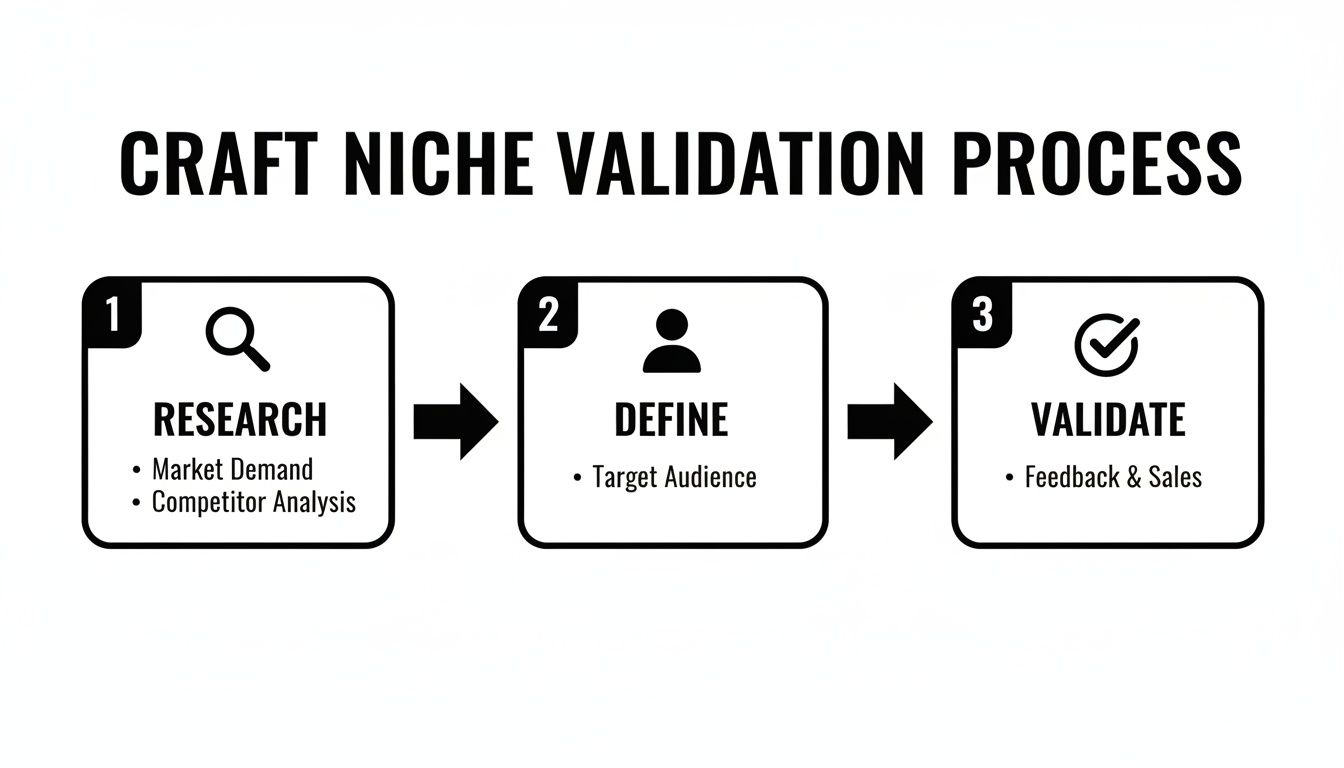
Following this simple workflow ensures you’re building a business on a solid foundation of real customer demand, not just wishful thinking.
Validating Demand with Real Data
Okay, so you have a niche and a customer in mind. Now it's time to confirm that people will actually pull out their wallets for it. Please, don't skip this step! It’s what separates a hobby from a viable business.
A classic mistake is creating a product and then desperately searching for a market. The successful approach is to find a hungry market first and then create the perfect product to serve it.
Start your detective work on popular marketplaces. Head over to Etsy, Amazon Handmade, and Pinterest and just start searching. Type in keywords related to your idea and see what pops up.
Look for items with a "Bestseller" tag. How many reviews do top products have? What styles seem to be trending? This is free, real-time market research right at your fingertips.
For more inspiration on what's hot right now, check out our guide on small business craft ideas. It might just spark a new angle or a fresh take for your own niche.
Use the checklist below to systematically evaluate your idea's potential before you invest too much time or money.
Craft Niche Idea Validation Checklist
| Validation Step | Key Question to Answer | Example Action |
|---|---|---|
| Marketplace Research | Is this already selling? Who are the top sellers? | Search Etsy for "custom pet portraits" and analyze the top 5 listings for pricing, style, and reviews. |
| Keyword Analysis | Are people actively searching for this online? | Use a free tool like Google Trends to compare search interest for "macrame plant hanger" vs. "crochet wall art." |
| Social Media Listening | Where does my ideal customer hang out and what do they talk about? | Join Facebook groups for "dungeon masters" or "book club enthusiasts" and observe their gift-giving discussions. |
| Profitability Check | Can I source materials and price this to make a healthy profit? | Calculate the cost of a blank tote bag, DTF transfer, and packaging vs. the average selling price on Amazon. |
| Uniqueness Factor | How can I stand out? What's my unique angle? | Instead of generic wedding signs, specialize in signs with a modern, minimalist aesthetic for non-traditional couples. |
Walking through these questions helps you move from "I think this is a good idea" to "I know this is a good idea," giving you the confidence to move forward.
Choosing Your Products and Smart Production Methods

Okay, you've zeroed in on a niche that actually has paying customers. Now for the fun part: deciding what you’re going to make and, just as crucial, how you're going to make it. This is where your abstract idea starts to become a real, tangible product.
Your production method is a big deal—it dictates your startup costs, how easily you can grow, and the final quality of your items. You could go the 100% handmade route, which gives you that unique, artisanal charm people love. The only catch? It's incredibly time-consuming and can be a real headache to scale up when orders start rolling in.
The alternative is to lean on modern tech to create professional-grade goods from your home, often with a surprisingly small investment.
Smart Production for the Modern Crafter
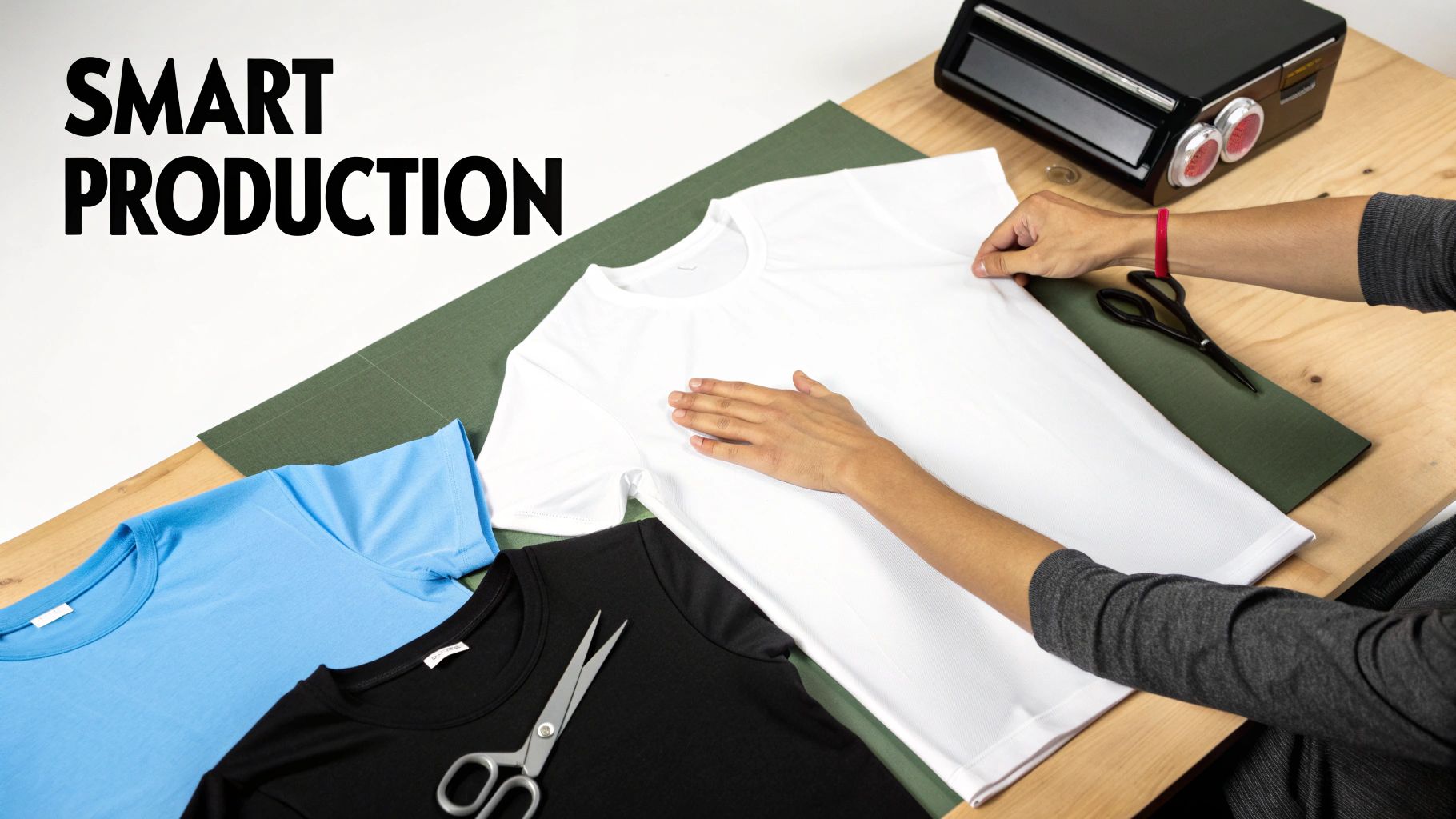
Let's be honest. Most of us starting out don't have a garage big enough (or a budget deep enough) for bulky equipment like screen printing carousels or industrial embroidery machines. This is where smart, accessible production methods change the game entirely.
Services that specialize in high-quality transfers, like Direct-to-Film (DTF) and UV-DTF, are the perfect bridge. They let you produce premium, durable, and vibrant designs without ever owning the expensive machinery yourself. You get access to top-tier quality on a simple, pay-as-you-go basis.
Think about what this means for a home-based business:
- No Massive Upfront Costs: You’re not sinking thousands into equipment that might just collect dust. You order exactly what you need, when you need it.
- Space Efficiency: Forget a dedicated workshop. All you really need is a quality heat press, which can easily fit into a spare room or a corner of your office.
- Professional Quality from Day One: Your products will look just as good as those from established brands, with crisp details and colors that truly pop.
The Power of DTF and UV-DTF Transfers
Once you understand what these technologies can do, you'll see the potential. DTF transfers are your go-to for fabrics—cotton, polyester, blends, even tricky materials like leather. You apply them with a heat press, and the result is a design with a soft feel, amazing stretch, and fantastic durability in the wash.
UV-DTF transfers, on the other hand, are for hard surfaces. Think of them as high-tech, permanent decals you can apply to glass, metal, wood, plastic, and ceramics—no heat required. This alone opens up a massive world of product possibilities beyond just apparel.
With transfer technology, you're not just a crafter; you're a product developer. You can test out new designs and product lines with almost zero risk, ordering small batches to see what sells before you commit to a big inventory.
The global handicrafts market is absolutely booming, projected to grow from $739.95 billion in 2024 to over $983.12 billion by 2030. This incredible growth is fueled by people wanting unique, personalized items—exactly what you can create with these versatile printing methods. Check out more stats on the handmade products market growth on amraandelma.com to see the opportunity.
A Real-World Production Scenario
Let's say you want to launch a small merch collection for a local hiking club. Your idea includes cotton t-shirts, canvas tote bags, and branded metal water bottles. Instead of juggling three different production processes, you can knock it all out with transfers.
- Design Consolidation: First, you arrange all the designs for the shirts, bags, and water bottles onto a single gang sheet. This is basically a large transfer sheet where you pack in as many designs as possible to maximize your value and cut down on cost.
- Placing Your Order: You order one DTF gang sheet for the t-shirts and totes (your fabric items) and one UV-DTF gang sheet for the water bottles (your hard goods).
- Production at Home: When the transfers arrive, you use your heat press to apply the DTF designs to the apparel and bags. For the water bottles, you just peel and stick the UV-DTF transfers on. It's that simple.
In a single afternoon, you’ve created an entire product line with consistent, professional-looking branding. This lean, efficient model is the secret to a successful print-on-demand strategy. For a deeper look, check out our complete guide on how to start a print-on-demand business. This is how you keep your operation nimble and profitable right from the start.
Building a Legitimate Business from Your Kitchen Table
Okay, let's talk about the part that often feels like the most intimidating leap: turning your craft from a hobby into an actual, legitimate business. This is where you put on your "business owner" hat, and while it might seem daunting, getting these foundational pieces right from the get-go will save you a world of headaches later.
It all starts with a name. Before you get too attached to that perfect, catchy name you thought of in the shower, do a quick search. You need to make sure another business hasn't already claimed it, especially in your state or on the social media handles you want to use.
Choosing Your Business Structure
Once you've landed on a name, it's time to decide on a legal structure. This sounds way more complicated than it is. For most people starting a craft business from home, it really boils down to two main options.
- Sole Proprietorship: This is the default. If you start selling your work without filing any official paperwork, you're automatically a sole proprietor. It's the simplest path, with no setup fees, and you just report your business income on your personal tax return. Easy.
- Limited Liability Company (LLC): An LLC creates a legal wall between you and your business. What does that mean? If your business ever faces a lawsuit or racks up debt, your personal assets—like your house or car—are generally protected. It does involve some state filing fees and a bit more paperwork, but that protection offers incredible peace of mind.
Honestly, for most new crafters, starting as a sole proprietorship is perfectly fine. You can always switch to an LLC later as your business grows and your income becomes more substantial. The important thing is just to know the difference.
Here's a simple way to think about it: a sole proprietorship is like working from a desk in your bedroom. An LLC is like giving your business its own room with a locked door. Both get the job done, but one provides a much clearer boundary for protection.
Getting Your Finances in Order
I cannot stress this enough: do not mix your personal and business finances. It’s the fastest way to create a bookkeeping nightmare. The single most important financial move you can make right now is to open a separate business bank account.
It doesn't have to be fancy; even a free business checking account will do. This one simple step makes tracking your income and expenses a breeze, lets you see if you're actually profitable, and makes tax season about a million times less stressful.
You don't need expensive software to start, either. A basic spreadsheet is your best friend in the beginning.
| Column | Description | Example |
|---|---|---|
| Date | The date of the transaction. | 10/26/2024 |
| Description | What the income or expense was for. | Order #1001 or "DTF Transfers" |
| Income | Money you received from a sale. | $45.00 |
| Expense | Money you spent on the business. | $19.99 |
| Category | Helps you see where money is going. | "Materials" or "Shipping" |
Something this simple gives you a powerful, at-a-glance snapshot of your business's financial health.
Understanding Your Tax Obligations
Finally, the topic everyone loves: taxes. As a business owner, you're on the hook for paying income tax on your profits and, depending on where you live, collecting sales tax from your customers. The IRS considers your craft venture a business as long as your primary goal is to make a profit.
This means you’ll likely have to pay self-employment taxes, which cover Social Security and Medicare. A smart rule of thumb is to squirrel away 25-30% of your profit in a separate savings account just for taxes. Do this from day one, and you’ll never be caught off guard by a surprise tax bill.
Don't let the "business" stuff scare you away. By tackling these small, manageable steps—picking a name and structure, separating your money, and planning for taxes—you’re building a solid foundation. This is what allows your kitchen table idea to grow into a real, sustainable business.
Pricing Your Crafts for Profit, Not Just for Parts
One of the fastest ways to kill the joy in your craft business is to underprice your work. It's an incredibly common mistake, especially when you're just starting out. You love what you make, so you charge just enough to cover the materials. But that's a recipe for burnout, turning your passion into a low-paying job you resent.
Let's not let that happen. Smart pricing isn't about being greedy—it's about respecting your own time, skill, and building a business that can actually last. A solid formula helps you move from simply covering costs to building real profit.
A great starting point is this classic formula: (Material Costs + Labor Costs + Overhead) x 2 = Wholesale Price. Then, you simply take the Wholesale Price x 2 to get your Retail Price. This method ensures you have a healthy profit margin and automatically builds in the room to work with wholesale partners later on without losing your shirt.
Figuring Out Your True Costs
To make that formula work, you have to get brutally honest about every single cost that goes into making and selling your product. It’s so much more than the main components.
- Material Costs: This is everything. The blank t-shirt, the DTF transfer, the mailer bag, the "thank you" card you slip inside, and even the sliver of tape you use to seal the package. Every penny counts, so get granular.
- Labor Costs: How much is your time worth? You need to pay yourself a fair hourly wage—at least minimum wage in your area, but ideally more to reflect your unique skills. Time yourself from start to finish on one item, from prepping the design to boxing it up for shipment.
- Overhead Costs: These are the sneaky, ongoing expenses of being in business. Think about a portion of your internet bill, your design software subscription (like Adobe Creative Cloud), and the transaction fees from platforms like Etsy or Shopify.
Once you have these numbers nailed down, you can plug them into the formula with confidence. The world of custom apparel is a perfect example where this level of detail is critical. For a much deeper dive, our complete guide breaks down exactly how to price custom shirts for maximum profitability.
Don't get caught in a race to the bottom on price. Instead, compete by being the best, offering something truly unique, or providing an unforgettable customer experience. Price yourself accordingly. The right customers will happily pay for quality and true craftsmanship.
Justifying Your Price with a Strong Brand
Setting the right price is only half the battle. You also have to build a brand that makes customers feel like they're getting incredible value for that price. A strong brand identity is what communicates quality before they even add to cart.
Remember, your brand is so much more than just a cool logo. It’s the entire feeling and experience you create for your customers.
- Your Visuals: This is your logo, your chosen color palette, and the fonts you use. Consistency is key here. Using the same visuals across your website, social media, and packaging is how you become memorable.
- Your Voice: How do you speak to your customers? Are you fun and quirky, or more polished and sophisticated? Your tone should feel natural and connect directly with your ideal buyer.
- Your Story: Why did you start making these things? People don't just buy products; they buy from people. Sharing your passion and what makes your work special creates a powerful connection.
Amazing product photography is absolutely non-negotiable. You don't need a high-end DSLR; modern smartphones are more than capable. The trick is to use plenty of natural light, find a clean, uncluttered background, and shoot your products from several different angles. Showing your item in use is a pro move—it helps customers imagine it in their own lives.
It's also crucial to remember that getting the product to the customer is a real cost. Learning how to calculate shipping charges accurately is essential for protecting your profit margins.
Finally, write product descriptions that truly sell. Don't just list the specs; tell a story. Instead of saying "100% cotton t-shirt," try something like, "Wrap yourself in the cloud-like comfort of this buttery-soft 100% ringspun cotton tee, your new go-to for weekend adventures." You want to evoke emotion and paint a picture. This powerful combination of strategic pricing and compelling branding is what turns casual browsers into loyal fans.
You’ve perfected your products and polished your brand. Now for the exciting part—it's time to open your doors and officially launch. This moment can feel overwhelming, but finding those first customers isn't about having a huge marketing budget. It’s all about smart, focused effort and connecting with people who will love what you create.
The first big decision is where your "storefront" will live. Where will you actually sell your crafts? There’s no single right answer here. The best choice really hinges on your goals, how comfortable you are with technology, and how much control you want over your brand's experience.
Choosing Your Sales Channel
For most new crafters, it boils down to two main paths: jumping into an established marketplace or building your own website. Each has some serious pros and cons for someone just starting out from home.
-
Marketplaces like Etsy: Think of Etsy as a massive, bustling craft fair that’s open 24/7. The biggest draw is its built-in audience of over 80 million active buyers who are already looking for handmade goods. Getting a shop live is incredibly fast—you can do it in an afternoon. The trade-off? You're a small fish in a giant pond, competing with thousands of others, and you have very little control over your shop’s branding and design.
-
Your Own Website (e.g., Shopify): This is your digital home base. You have total control over the look, feel, and customer experience. It’s the best way to let your brand’s personality shine, and you never have to compete with another seller on the same page. The catch, and it's a big one, is that you are responsible for bringing in 100% of your own traffic. Building that audience from scratch takes serious time and dedication.
A great hybrid approach is to start on Etsy to get some early sales and visibility from its built-in traffic. At the same time, build a simple website that tells your brand story and acts as a portfolio. You can then direct people from your social media to your website to learn more about you, with a clear button that sends them to your Etsy shop to complete a purchase.
Marketing That Actually Works for Crafters
Once your shop is live, you have to get eyeballs on your products. For visual crafts, there are no better tools than Instagram and Pinterest. These platforms are less about the hard sell and more about sparking inspiration and telling a story.
Use high-quality photos and videos to show your process. People are fascinated by the "how-it's-made" journey—it builds a genuine connection and makes them feel invested in your work. Showcase your finished products in beautiful, well-lit settings that help customers instantly imagine them in their own homes.
Don't just post a picture of your product with the price. Tell the story behind it. Was it inspired by a walk in the woods? Did a customer request spark a whole new idea? People buy from people, and your story is what makes your brand impossible to duplicate.
Engage with every comment, run polls in your stories, and ask your followers questions. This isn't just about chasing a sale; it's about building a community of people who are genuinely excited about what you do. This loyal following will become your most powerful marketing asset, hands down.
Building Relationships to Grow Your Reach
As you start to gain some momentum, think about how you can expand beyond your own followers. Collaborating with other creators or influencers in your niche can be a game-changer, introducing your brand to a whole new, perfectly targeted audience. To find the right partners and manage those campaigns effectively, you might even consider using influencer outreach services to really amplify your efforts.
Another incredibly powerful tool that's often overlooked is email marketing. Start collecting email addresses from day one. A simple pop-up on your site offering a small discount on a first purchase is a fantastic way to do this.
Even a simple monthly newsletter can work wonders. Use it to:
- Announce new product launches to your list before anyone else.
- Offer exclusive discounts just for your subscribers.
- Share personal stories about your brand and your creative process.
Unlike social media, you own your email list. It’s a direct line to your most engaged customers, completely unaffected by unpredictable algorithm changes. Nurturing this list is how you turn one-time buyers into repeat customers and passionate fans who will champion your brand for years to come.
Common Questions When Starting a Craft Business

As you stand on the edge of this exciting new venture, it's totally normal for a flood of questions to pop into your head. Getting a home-based craft business off the ground can sometimes feel like trying to assemble complicated furniture with a one-page, text-only manual.
Let's clear up some of the most common uncertainties I see new crafters face. Think of this as a practical chat to help you move forward with clarity, tackling those early hurdles one by one.
How Much Money Do I Really Need to Start?
This is the big question, isn't it? The good news is, the answer is usually much smaller than people think. Your startup costs are tied directly to how complex your craft is and how you decide to make your products.
One of the smartest ways to keep those initial costs down is to sidestep buying expensive, specialized equipment right away. For example, instead of a pricey direct-to-garment printer, you can partner with a service for DTF transfers for apparel or UV-DTF for hard goods. This lets you produce professional-quality items with just a heat press, which is a far more manageable first investment.
A lean startup budget might look something like this:
- Business Registration: This can be as low as $0 if you start as a sole proprietorship. An LLC might cost a few hundred dollars, depending on your state.
- Basic Supplies: Order a small batch of blank items (like t-shirts or mugs) and your first set of custom transfers. You can easily get started for under $200.
- Shipping Materials: A starter pack of mailers, tape, and a small shipping scale can be had for around $50.
- Website/Platform Fees: An Etsy shop has listing fees of just cents per item, while a basic Shopify plan starts at around $30 per month.
You really don't need thousands of dollars. By making smart, strategic choices, you can get your business off the ground with a few hundred dollars.
Do I Need a Business License Right Away?
The classic, and sometimes frustrating, answer here is "it depends." The rules for business licenses and permits are set at the state, county, and even city level. What's required in Austin, Texas, is going to be different from what's needed in Portland, Maine.
For most people selling online from home as a sole proprietor, you may not need a specific license immediately to get started. However, you absolutely need to check your local government's website for rules on a "home occupation permit" or a general business license.
Your best first step is to visit your city or county's official website and search for "starting a home-based business." This will give you the most accurate local information and help you avoid any potential fines. It’s a little bit of research that provides huge peace of mind.
Also, you will almost certainly need a seller's permit or sales tax ID if your state collects sales tax. This is usually free to register for and is what allows you to legally collect sales tax from customers in your state.
How Do I Manage My Time with Another Job?
Juggling a full-time job while building your craft business is a marathon, not a sprint. The key to avoiding burnout is to be incredibly intentional with your time and realistic with your goals. Success isn't about working 18-hour days; it's about making your limited hours count.
Start by blocking out specific, non-negotiable "business hours" in your weekly calendar. Maybe it's two hours every Tuesday and Thursday evening and a four-hour block on Saturday morning. You have to treat these appointments with yourself as seriously as you would a meeting with your boss.
To get the most out of this time, batch your tasks together:
- Production Day: Dedicate one block of time only to making your products. Press all your shirts, apply all your decals, and get your inventory ready.
- Shipping Day: Fulfill and package all your orders from the past few days at once. This is so much more efficient than packing orders as they come in.
- Marketing & Admin: Use another session to schedule all your social media posts for the week, answer emails, and update your books.
This structured approach keeps you from constantly switching gears, which can be incredibly draining.
Can I Really Make a Full-Time Income?
Yes, you absolutely can. But it requires a shift in mindset from being a hobbyist to becoming a business owner. A successful craft business is built on more than just beautiful products; it's built on solid profitability, smart marketing, and scalable systems.
Your ability to go full-time really hinges on a few key things:
- Profitable Pricing: You have to price your items to cover all your costs, pay yourself a fair wage for your time, and still have a healthy profit margin to reinvest in the business.
- Scalable Production: Your creation process has to be efficient. Using methods like DTF transfers allows you to make more products in less time, which directly increases your earning potential without requiring more hours from you.
- Consistent Marketing: You need a repeatable system for finding new customers, whether that's through social media, email marketing, or another channel that works for you.
So many successful entrepreneurs started their journey exactly where you are now—at the kitchen table, after the kids are in bed, with a big dream and a small budget. By asking the right questions and focusing on smart, sustainable growth, you can turn that dream into your full-time reality.
Ready to create stunning, professional-quality products from home without the massive upfront cost? At Raccoon Transfers, we provide premium DTF and UV-DTF transfers that make it easy. Get started today at Raccoon Transfers.