
Your Guide to Selling Shirts on Etsy
So, you've decided to jump into the world of selling t-shirts on Etsy. It's a fantastic way to transform your creative sparks into a real business, but success starts with a solid plan. You'll need to figure out how you're going to make your shirts, pinpoint a unique niche, and get your shop set up to attract the right kind of attention. The real secret is striking the right balance between your awesome designs and a savvy business strategy from day one.
Building Your Etsy T-Shirt Shop Foundation

Before you even think about your first design, laying the right groundwork is critical. Let's be honest, the t-shirt market on Etsy is huge and competitive. But it's also incredibly resilient because shoppers come here for unique, custom, and niche apparel they just can't find anywhere else.
That built-in demand for originality is your biggest asset. We've seen some major shifts in Etsy's apparel category, with vintage-inspired and personalized designs driving huge sales. What does that tell us? Buyers are actively looking for shirts with personality—things that feel nostalgic, special, or made just for them—instead of another mass-produced tee. You can dive deeper into these trends with insights on best-selling Etsy shirts from Accio.com.
Choosing Your Production Method
Your first big decision is how you'll actually make your shirts. This choice ripples through your entire business, affecting everything from your startup costs and profit margins to your daily workflow and the quality of what you sell.
You've got two main roads to go down:
- Print-on-Demand (POD): This is the hands-off route. You sync your Etsy shop with a service like Printful or Printify. When an order comes in, they print, pack, and ship the shirt directly to your customer. You never touch the inventory.
- Self-Pressing with DTF Transfers: This is the hands-on approach. You source your own blank tees, order high-quality Direct-to-Film (DTF) transfers of your designs (that's where we come in!), and press them yourself with a heat press.
Let's break down how these two methods stack up.
Production Method Comparison POD vs Self-Pressing DTF
Choosing between Print-on-Demand and self-pressing with DTF transfers is one of the most important decisions you'll make for your t-shirt shop. Each path offers distinct advantages and trade-offs that cater to different business goals, budgets, and levels of involvement. This table compares them side-by-side to help you figure out which is the right fit for you.
| Feature | Print-on-Demand (POD) | Self-Pressing with DTF Transfers |
|---|---|---|
| Upfront Cost | Very low to none. No need to buy equipment or inventory. | Moderate. Requires a heat press and an initial stock of blank shirts & transfers. |
| Profit Margins | Lower. The POD company takes a significant cut for production and shipping. | Higher. You control costs, leading to better per-shirt profit. |
| Quality Control | Limited. You rely on the POD provider's standards and can't inspect each item. | Total control. You inspect every shirt and transfer, ensuring top-notch quality. |
| Inventory | None. Products are created only when an order is placed. | Required. You need to manage a stock of blank apparel and transfers. |
| Shipping & Fulfillment | Handled by the POD provider. Completely hands-off for you. | You handle all packaging and shipping, which adds to your workload. |
| Flexibility | Limited to the POD company's catalog of apparel and print locations. | High. You can source any blank you want and place designs anywhere. |
While POD is tempting for its low barrier to entry, self-pressing gives you complete command over your product's quality and, in the long run, often leads to much healthier profit margins. For a deeper dive into the POD model, check out our guide on how to start a print-on-demand business.
Finding a Profitable and Passionate Niche
To win on Etsy, you absolutely must stand out. Generic shirts with tired phrases get lost in the noise. The magic happens when you find a specific niche that you're genuinely into and that has an audience hungry for products.
So, don't just think "funny shirts." Drill down.
Instead of targeting "dog lovers," what about "Corgi moms who love hiking"? Or "owners of sassy rescue greyhounds"? Getting that specific makes your designs instantly relatable and your marketing a whole lot easier.
Your niche is your superpower on Etsy. It's what separates you from the thousands of other shops and connects you directly with a loyal, enthusiastic customer base that feels like you're speaking just to them.
Setting Up Your Shop for Success
Alright, you’ve picked your production method and nailed down your niche. Now it's time to build your digital storefront. This isn't just about uploading a few listings; it's about crafting a cohesive brand that makes people trust you and want to buy from you.
Here’s your initial setup checklist:
- A Memorable Shop Name: Make it unique, easy to spell, and a reflection of your niche or brand vibe.
- A Professional Brand Identity: Get a simple logo, a sharp-looking shop banner, and a profile picture. It doesn’t have to be fancy, just polished.
- Clear Shop Policies: Don't skip this! Fill out your return, exchange, and shipping policies. Being upfront prevents headaches for both you and your customers.
- A Compelling "About" Section: Tell your story. Why did you start this shop? What gets you excited about your designs? This personal touch helps shoppers connect with the human behind the brand, turning a simple purchase into a real experience.
Developing T-Shirt Designs That Actually Sell

Let's be honest: a killer design is the lifeblood of any t-shirt shop. It’s that visual hook that stops a scroller mid-swipe and makes them think, "I have to have that." But creating designs that actually sell is more than just artistic flair—it’s about smart, research-backed strategy.
The real magic happens when you find that sweet spot between what you love to create and what people are desperately searching for. Think of the Etsy search bar as your new best friend. Start typing in broad terms in your niche, like "retro floral shirt," and watch the autocomplete suggestions. Those aren't just random phrases; they're the exact words real shoppers are using.
This simple exercise helps you start speaking your customers' language. It's the difference between a generic "cat shirt" and a "whimsical black cat tarot card shirt"—a long-tail keyword that targets a specific, motivated buyer who is far more likely to click "add to cart."
Finding Your Design Inspiration
With a general direction in mind, it's time to go deeper. Inspiration is everywhere, but for a t-shirt business, you need to look for profitable ideas. Don't just guess what might be popular; use data and observation to guide your creative process.
- Snoop on the Competition: Check out the best-selling shops in your niche. What styles, themes, and colors keep popping up? You’re not looking to copy, but to analyze. What makes their designs work? Is it the witty text, the unique art style, or the super-specific sub-niche they're cornering?
- Listen to Social Media: Platforms like Pinterest, TikTok, and Instagram are trend-making machines. Search hashtags related to your niche (think #booktok, #darkacademia, or #cottagecore) and see what aesthetics, quotes, and images are blowing up. These trends often translate perfectly to t-shirt designs.
Certain niches and specific designs can see absolutely explosive growth on Etsy. We're talking growth rates that can exceed 9,600%. This is often sparked by pop culture moments, celebrity trends, and good old-fashioned nostalgia. For a real-world example, you can learn in this video analysis how a trending personality can cause a massive spike in related merchandise sales.
From Idea to Flawless Print File
Now for the technical side. Bringing your vision to life means creating a print file that's ready for production. Whether you're a pro in Adobe Illustrator or using a beginner-friendly tool like Canva, the final output has to be perfect. A blurry, poorly formatted design leads to a shoddy print, which leads to an unhappy customer. No one wants that.
Your print files need to be spot-on to get that crisp, vibrant look you’re after. Here’s what you absolutely must get right:
- High Resolution: Always design in 300 DPI (dots per inch). This is the gold standard for quality printing and is your best defense against a pixelated, amateurish-looking final product.
- The Right File Type: Save your final design as a transparent PNG. This is crucial. It preserves quality and gets rid of that ugly white box around your design when it's printed on a colored tee.
- Size It Right: The physical dimensions of your design file matter. A small graphic for a left-chest placement is obviously going to be sized differently than a huge full-back design. If you're unsure, we've got a complete guide on finding the best graphic size for a t-shirt.
Staying Original and Legally Safe
As you get into the creative groove, it can be tempting to use popular characters, song lyrics, or brand logos. Don't do it. Seriously. It's the fastest way to get your listings yanked or your entire shop shut down. Understanding the basics of intellectual property isn't just a suggestion—it's essential for building a business that lasts.
Before you go too far, make sure you understand what intellectual property protection entails. It'll help you protect your own work and stay out of trouble.
Focus on creating 100% original artwork or using elements you have a proper commercial license for. This keeps you legally safe and, more importantly, helps you build a unique brand that customers will remember. In a crowded marketplace, your originality is your biggest advantage.
Crafting Etsy Listings That Get Found and Convert
Having a killer t-shirt design is a great start, but it's only half the battle on Etsy. If shoppers can't find your products, they can't buy them. This is where you need to get good at playing the Etsy search game—it's what turns your creative spark into actual, consistent sales.
Don't think of Etsy SEO as some dry, technical chore. It's really just about building a bridge between your design and the exact person who's going to love it. The first step is to get inside their head. What words are they actually typing into that search bar? I guarantee it’s not just "cool shirt."
They're using what we call long-tail keywords—these are longer, more specific phrases that tell you exactly what they're looking for. Someone might search for a "minimalist wildflower crewneck sweatshirt" or a "retro groovy bachelorette party shirt." These phrases are pure gold, and your job is to dig them up.
Uncovering High-Intent Keywords
Your keyword research always starts with a good old-fashioned brainstorm. Jot down broad terms related to your niche, then start getting more and more specific. A great trick is to just start typing in Etsy's search bar and see what autocomplete suggestions pop up. Those aren't guesses; they're what real people are searching for right now.
Next, do a little friendly snooping on your competition. Take a hard look at the titles and tags on their best-selling items. You’re not there to copy them, but to spot the patterns. See what keywords are clearly working for others in your space.
-
Titles: Your title is your most valuable piece of SEO real estate. You have to lead with your strongest, most descriptive keywords. A title like "Funny Graphic Tee" is basically invisible. But a title like "Sarcastic Skeleton Coffee Shirt, Dark Humor Goth Tee, Funny Skull Graphic Top" is a powerhouse because it hits multiple different search queries.
-
Tags: Etsy gives you 13 tags. Use every single one. Mix it up with a few broad keywords and a bunch of very specific long-tail ones. Think of each tag as another fishing line in the water. If you've got a shirt with a corgi on a mountain, your tags should include things like "corgi mom gift," "hiking dog shirt," "cute corgi apparel," and "outdoorsy pet lover tee."
-
Attributes: This is the section so many sellers skip, and it's a huge mistake. Details like sleeve length, neckline style, color, and fit are all filters that shoppers use to narrow down their search. Filling these out is one of the easiest ways to get your listing in front of more qualified buyers.
Writing Descriptions That Persuade
Okay, so your SEO did its job and someone clicked. Awesome! Now it's up to your photos and your product description to close the sale. A description needs to do more than just spit out facts; it has to tell a story and make the shopper want the shirt.
Paint a picture for them. Where will they wear it? How will it make them feel? You also need to answer their questions before they even think to ask them. Be upfront about the fabric blend, how soft it is, the printing method you use, and always, always include a clear, easy-to-read size chart with actual measurements.
The Etsy marketplace is more packed than ever. While the number of sellers has changed, overall revenue keeps climbing, which means the competition is fierce. To win, your listings can't just attract clicks—they have to convert. You can discover more insights about the competitive Etsy environment at Thunderbit.com.
Creating Irresistible Mockups
Since a customer can’t reach through the screen and feel the fabric, your photos have to do all the work. For anyone serious about selling t-shirts on Etsy, high-quality mockups are completely non-negotiable. They are what help a shopper imagine what that shirt will look and feel like in their own life.
Use mockups that speak directly to your target customer. If you’re selling edgy streetwear, your models and backgrounds should have an urban vibe. If your designs are more cozy and cottagecore, find mockups that feel warm and rustic.
It’s always a good idea to have a clean, flat-lay image that shows the design clearly. But you absolutely need several lifestyle mockups with people actually wearing the shirt. This gives the product context and helps build that crucial emotional connection. Getting these visuals right is so important, and good lighting is a huge piece of the puzzle. We put together a whole guide on how to build a product photography lighting setup that will give you professional-looking shots every time.
Nailing Your Production and Shipping Workflow
Okay, you've got killer designs and your Etsy listings are looking sharp. Now comes the real work: turning those digital files into physical t-shirts that land on your customers' doorsteps. This is where the rubber meets the road. Getting your production and shipping process ironed out (pun intended) is what separates the hobbyists from the pros. A smooth workflow is the engine of your business—get it right, and you'll ship orders effortlessly and build a reputation for being a reliable, high-quality shop.
This infographic breaks down the journey from idea to sale. Notice how it flows from research and optimization right into converting shoppers into buyers.
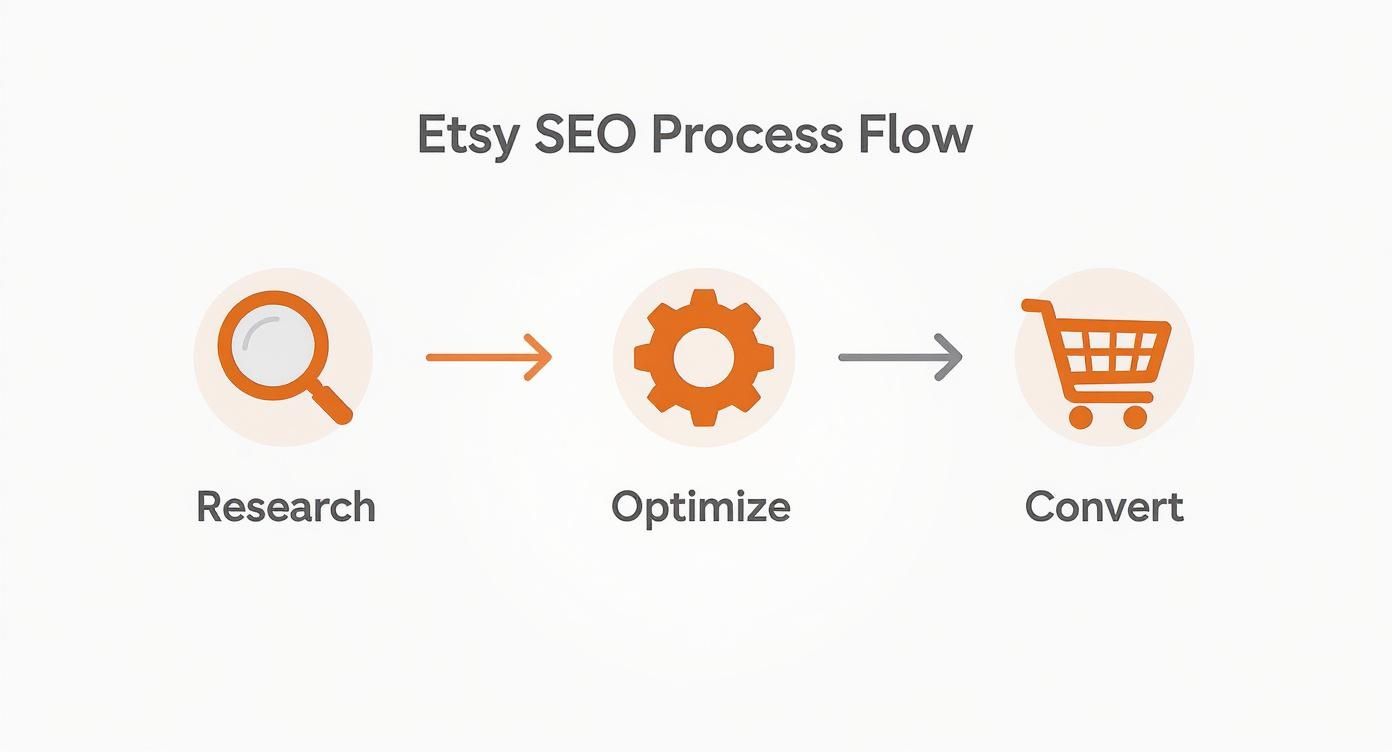
That final step—the conversion—hinges entirely on your ability to produce and ship a great product. It’s the critical final piece that turns a good listing into a happy customer.
The DTF Transfer Production Process
Using Direct-to-Film (DTF) transfers is an absolute game-changer, especially when you're starting out. You get that vibrant, professional look of screen printing without the messy, complicated setup. The concept is simple: you order your designs as pre-made transfers and then press them onto blank shirts yourself.
The most important decision you'll make here is choosing your transfer supplier. Don't cheap out. A bad transfer will crack, peel, and fade after one wash, torpedoing your reviews and your shop's reputation. Find a trusted supplier like Raccoon Transfers known for producing durable, wash-resistant prints that look amazing.
Once you have your transfers and blank shirts, your heat press takes center stage. This isn't just a big iron; a heat press delivers the precise temperature and even pressure needed to permanently fuse the transfer's adhesive into the fabric. This is the non-negotiable step for a professional, retail-quality finish that actually lasts.
Essential Equipment and Supplies
You don't need a factory-sized space to get started, but you do need a few key pieces of equipment. Getting your production station organized from day one will save you a ton of stress and time, especially when you get that first big rush of orders.
Here’s a quick checklist of what you'll need on hand:
- A Reliable Heat Press: This is your MVP. A 15x15 inch clamshell or swing-away press is a fantastic, versatile starting point for almost any t-shirt size.
- High-Quality Blank T-Shirts: Find a brand and style you love that fits your shop's vibe. Always, always order samples first to test for softness, fit, and how they perform with your DTF transfers.
- DTF Transfers: It’s a good idea to keep a stash of your best-selling designs ready to go. Ordering multiple designs together on "gang sheets" is a great way to save money.
- Packing Supplies: Stock up on poly mailers, a small shipping scale for accurate weights, and a label printer. Trust me, a label printer will save you an incredible amount of time compared to printing and taping paper.
- Branding Extras: Small touches go a long way. Think about including a branded thank you card, a cool sticker, or even some custom tissue paper. These details create a memorable unboxing experience that gets people talking and coming back for more.
Shipping, Demystified
Shipping can feel like a beast, but Etsy actually makes it pretty straightforward. The secret is setting up your Shipping Profiles correctly from the get-go. A shipping profile is basically a saved template with all your shipping settings—carrier, cost, and processing time.
For instance, you can create one profile for all your domestic orders using USPS First Class Mail and a separate one for international shipping. Then, when you create a new listing, you just pick the right profile from a dropdown menu. No more typing in the same info over and over.
Getting your shipping costs right is absolutely crucial. Did you know that unexpected shipping fees are responsible for 47% of abandoned carts? Weigh one of your fully packaged shirts and use Etsy’s calculated shipping option. This lets you offer precise, fair rates or strategically roll that cost into your item price to offer "free" shipping.
Honestly, the most efficient way to handle this is by buying your shipping labels directly through Etsy. It pulls the customer's address automatically, calculates the postage for you, and marks the order as shipped the moment you print the label. Not only does this save a ton of time, but it also provides immediate tracking info to your customer, which helps keep your seller metrics in good standing.
Pricing, Marketing, and Scaling Your T-Shirt Business
You've got your designs live and a solid production process in place. Now comes the fun part: making money and growing your shop. Getting these next steps right is what separates a side hustle from a real, sustainable business. It all starts with pricing your shirts correctly.
Pricing isn't about guesswork. If you price too low, you'll be working around the clock for peanuts. If you price too high, you might scare away buyers. The goal is to find that sweet spot that covers every single cost, pays you for your time, and leaves you with a healthy profit.
Calculating Your True Costs for Profit
To nail your pricing, you have to know exactly what it costs to produce and sell a single t-shirt. So many new sellers just add the cost of the blank shirt and the transfer, but that's a fast track to losing money.
Let’s break down what really goes into your final cost:
- Cost of Goods Sold (COGS): This is the obvious stuff. It’s your blank t-shirt, the DTF transfer from Raccoon Transfers, and your packing supplies—think poly mailers, thank you cards, or little extras.
- Etsy Fees: These can sneak up on you. A good rule of thumb is to set aside 10-15% of your total sale price (including shipping!) to cover everything from the listing fee to transaction and payment processing fees.
- Your Time: Don't work for free! Seriously. Assign yourself a realistic hourly wage for the time it takes to press a shirt, pack it up, and manage the order. Even if it's just a couple of dollars per shirt, it validates your work.
A Real-World Pricing Example:
Let’s say your costs are: Blank Tee ($4) + DTF Transfer ($3) + Packing Supplies ($0.50) + Estimated Etsy Fees ($3) + Your Labor ($2) = $12.50 Total Cost.If you sell that shirt for $25, your profit is $12.50. That’s a 50% profit margin, which is a fantastic target to aim for.
Getting Your Shirts in Front of Buyers
With your prices locked in, it’s time to bring in the customers. Etsy search is a great start, but you can't rely on it alone. Getting proactive with your marketing is how you really start to see the sales notifications roll in.
Two platforms are absolute gold for visual products like t-shirts:
- Pinterest: Think of Pinterest as a visual search engine, not just social media. Create eye-catching Pins using your best lifestyle mockups. Link them straight to your Etsy listings and pack the descriptions with keywords people are actually searching for, like "vintage floral sweatshirt" or "funny book lover t-shirt." One great Pin can send you traffic for months on end.
- Instagram & TikTok: Video is king here. Reels and short clips are perfect for showing off your t-shirts. Film a behind-the-scenes of you packing an order, a satisfying time-lapse of a shirt being pressed, or a quick video showcasing a brand new design. This is how you build a community and let your brand's personality shine.
Once you have a few sales under your belt, you can be strategic with Etsy Ads. Don't just throw money at promoting everything. Find your "winner"—that one design that sells over and over again. Putting a small daily ad budget behind that proven listing is a much smarter way to amplify its success and bring new shoppers into your store.
Smart Ways to Scale Your Shop
"Scaling" is just a fancy word for growing your business without losing your mind. As more orders come in, you'll need a plan to keep up without sacrificing the quality that got you there.
The most natural first step is to expand your product line. If a t-shirt design is a certified bestseller, why not give your customers more ways to buy it?
- Sweatshirts and Hoodies: These are an easy next step. Customers see them as higher-value items, which means better profit margins for you.
- Tote Bags: A fantastic, low-cost way to offer a popular design on a completely different product.
- Stickers: Using UV-DTF transfers, you can create stickers of your best designs. They make for a perfect, easy add-on item to increase your average order value.
As you grow, keeping track of your blank shirt inventory becomes absolutely critical. To effectively scale your T-shirt business, robust operations are essential. Implementing sound inventory management best practices ensures you can track stock, fulfill orders efficiently, and avoid costly overstocking or stockouts. This is non-negotiable once you start adding more sizes, colors, and different apparel types. Eventually, you'll hit a fork in the road where you need to decide: keep pressing every shirt yourself, or look into outsourcing fulfillment to free up your time for what you do best—designing and marketing.
Common Questions We Hear About Selling Shirts on Etsy
Jumping into the world of Etsy t-shirts is exciting, but let's be honest, it brings up a ton of questions. Getting these sorted out from the start is the best way to build your confidence and turn those cool ideas into a real, thriving business.
Let's walk through some of the most common things new sellers ask.
How Much Money Do I Really Need to Start?
This is probably the biggest question on everyone's mind. There's a myth that you need a huge pile of cash to launch a t-shirt shop, but that’s not the whole story. Your actual startup cost really just depends on how you decide to make your shirts.
-
Print-on-Demand (POD): This is your leanest option, requiring almost no startup capital. Since a partner company handles the printing and shipping, you aren't buying blank shirts or equipment. Your only real costs are the $0.20 Etsy listing fee and maybe a subscription for design software. You could realistically get a POD shop off the ground for less than $20.
-
Self-Pressing with DTF Transfers: Going this route means you're more hands-on, which involves a bigger upfront investment but also opens the door to much better profit margins. Your main costs will be a decent heat press (plan for $200 to $500 for a solid starter model), a first batch of blank tees, and your DTF transfers. A realistic budget to get going here is probably somewhere in the $400 to $700 range.
How Do I Avoid Copyright and Trademark Trouble?
Okay, this one is non-negotiable for anyone who wants to build a business that lasts. Getting a listing pulled or your entire shop shut down is a nightmare, and it's completely avoidable.
The golden rule is simple: do not use any intellectual property you didn't create yourself or don't have a commercial license for.
That means no famous movie quotes, no characters from your favorite cartoons, no band logos, and no brand names. It's so tempting to create a design based on a trending TV show, but that's a fast track to getting a nasty infringement notice.
Your creativity is your best asset and your best legal shield. Focus on making 100% original designs. Not only does this keep your shop out of hot water, but it also helps you build a unique brand that people can't get anywhere else. That’s where the real value is.
Before you list anything, just ask yourself: "Did I make this from scratch?" If not, you need to be absolutely certain you have the legal right to sell it.
Is Selling T-Shirts on Etsy Still Profitable?
Absolutely, but you have to be smart about it. The days of throwing up a generic design and watching the sales roll in are over. The global custom t-shirt market is expected to hit a staggering $9 billion in 2025, which shows that people are more hungry than ever for unique apparel.
The key to making real money on Etsy today is standing out. You won't win by being the cheapest, so you have to win by being the most original and offering the best quality.
Profitability really boils down to three things:
- Find a Niche: Don't just sell "funny shirts." Sell "funny shirts for tired toddler moms who love coffee." Getting specific is how you find your people.
- Create Killer Designs: Your art has to be original and eye-catching enough to stop someone mid-scroll.
- Offer a Premium Product: If you're pressing your own shirts, use soft, high-quality blanks and durable DTF transfers. A shirt that feels amazing and holds up in the wash is what earns you those glowing 5-star reviews.
What's the Single Most Important Thing for Success?
If I had to pick just one thing, it would be consistency.
Success on Etsy isn't a one-hit-wonder. It’s not about a single design going viral. It's about showing up, day after day, and doing the work.
That means consistently adding new, well-researched designs. It means consistently shipping on time and giving every customer a great experience. And it means consistently putting your products out there, whether on Pinterest, Instagram, or by running a few Etsy Ads.
The Etsy algorithm loves activity. When you're regularly adding listings and making sales, you're telling Etsy that your shop is alive and relevant, which can seriously boost your visibility in search. One great design is a spark, but a consistently managed shop is what builds a real, income-generating business.
Ready to bring your t-shirt designs to life with vibrant, durable, and easy-to-apply transfers? Raccoon Transfers provides premium DTF prints with a rapid 24-hour turnaround, ensuring you can create retail-quality apparel your customers will love. Explore our gang sheet builder and start pressing today.