
The Blank Black Beanie Guide for Custom DTF Apparel
The popular advice is simple: buy any black beanie, press the logo, and move on. That shortcut is responsible for more failed custom merchandise than most decoration mistakes. A blank black beanie is a stretchable, dyed textile surface, and its fiber content, knit density, dye fixation, and heat tolerance all affect whether a DTF transfer looks sharp after application and remains wearable after washing.
For a reliable result, treat the beanie as part of the decoration system rather than as a disposable placeholder. The right product gives you a stable crown, predictable stretch, controlled color migration, and enough comfort for repeated wear. The wrong one can shrink under heat, distort fine artwork, rub black dye onto light clothing, or feel so stiff that customers stop wearing it.
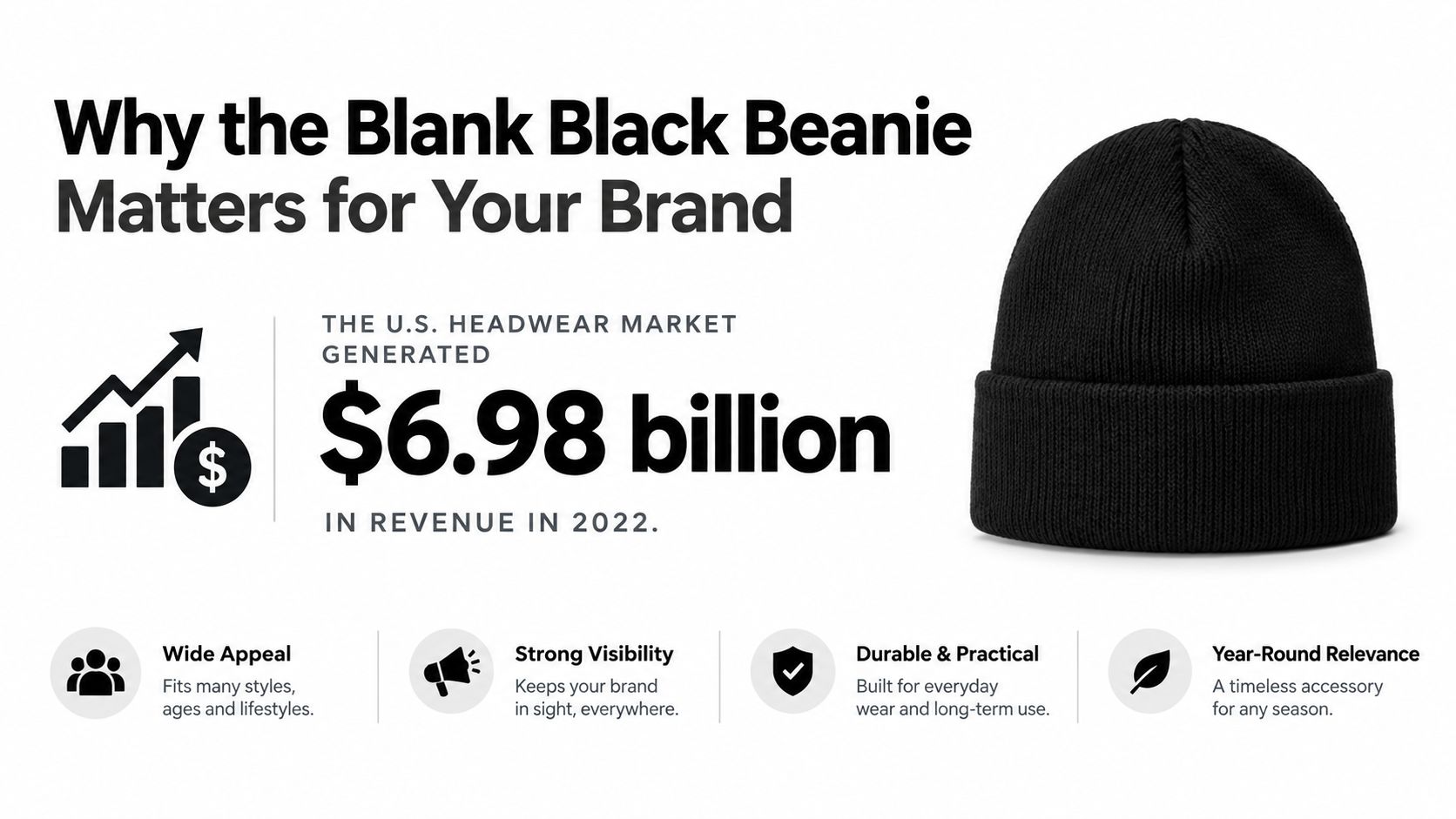
Why the Blank Black Beanie Matters for Your Brand
A black beanie isn't automatically a good decoration blank. The crown may be too ribbed for clean transfer adhesion, the cuff may recover poorly after stretching, or the dye may migrate when moisture and heat enter the process. Before considering the logo, inspect the substrate.
That caution doesn't make the product less attractive commercially. It makes quality control more important because black offers unusual flexibility. A neutral black base works with white graphics, saturated colors, reflective treatments, embroidered marks, woven labels, patches, and understated tonal branding. It can fit workwear, streetwear, school merchandise, outdoor products, promotional campaigns, and seasonal retail without forcing your brand into one visual category.
The broader market provides a useful reason to take the category seriously. The U.S. headwear market generated approximately $6.98 billion in revenue in 2022 and was forecast to reach $11.64 billion by 2030, with an estimated 6.6% compound annual growth rate from 2023 through 2030, according to market data on the U.S. headwear category. That source covers headwear overall, not blank black beanies specifically, so use it as category context rather than a sales forecast for your product.
A useful canvas for several sales channels
The same blank can support different offers:
- Independent apparel brands: Apply a front mark, fold label, or small side design while keeping the hat compatible with different collections.
- Promotional buyers: Use a neutral color that works across uniforms, event apparel, and employee gifts.
- Schools and clubs: Combine a high-contrast mascot or department mark with a practical cold-weather item.
- Creators and retailers: Test multiple graphics on one base style instead of sourcing a new silhouette for every design.
The opportunity also extends beyond a product page. A coordinated gifting campaign can place decorated beanies with creators who already speak to a relevant audience. For a practical overview of how influencer gifting programs work, Linda's Electric Quilters offers useful context on matching products, outreach, and audience fit.
The commercial lesson is straightforward. Black gives you a broad visual starting point, but the blank still has to survive decoration and wear. A scalable program begins with a repeatable substrate, not with the lowest unit cost.
Material Science and Acrylic, Wool, and Polyester for Decoration
Fiber choice changes both how a beanie wears and how it responds to decoration. Acrylic and polyester knits are hydrophobic and typically use disperse dyes applied at high temperatures, while wool uses acid dyes in an acidic bath. Those differences matter once a heat press introduces pressure and controlled heat.
Acrylic as the practical starting point
Acrylic is often the lower-risk option for repeatable custom merchandise, particularly in a cuffed knit with a stable crown. Its fibers and knitted loops trap air, which can provide effective insulation without creating an excessively heavy hand feel. A black acrylic or acrylic-blend beanie also tends to be easier to standardize across a small production run than a delicate premium wool style.
That doesn't mean every acrylic blank behaves identically. Request the fiber percentage, knit weight, stretch recovery, care label, and manufacturer heat limit. A dense knit creates a flatter surface for the transfer, while a loose or unstable knit can make edges rise and fall across the artwork.
Polyester and heat-sensitive decoration decisions
Polyester can offer a stable synthetic base, but synthetic dye behavior deserves attention. DTF application combines heat, pressure, and dwell time, so a manufacturer-approved temperature range is essential. Excessive heat can contribute to glazing, distortion, or dye migration, especially when the blank is dark and the transfer contains white or pale areas.
Use a test piece before production. Check the design immediately after pressing, then inspect it after the beanie has stretched over a form and after laundering according to the care label. The exact press setting should come from the transfer supplier and the beanie manufacturer, not from a generic setting copied from another garment.
Wool belongs in a controlled premium workflow
Wool can support a premium winter product, but it gives you less room for careless heat application. Wool can felt when exposed to excessive heat, and its surface may react differently from a smooth synthetic knit. If wool is part of the product concept, use lower-temperature application where the transfer system permits it, support the crown carefully, and test for both surface distortion and comfort.
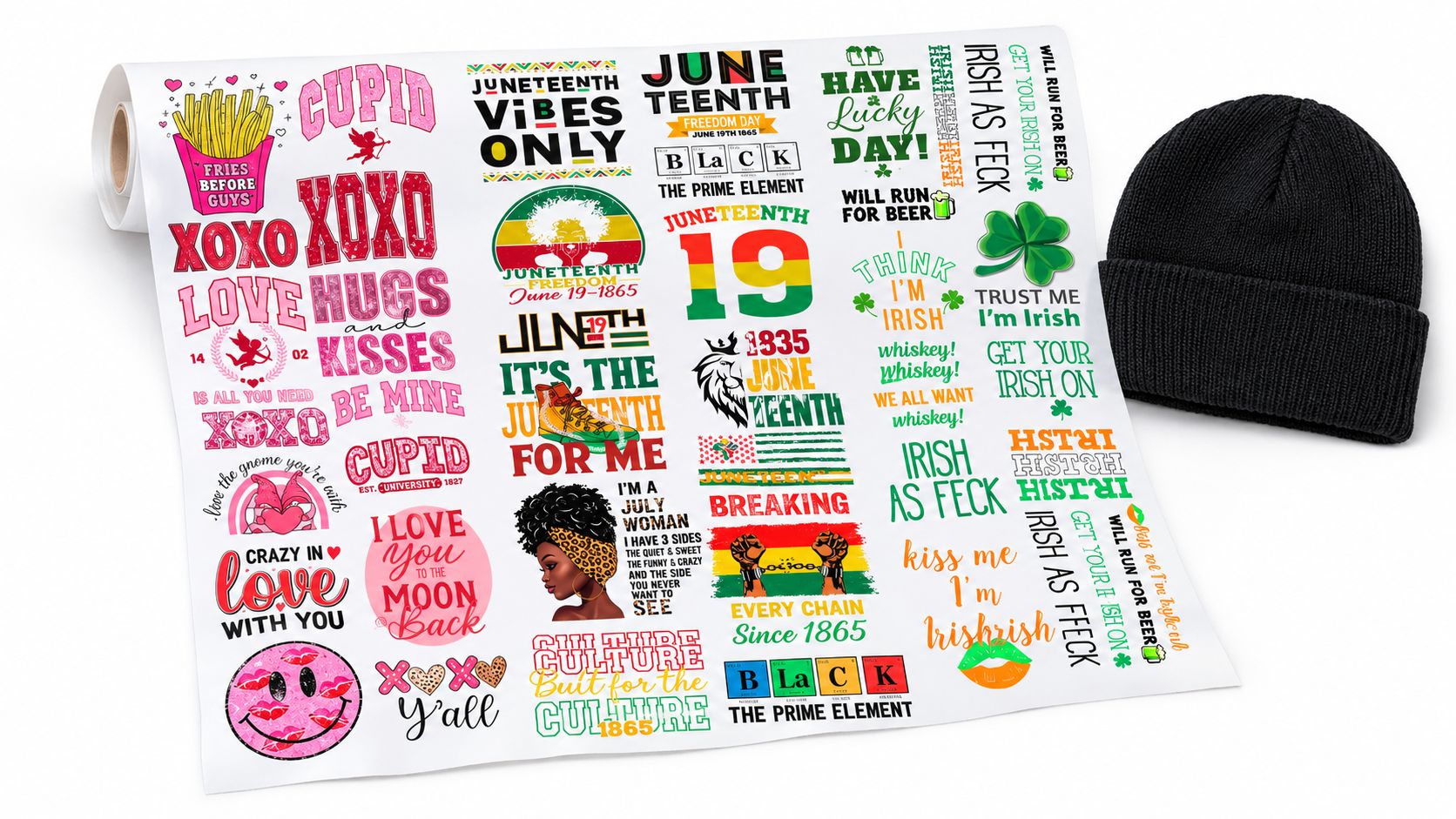
The material compatibility chart is a useful reference when comparing fiber content with a decoration method. For teams that need multiple graphics arranged for one production workflow, Upload Your DTF Gang Sheet can be evaluated as a gang-sheet option, but the finished beanie still requires substrate testing because a transfer designed well on film can fail on an unstable knit.
Production rule: Never approve a fiber blend from its color and appearance alone. Record the composition, press limit, stretch response, and post-wash result for the exact blank you plan to reorder.
Colorfastness and Avoiding Fading and Dye Transfer Disasters
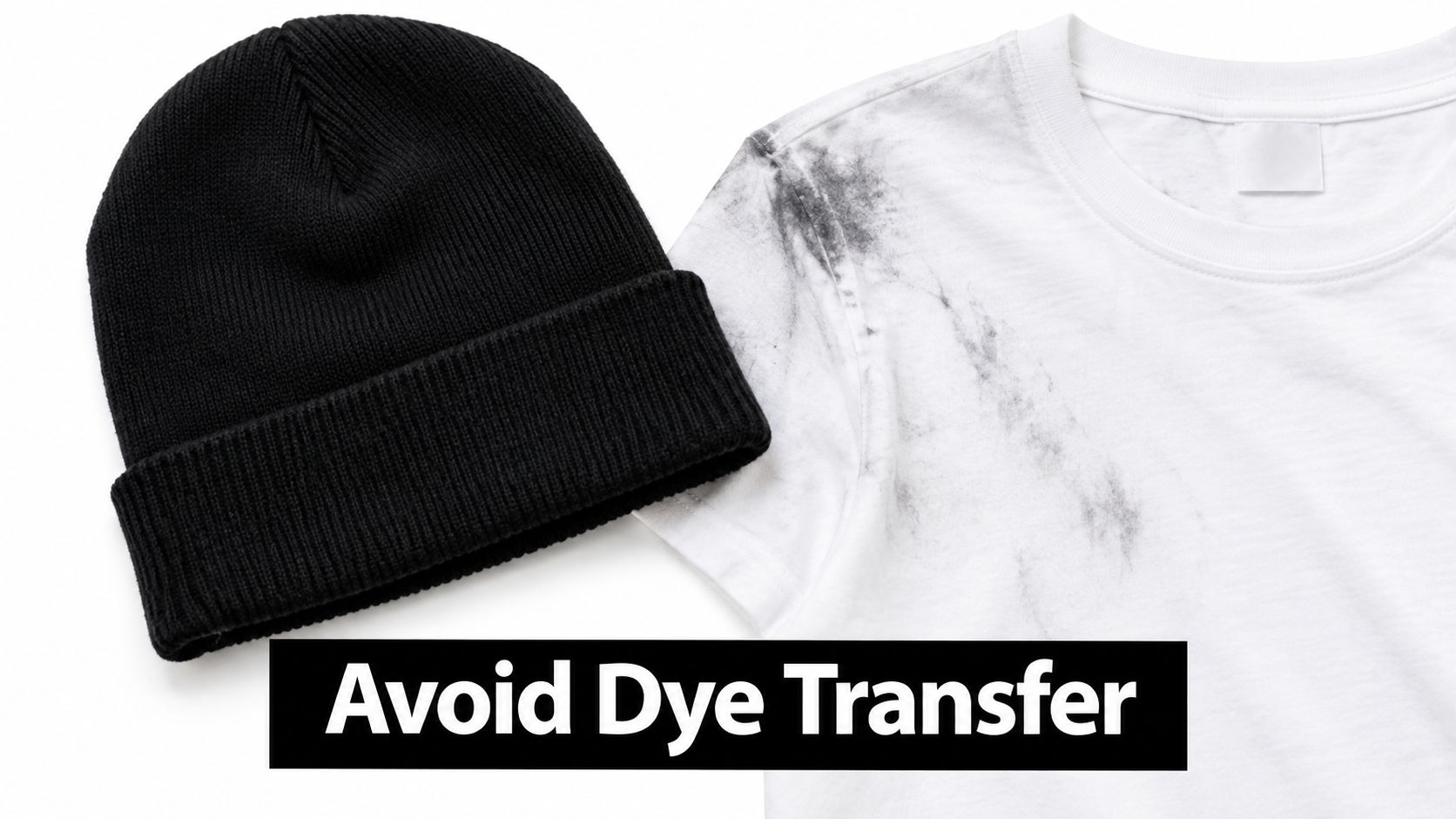
Black exposes weak dye control quickly. A beanie can look perfect under showroom lighting and still rub dark color onto a white shirt, pale skin, light packaging, or a transfer edge. Fading is visible too, but dye transfer often creates the first complaint because it affects another item.
Textile laboratories commonly assess wash fastness with AATCC 61 or ISO 105-C06, and crocking with AATCC 8 or ISO 105-X12. These tests examine color change and the transfer of dye to an adjacent fabric or rubbing cloth. A practical procurement target is a washing and dry-crocking result around Grade 4 or better, while wet crocking should be evaluated separately because moisture can increase color migration. See the colorfastness testing guidance for the relevant testing categories.
A simple incoming-stock check
You don't need a laboratory for the first screening step. Pull a sample from each new blank style or production lot and test the areas customers will touch and stretch.
- Dry rub: Rub the crown and cuff firmly with a clean white cloth. Look for black transfer, especially along raised ribbing.
- Damp rub: Slightly dampen a second white cloth and repeat the test. Moisture can reveal migration that a dry test misses.
- Wash sample: Follow the care label, then inspect the beanie and the white cloth or garment used for the test.
- Repeat inspection: Check the crown, cuff, seams, and any area where the transfer will sit. Compare color uniformity and surface condition.
- Record the result: Keep the blank's fiber content, lot information, care instructions, and observations with the approved sample.
Residual dye and insufficient wash-off can increase crocking risk in deep black shades. A supplier's color statement is useful, but it shouldn't replace your own rubbing and wash checks before decoration.
Protecting the transfer and the customer
Use cool washing, mild detergent, and low mechanical abrasion where the care label permits it. Give buyers clear care instructions through the product page or packaging, and don't promise performance beyond what your sample testing supports. For post-application care, use the DTF washing instructions as a reference, then reconcile those instructions with the beanie manufacturer's label.
DTF Transfer Compatibility with Knit Textures
DTF can reproduce vibrant color and fine detail, but the film isn't the only surface that determines the result. The knit underneath controls how evenly the transfer sits, how the edges flex, and whether the adhesive contacts the high points and valleys of the fabric.
A smooth jersey knit gives the transfer a flatter landing area. A ribbed cuff can work for small, bold marks, but the vertical ridges may create uneven pressure across the design. Cable knits and pronounced textured patterns are more demanding because the transfer can bridge depressions rather than bonding evenly across the entire graphic.
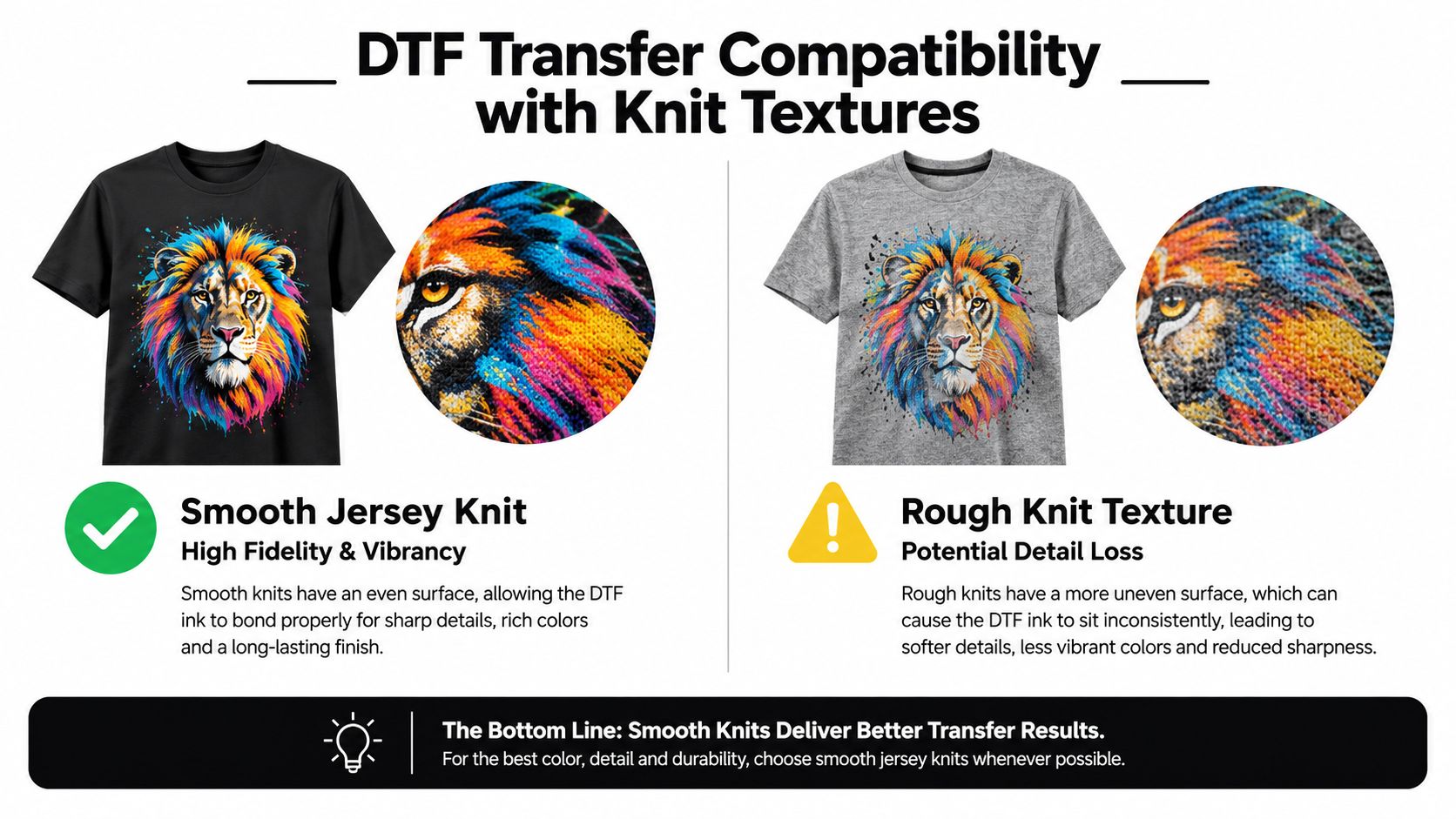
Comparing common knit surfaces
| Knit surface | What usually works | Main risk |
|---|---|---|
| Smooth jersey knit | Detailed artwork, gradients, small lettering | Stretch can still distort a large solid graphic |
| Dense rib knit | Bold icons, short words, compact marks | Edges may follow the ribs unevenly |
| Loose rib knit | Simple patches or labels with controlled attachment | Poor recovery and uneven pressure |
| Cable or heavy texture | Large uncomplicated shapes after testing | Fine details can disappear across raised and recessed areas |
| Cuffed acrylic blend | Repeatable small-batch decoration when the crown is stable | The fold, seam, and cuff tension can affect placement |
For a black acrylic or acrylic-blend cuffed beanie, start on the flattest crown area rather than the folded cuff. Measure the design at actual size, stretch the hat over a form, and inspect how the artwork behaves when the fabric is relaxed and extended. A transfer that looks clean on a flat table may buckle when the customer wears it.
Placement is part of comfort
Avoid bulky decoration directly over a forehead pressure zone or on an interior seam. A soft, lightweight transfer can be comfortable, but placement still matters when the beanie is worn for a long shift or over textured hair. Keep the design clear of rough labels and test the finished item on different head shapes or fitting forms.
Use the heat transfer on hats guide alongside your equipment instructions. The right process depends on the press, the transfer, the blank, and the support method. No guide can remove the need for a sample.
A smooth knit doesn't guarantee success. It gives you a better starting surface, while density, recovery, pressure, and placement determine the finished result.
Pre-Production Checklist for Black Beanie Customization
Black hides some design problems until the transfer is pressed. Low-contrast artwork can disappear, lint can stand out against the surface, and ribbing can make a clean digital proof look uneven in production. Approve the physical sample, not only the screen preview.
Artwork and visibility
Start by photographing or rendering the artwork on a black beanie at its actual intended size. A white underbase or other high-opacity color may be necessary for legibility, but don't assume every pale color will look identical after it meets the knit.
Check these points before cutting or ordering transfers:
- Contrast: View the artwork from normal retail distance and under indoor light. If the design depends on subtle gray or dark color differences, test a brighter version.
- Line weight: Remove excessively fine lines that cross rib valleys. They can lose continuity when the fabric stretches.
- Lettering: Use enough separation between characters for the knit texture and transfer edge to remain readable.
- Color coverage: Test white, high-opacity colors, gradients, and saturated tones separately. Black can make small coverage inconsistencies more visible.
- Shape integrity: Look for sharp corners and narrow openings that may close when the beanie stretches.
Blank and placement tests
Use one blank for a complete application test. Mark the crown center, side seam, cuff fold, and any interior label so the placement can be repeated by another operator.
- Measure the crown: Identify the flattest usable zone and note its width when relaxed and gently stretched.
- Support the knit: Use a hat platen, form, or carefully controlled support that prevents the crown from collapsing during pressing.
- Apply one sample: Follow the transfer supplier's instructions and the blank manufacturer's heat limitations.
- Inspect the bond: Check corners, narrow details, and areas crossing ribs. Look for lifting, trapped texture, glazing, or distortion.
- Test stretch recovery: Expand the beanie over a form, remove it, and inspect whether the graphic or knit stays misshapen.
- Wash and repeat: Launder the sample according to the care label, then check adhesion, color, edge definition, and comfort.
Approve the customer experience
Wear the finished sample for long enough to identify pressure, scratchy seams, or an interior transfer edge. Try it with the intended hairstyle or head covering when the audience includes people with curly or textured hair. A technically durable decoration still fails commercially if the wearer avoids the product.
Document whether the item is intended for one season, repeated winter use, event distribution, or resale. That decision affects how much testing, packaging, and replacement planning the product deserves.
Fit, Sustainability, and Cost Per Wearable Impression
A low blank price can hide an expensive product. Rejected samples, operator time, packaging, unsold inventory, and replacements all affect what each wearable impression costs your business. For a small brand, a beanie that survives use and remains comfortable can create more value than a cheaper item that generates returns.
Fit deserves the same practical attention. Style coverage points to growing interest in more precise, moderate slim-fit proportions rather than universally oversized silhouettes, while a cited marketplace trend report says 66% of Gen Z consumers are willing to pay a premium for sustainable products. Those signals don't tell you which silhouette will sell, but they do support a more careful product decision than choosing the largest or cheapest blank.
Measure the whole product, not one label
Sustainability isn't proven by a single fiber name. Evaluate the relationship among:
- Fiber and construction: Record the material composition, knit density, stretch recovery, and expected service life.
- Decoration lifespan: A blank that lasts longer has greater value only if the transfer remains bonded and legible.
- Care burden: Frequent washing, harsh detergents, and high abrasion can shorten the useful life of the entire product.
- Packaging: Reduce unnecessary packaging while protecting the finished item from lint, moisture, and dye transfer.
- Inventory risk: A neutral base can support several graphics, which may reduce the number of distinct styles you need to carry.
Cost per wearable impression is a decision framework, not a universal formula. Include the blank, transfer, labor, testing, packaging, rejected pieces, expected replacements, and the number of realistic wears your customer will get. A durable product with a slightly higher starting cost can be the sounder choice when it reduces waste and protects trust.
Commercial test: Ask whether the customer will still want to wear the beanie after the first wash, not merely whether it looks good at dispatch.
Choosing the Right Blank Black Beanie for Your Project
Choose the blank by working backward from the finished use. A promotional event, a premium winter collection, a school order, and a craft project may all use black, but they won't demand the same fiber, fit, decoration size, or testing depth.
Match the blank to the project
For repeatable small-batch DTF work, start with a dense acrylic or acrylic-blend crown, a stable cuff, and enough flat area for the artwork. This combination usually gives you a more manageable surface than a loose, highly textured knit. If the product is positioned as a premium winter item, wool may be appropriate, but only when you can control heat exposure and validate the result with samples.
Use this decision path:
- Define the wear context: Identify whether the beanie is for daily workwear, casual retail, a seasonal gift, an event, or personal use.
- Select the fiber: Favor a synthetic or blended substrate when repeatability and controlled heat application matter. Choose wool only with a tested lower-temperature workflow.
- Inspect the knit: Prefer a stable crown with enough flatness for the design. Reject blanks with inconsistent ribbing, weak recovery, or rough interior construction.
- Check black performance: Run dry and damp crocking checks, then wash a sample before decorating the production batch.
- Test the design: Use actual-size artwork, inspect high-opacity colors, and avoid fine lines that cross deep texture.
- Review comfort: Confirm that the placement, seam, label, and transfer don't create pressure or friction during extended wear.
- Calculate the full cost: Include labor, rejected pieces, packaging, and replacement expectations rather than comparing blank prices alone.
Raccoon Transfers offers DTF transfers that can be uploaded as custom gang sheets, with stated support for cotton, polyester, blends, leather, and other listed materials. Its process is designed for full-color artwork and place-and-press application, but the beanie itself still needs compatibility testing because material claims don't replace a substrate-specific sample.
For styling outside the usual streetwear context, golf beanie styling tips can help you consider proportion, outfit balance, and how a moderate silhouette changes the product's perceived use. That matters when a black beanie needs to work across more than one audience.
The best buying decision is the one you can repeat. Keep an approved blank, a pressed sample, a washed sample, artwork dimensions, placement measurements, and care instructions in your production records. When the supplier changes fiber content, dye lot, knit density, or labeling, test again instead of assuming the new stock will behave like the old stock.
Raccoon Transfers provides custom DTF transfers and gang-sheet uploads for full-color artwork, fine details, and place-and-press application on compatible materials. Visit Raccoon Transfers to prepare your designs, then validate every blank black beanie with a heat, stretch, colorfastness, and wash test before committing to production.