
Dropshipping vs Print on Demand for Apparel Brands
At its core, the difference between dropshipping and print-on-demand is pretty straightforward. With dropshipping, you're selling pre-existing products made by someone else. With print-on-demand, you're selling your own custom-designed products that are created only after a customer buys them.
The real question is what you want to build. Are you chasing speed and a massive product catalog? Dropshipping is your game. Want to build a unique brand from the ground up? Print-on-demand is where it's at.
Understanding The Core Business Models
Picking a side here is one of the first big decisions you'll make for your apparel brand. Each path has its own set of rules, challenges, and rewards that will define how you operate from day one. Getting this right means matching your business model to your long-term goals and creative vision.
A Tale of Two Fulfillment Methods
When you boil it down, the dropshipping vs print-on-demand debate is all about sourcing and fulfillment. Both let you start an e-commerce store without buying a mountain of inventory upfront, but they're built for entirely different kinds of businesses.
- Dropshipping: Think of yourself as a store curator or a reseller. You find cool products from different suppliers, list them on your site, and when an order comes in, the supplier ships it directly to your customer. Your job is to market and sell existing stuff.
- Print-on-Demand (POD): Here, you're the creator. You come up with the designs that go on blank products like t-shirts, hats, or hoodies. Your POD partner only prints and ships an item when someone actually buys it. For a deeper dive, check out our guide on how to start a print on demand business.
The market sizes tell a story, too. The global dropshipping market was valued at an enormous $301.11 billion in 2024. In contrast, the custom t-shirt printing market (a huge slice of POD) hit $7.56 billion in 2023. Dropshipping is the established giant, but POD is a rapidly growing niche that’s all about personalization. You can find more market data from sources like Dropship.it.
| Aspect | Dropshipping | Print on Demand |
|---|---|---|
| Product Origin | Pre-made items from a third-party supplier. | Blank products customized with your unique designs. |
| Primary Role | Reseller and marketer of existing products. | Creator and designer of original branded goods. |
| Key Advantage | Huge product variety and quick to market. | Total brand control and one-of-a-kind products. |
| Best For | Entrepreneurs focused on sales volume and trends. | Creatives focused on building a unique brand identity. |
Comparing Daily Business Operations
To really get a feel for the dropshipping vs. print-on-demand debate, you have to look past the surface-level definitions. It's about what it actually takes to run the business day-to-day. The daily grind—from managing your money to dealing with unhappy customers—looks completely different for each model. Your choice here will dictate your startup costs, how much money you can realistically make, and what your daily to-do list looks like.
A common mistake is thinking both models are financially the same just because you don't buy inventory upfront. While that's true, where your money goes and how your expenses are structured are worlds apart.
Startup Costs and Realistic Profit Margins
With dropshipping, your first big checks are usually written for marketing and setting up your store. You're selling products that already exist, so the real battle is getting noticed in a very crowded room. That means a hefty chunk of your initial budget will likely pour straight into ad campaigns, SEO, and social media promotion.
Print on demand, on the other hand, shifts that early investment toward the creative side of things. You might be spending on design software, hiring a freelance artist to bring your ideas to life, or buying professional-grade mockups. Your ad spend might be a bit lower at the start since you have a more unique product, but getting those designs right requires its own budget.
The difference in profit margins is where things get really interesting. Data from 2024–2025 shows that successful dropshipping businesses typically land somewhere between 10–30% in net profit margins. In contrast, print-on-demand sellers often see much healthier gross margins, frequently in the 20–50% range, simply because a unique design lets them charge a premium.
For instance, a POD hoodie that costs $25 to produce can easily sell for $45–$55, giving you a gross margin over 40% before you even factor in marketing.
Key Takeaway: Dropshipping is a volume game that funnels money into marketing to move products with lower per-item margins. Print on demand requires an upfront investment in design but can reward you with much higher margins on every single sale. For a closer look, explore our complete guide on understanding print on demand profit margins.
Fulfillment Speed and Shipping Complexities
Let's be honest: customers today expect fast shipping. This is where the operational differences between the two models really hit home and can make or break customer satisfaction.
Dropshipping usually takes the win on speed, assuming you've picked the right supplier. A good dropshipper with inventory sitting in a warehouse can get an order out the door within hours. This can lead to domestic delivery times of just 3–10 days. The catch? If you start sourcing products from multiple suppliers or from overseas, you can run into a logistical nightmare of inconsistent shipping times and surprise costs.
Print on demand has an extra step built right in: production. An order doesn't just get picked and packed; it has to be printed, cured, and then packaged before it can ship out. This means fulfillment can take anywhere from a few days to over two weeks. It's the necessary trade-off for getting a custom product, but it's something you have to be crystal clear about with your customers.
Let's break down how these two models stack up in the real world.
Operational Deep Dive Dropshipping vs Print on Demand
This table offers a side-by-side look at the key operational factors and business trade-offs you'll face with each model.
| Operational Factor | Dropshipping | Print on Demand | Key Takeaway |
|---|---|---|---|
| Startup Investment | Mostly marketing and store setup. Your money goes to getting seen. | Focused on creative development (designs, mockups) plus store setup. | Dropshipping is sales-first; POD is brand-first. |
| Profit Margins | Typically lower (10-30% net) and driven by selling in high volume. | Potentially higher (20-50% gross) because your product is one-of-a-kind. | POD offers better per-unit profit if you have great designs. |
| Fulfillment Time | Faster (3-10 days) if you're using a domestic supplier with ready-made stock. | Slower (7-14+ days) because every item is made to order. | The core trade-off is speed versus customization. |
| Quality Control | You're at the mercy of your supplier. You have very little direct control. | Depends on your POD partner, but you control the design quality. | You have to vet your partners carefully in both models. |
| Product Customization | None. You sell what's already on the shelf. | Complete control over the design, which creates a unique product. | Customization is the entire point and value of POD. |
As you can see, the daily realities are quite different. One prioritizes speed and volume, while the other is all about creating a unique brand through customization, even if it takes a bit longer.
Quality Control and Customization Potential
Quality control can be a massive headache in both models, but the source of the pain is different. With dropshipping, you are completely dependent on your supplier's standards. If they suddenly switch to a cheaper material or have a bad production run, you're the one who has to deal with the flood of angry customer emails, and there's not much you can do about it directly.
Print on demand gives you control over the most important piece of the puzzle: the design. However, you're still trusting a partner to handle the print quality and the quality of the blank garment itself. This is exactly why ordering samples is an absolute, non-negotiable step for any POD business. It’s your only shot to physically hold and inspect the product before it ends up in your customer's hands.
Here's a look at a typical interface from a print-on-demand provider, where you browse a catalog of blank items ready for your creative touch.
This interface gets to the heart of the POD model's strength: you start with a quality blank canvas, but the real value is in the unique art you bring to it.
The final comparison boils down to this:
- Dropshipping gives you access to a huge catalog of existing products, but with zero ability to customize them.
- Print on Demand offers a more limited catalog of blank items, but with infinite possibilities for design customization.
As you weigh the daily operations of dropshipping and print on demand, remember that your success hinges on more than just fulfillment. Diving into effective e-commerce marketing strategies is crucial, no matter which path you take. Getting your products in front of the right people is a universal challenge. The right marketing plan can help you navigate the specific hurdles of each model, whether that’s competing on price with dropshipped goods or building a niche audience for your unique POD products.
Building Your Brand and Customer Experience
Beyond the nuts and bolts of operations and profit, your choice between dropshipping and print-on-demand will fundamentally define your brand. It dictates how you connect with your customers and what they remember about you long after the package arrives. This is where the two models really show their differences.
Dropshipping gets you selling fast, but you're essentially acting as a reseller. Your brand lives on your website, in your marketing, and on your social media, but the physical experience is out of your hands. The product, the box it comes in, the packing slip—it’s all controlled by a third-party supplier who is shipping the exact same way for hundreds of other stores.
The Dropshipping Branding Challenge
Think about the customer journey in a dropshipping setup. A buyer loves your online store and places an order, but what shows up at their door? A generic package, often from an unfamiliar supplier, with no personal touch. There’s no branded tissue paper, no custom thank-you note, no unique label that makes them feel like they bought from you.
This disconnect is a big deal. When a customer can find the same product on five other sites, their loyalty usually boils down to one thing: price. Without a unique product or a memorable experience to set you apart, you’re stuck in a race to the bottom on pricing. That's a tough place to build a lasting business.
Print-On-Demand as a Brand-Building Tool
Print-on-demand completely flips the script. Here, your designs are the brand. Every single item you sell is exclusive to your store, and that’s a powerful starting point. But the control goes much deeper than just the artwork. Top-tier print-on-demand (POD) partners give you the tools to create a genuine brand experience.
Here’s how POD helps you build a real brand:
- Custom Neck Labels: You can swap out the generic manufacturer's tag for your own branded label. This instantly gives your apparel a professional, retail-ready feel.
- Branded Packaging: Some services let you use custom mailers, branded tape, or personalized packing slips, keeping your brand visible from the mailbox to the unboxing.
- Personalized Pack-ins: Imagine your customer opening their package to find a custom thank-you card, a cool sticker with your logo, or a discount code for their next purchase.
Having this much control over the final product is what separates the forgettable stores from the memorable brands. It lets you craft a cohesive identity that customers can actually see and touch.
When it comes down to dropshipping vs. print-on-demand, brand control is often the tie-breaker. Dropshipping is about selling a product; print-on-demand is about selling your product.
The trade-offs between speed, profit, and control are crucial, as the infographic below illustrates.
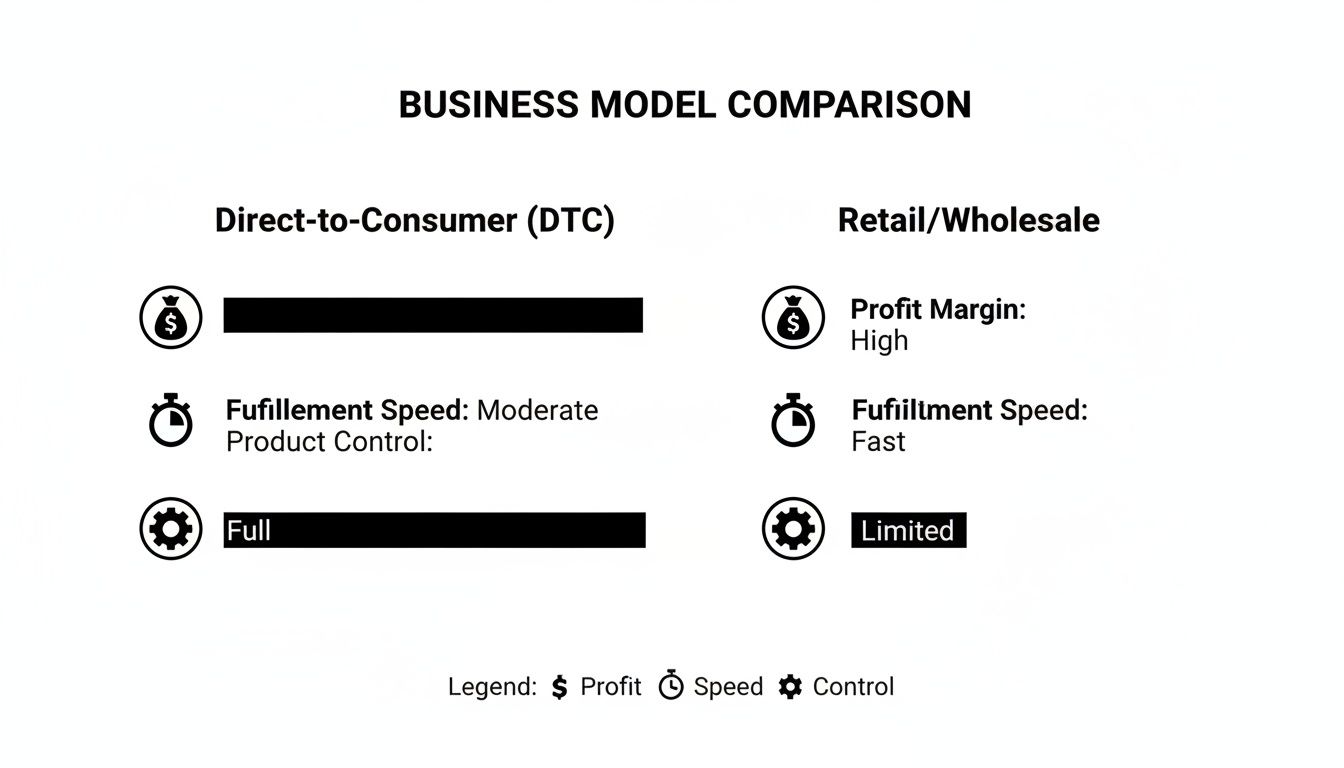
While dropshipping might get an item out the door faster, the infographic makes it clear that POD gives you far more command over the product itself—the very heart of your brand.
Navigating Customer Support and Returns
Your reputation is also built on how you handle things when they go wrong. Both models have their headaches here, but the types of problems are very different. With dropshipping, you’re often stuck in the middle. If a customer gets a shoddy item, you have to play telephone with a supplier you barely know, which can lead to slow, frustrating resolutions.
Print-on-demand issues tend to be more black and white. Problems usually involve print quality, a sizing mix-up, or shipping damage. Since every item is made to order, you generally don't accept returns for "buyer's remorse" (and you need to make that crystal clear in your store policies). But when there's a real quality problem, a good POD partner will quickly offer a reprint or a refund. This allows you to solve the issue fast, keep your customer happy, and protect the brand you're working so hard to build.
Finding The Right Suppliers And Technology
Whether you choose dropshipping or print-on-demand, your success hinges on the partners and technology powering your store. It’s not just about what you sell, but who you work with. A great supplier can make your business run like a well-oiled machine, while a bad one can create a nightmare of customer complaints and logistical headaches. This isn't a small decision—it’s the foundation of your entire operation.
For a classic dropshipping setup, your main job is to find reliable suppliers for existing products. Platforms like AliExpress or Spocket have massive catalogs, but wading through them can be a real challenge. You have to look past the slick product photos and do your homework. That means digging into supplier ratings, checking their shipping history, and reading every customer review you can find to see if they’re actually reliable.
A huge part of the dropshipping game is simply knowing what's hot. If you need some help with that, there are great resources on finding winning products for your dropshipping store that can really give you an edge.
Evaluating Print-On-Demand Partners
When it comes to print-on-demand, your choice of partner is a direct reflection of your brand. The big players like Printful and Printify offer slick integrations that connect right to your store, handling everything from the printing to the shipping. They’re a solid, hands-off option for getting started quickly.
But there's another way to do it—a more hands-on approach that's gaining traction with brands serious about quality and profit. This involves working with a specialty print provider for your designs and handling the final application yourself.
This hybrid model is a game-changer. It combines the flexibility of on-demand printing with the quality control of doing it in-house, giving you a serious competitive advantage.
The DTF Transfer Advantage For Apparel Brands
Instead of letting a POD service handle everything, imagine this: you order incredibly high-quality Direct-to-Film (DTF) transfers. This simple shift puts you back in the driver's seat. You get to source your own blank apparel, which means you can choose the exact fabrics, fits, and ethical suppliers you want. Our guide on sourcing wholesale blank apparel suppliers is a great place to start finding the perfect garments for your brand.
With your transfers and blank apparel in hand, you just press the design onto the garment as soon as an order comes in. This approach unlocks some pretty powerful benefits:
- Superior Quality Control: You physically see and touch every single item before it goes out the door. No more crossing your fingers and hoping the POD provider got it right.
- Higher Profit Margins: Buying your blanks and transfers separately is almost always cheaper than the bundled pricing of POD services. That means more money in your pocket from every sale.
- Faster Turnaround: When you have transfers ready to go, you can press and ship an order the very same day. That blows the typical 3-5 day production time of many POD companies out of the water.
Tools like a gang sheet builder are designed to make this process even more efficient and affordable. You can arrange multiple designs on a single DTF transfer sheet, which drastically cuts down on waste and lowers your cost for each individual design.
Here’s a look at what a gang sheet builder looks like in action, letting you pack your designs onto a single sheet.
This tool gives you complete control over your production costs, helping you squeeze the most value out of every single transfer you order.
Creating A Hybrid Business With Raccoon Transfers
The whole "dropshipping vs. print-on-demand" debate often makes you feel like you have to pick one rigid path. But in my experience, the smartest apparel entrepreneurs know that the most successful businesses cherry-pick the best parts of both models. By bringing Raccoon Transfers into the mix, you can build a hybrid operation that gives you total brand control, better profit margins, and way less risk.
This isn't about choosing one over the other. It's about building something better from the ground up that's uniquely yours.
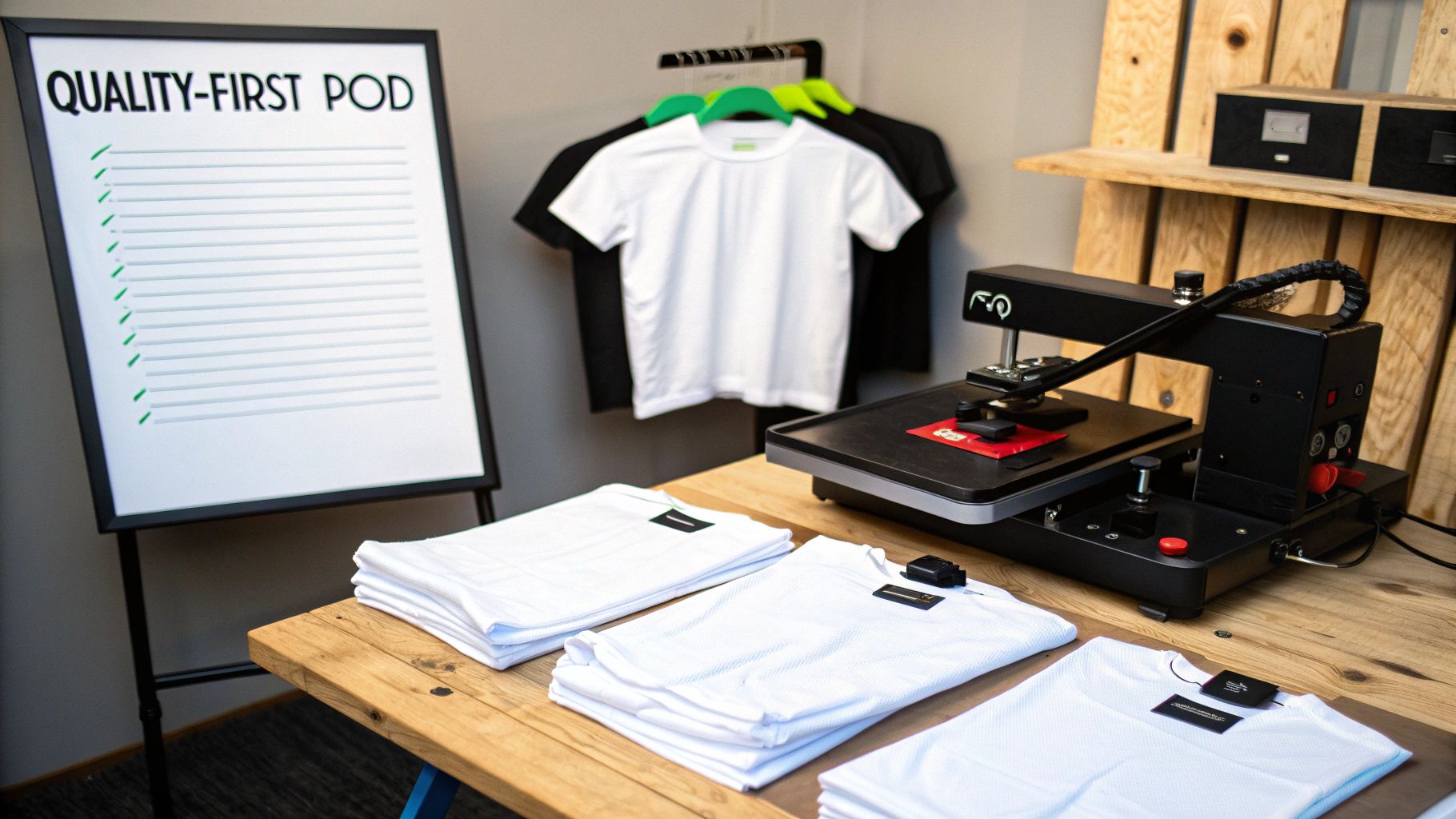
Blueprint 1: The Quality-First POD Model
This first approach is for anyone who's been burned by the quality control issues and razor-thin margins of traditional print-on-demand services. Instead of outsourcing the whole process, you take charge of the most important step—the actual production—using top-notch DTF transfers. This gives you the quality of an in-house operation with the flexibility of a POD setup.
It’s a surprisingly simple and powerful process:
- Source Premium Blank Apparel: First, you hand-pick your own blank garments from wholesale suppliers. This simple step gives you complete say over the fabric, fit, and feel—something you just don't get with standard POD.
- Design and Order DTF Transfers: Next, lock in your designs and use the gang sheet builder from Raccoon Transfers. This tool is a game-changer; it lets you cram multiple designs onto a single sheet, which massively drops your cost per design.
- Establish an In-House Pressing Station: You don't need a giant warehouse for this. A decent heat press and some organized shelves for your blanks and transfers are all you need to create your own mini-production hub.
- Press on Demand: When an order rolls in, you just grab the right blank, press the design, and ship it out. You’re fulfilling orders as they come, which means zero inventory risk.
This model completely flips the standard POD equation on its head. You get incredible quality control, you pocket much higher profit margins by cutting out the middleman, and you can even offer same-day shipping. That last one is a huge competitive advantage.
This hands-on method directly solves the biggest problems people have when comparing print-on-demand and dropshipping, creating a much better option for serious apparel brands.
Blueprint 2: The Brand-Focused Dropshipping Hybrid
This second blueprint is for the marketer who loves the cash flow of dropshipping but still wants to build a brand with real, long-term value. Instead of just reselling other people's stuff, you create a store that dropships complementary products while building out a core line of exclusive, high-margin merch that you produce yourself.
Here's how you can structure this hybrid model:
- Curate a Dropshipping Catalog: Use a platform like Printful or Printify to dropship items that make sense for your niche but aren't your main focus. For example, if you sell custom graphic tees, you could dropship accessories like hats, phone cases, or tote bags. It fills out your store and brings in extra revenue without you having to touch any inventory.
- Create Your Signature Branded Line: At the same time, use Raccoon Transfers to produce your main collection of high-quality, exclusive apparel. These are your signature items—the ones customers can only get from you.
- Market the Exclusive Collection Aggressively: Your marketing should be all about your unique, self-produced gear. The dropshipped items are great, profitable add-ons, but your branded apparel is what builds loyalty and gives your brand its identity.
This strategy strikes the perfect balance. Dropshipping gives you a steady stream of cash and a wide selection of products, while your DTF-printed branded line delivers fantastic profit margins and creates a loyal following that competitors can't steal. It’s the ideal setup for anyone who wants the scale of dropshipping with the brand power of a truly unique product line.
Which E-Commerce Model Is Right For You?
Choosing between dropshipping and print-on-demand isn't about picking a clear winner. It’s about figuring out which model best fits your goals, your creative drive, and how much risk you're comfortable with. The right answer really depends on what kind of business owner you see yourself becoming.
To help you decide, let's break it down into two common entrepreneurial profiles. See which one feels more like you.
Are You a Market Opportunist or a Creative Brand Builder?
The Market Opportunist is all about speed and spotting trends. You're great at seeing what's hot right now and want to jump on that wave—fast. Your skills are in marketing and sales, and you excel at quickly connecting an existing product with eager buyers. For you, the product is a means to an end, and having a wide selection is a major plus.
- Your Best Fit: Dropshipping was practically designed for this mindset. It gives you instant access to a huge catalog of products, letting you test ideas with almost no cash upfront and switch gears the moment a new trend emerges.
The Creative Brand Builder is motivated by a vision. You're not just selling a product; you're creating something unique that people can't get anywhere else. You're passionate about the design, the story, and the feel of the items that feature your brand. Your main goal is to build a loyal following that truly connects with what you're doing.
- Your Best Fit: Print-on-demand is the perfect launchpad for this journey. It lets you turn your ideas into reality without buying a mountain of inventory, making it an ideal way to build a distinct brand identity from the very beginning.
At the end of the day, it boils down to this: Do you want to be known for selling great products, or for creating them?
Keep in mind, these paths don't have to be separate. Many of the smartest brands mix and match. You could dropship a few complementary accessories while using a service like Raccoon Transfers to produce a core line of high-quality, high-margin apparel.
This hybrid strategy gives you the best of both worlds: the broad reach of dropshipping and the powerful brand identity that comes from having a unique product you created yourself.
Common Questions Answered
When you're weighing dropshipping against print-on-demand, a few key questions always seem to pop up. Let's clear the air and tackle them head-on so you can move forward with confidence.
Can I Use Both Dropshipping and Print-On-Demand in the Same Store?
You absolutely can, and frankly, it's often a smart move. Think of it as a hybrid strategy. You can use print-on-demand for your core, branded designs—the stuff that makes your brand your brand. Then, you can dropship complementary items like hats, phone cases, or basic apparel to fill out your catalog.
This approach gives you the best of both worlds: you build a strong brand identity with unique, high-margin products while offering a wider variety of items without holding any inventory.
What Are the Biggest Hidden Costs I Should Watch Out For?
With dropshipping, the real budget-killers are often the marketing spend and returns. Since you're selling products others also have access to, you have to spend heavily on ads to cut through the noise. Managing returns can also eat into your profits, especially when dealing with generic items.
For print-on-demand, the sneaky costs usually come from two places. First, you must order samples to check the quality of your designs, and that adds up. Second, shipping can get pricey since each item is often printed and shipped individually, sometimes from different facilities.
Is Dropshipping Still Worth It With So Much Competition?
Yes, but with a big asterisk. Dropshipping can still be very profitable, but you can't just throw up a store and expect sales. Success today is all about the execution.
It comes down to finding a specific niche you can dominate, building a killer marketing plan, and, most importantly, finding suppliers you can truly rely on. The model works, but only if you build a real, strategic brand around it.
Ready to take full control of your apparel brand's quality and profit margins? With Raccoon Transfers, you can create stunning, durable custom apparel in-house. Our DTF transfers, gang sheet builder, and fast turnaround give you the power to press on demand, ensuring every piece meets your standards. Explore our high-quality transfer solutions today at https://raccoontransfers.com.