
Silk Printing vs Screen Printing: A Clear Guide to Quality and Cost
Let's get one thing straight right away: when you hear "silk printing" versus "screen printing," you're actually talking about the same process. There is no difference.
Silk printing is simply the old-school name for what the industry now calls screen printing. Back in the day, printers used mesh made from silk to create their stencils. Today, we use more durable synthetic fabrics like polyester, but the name "silk screening" has lingered, creating a lot of unnecessary confusion for new designers and brands.
So, the real conversation you should be having isn't about two names for one technique. It's about how traditional screen printing stacks up against its modern digital competitor, Direct-to-Film (DTF) printing. Getting a handle on this is the key to making smart, budget-friendly decisions for your apparel line.
Decoding Modern Apparel Printing
The name "silk printing" comes from the very origins of the method, when artisans stretched silk across a frame to push ink through. The core concept hasn't changed, but the materials certainly have. This historical naming is a common tripwire for newcomers, sending them down a rabbit hole comparing two things that are identical.
Here’s the key takeaway: when you're weighing your options, the conversation needs to shift to Screen Printing vs. DTF. This is where you'll find the real-world differences in cost, quality, speed, and versatility that actually matter to your project. To choose wisely, you have to look past the outdated lingo and get practical about today's printing technologies.
Screen Printing vs DTF A Quick Comparison
To get you oriented, let’s quickly break down the fundamental differences between these two powerhouse methods. This table gives you a snapshot of which technique might fit your needs before we get into the nitty-gritty details.
| Attribute | Screen Printing | DTF (Direct-to-Film) |
|---|---|---|
| Best For | Large bulk orders (50+ units) with simple, limited-color designs. | Small batches, print-on-demand, and designs with complex, full-color details. |
| Setup Cost | High initial cost per color/screen, making small runs expensive. | Zero setup costs per design, making it ideal for testing and small orders. |
| Color Complexity | Limited number of colors; complex gradients are difficult and costly. | Unlimited colors and perfect photorealistic gradients at no extra charge. |
| Turnaround Time | Slower due to multi-step screen preparation and manual setup. | Very fast, with potential for 24-hour turnaround and next-day shipping. |
Even with all the new digital options, screen printing is still a massive player in the apparel world. In the US, there are 15,427 custom screen printing businesses as of 2025, and the industry is pulling in an estimated $12.8 billion in revenue. That tells you it's still the undisputed king for high-volume jobs where getting the lowest per-unit cost is everything. You can explore more about this market's growth to see why it remains a go-to for bulk producers.
How Each Printing Process Actually Works
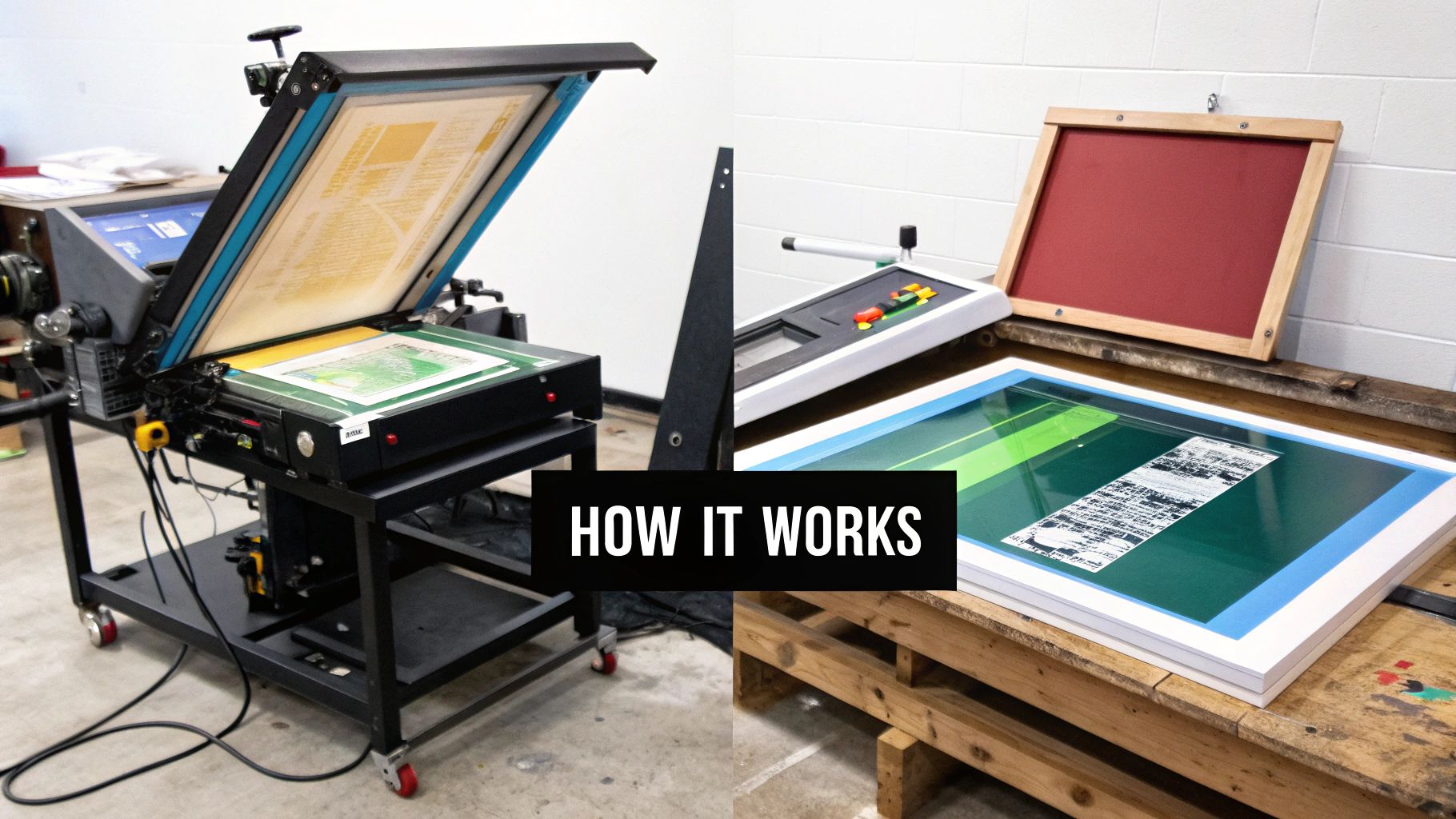
To really get which method is right for your apparel brand, you have to look past the finished shirt and understand how it’s actually made. The day-to-day reality of running a screen printing setup versus a Direct-to-Film (DTF) operation couldn't be more different, and those differences ripple out to affect everything from your turnaround times to your creative freedom.
Screen printing is a hands-on craft with a lot of moving parts. DTF, on the other hand, is a digital-first process that’s much more streamlined. This core distinction is why one is the king of bulk orders and the other is the champion of print-on-demand. Let's pull back the curtain on how each one works.
The Screen Printing Workflow: A Manual Art
Screen printing is truly an art form, built on years of refinement but still fundamentally a manual, layer-by-layer process. Every single color in your design adds another step, more time, and more cost to the setup.
The work starts long before a drop of ink hits the fabric. Here’s a quick rundown of the steps involved:
- Artwork Separation: First, your design file is broken down into individual layers, one for each color. A simple logo with red, white, and blue becomes three separate black-and-white images.
- Screen Creation: A mesh screen—historically made of silk, but now almost always polyester—is coated with a light-sensitive emulsion. The film for one color layer is placed on this coated screen.
- Screen Exposure: The screen gets blasted with powerful UV light. The light hardens the emulsion everywhere except where the black artwork on the film blocks it. That part stays soft.
- Washing and Stencil Creation: The screen is then washed out. The soft, unexposed emulsion rinses away, leaving a perfect stencil of that color’s design in the mesh. You have to do this for every single color.
- Press Registration and Printing: Each screen is meticulously mounted and aligned on the printing press in a crucial step called registration. Get this wrong, and the colors won't line up. Finally, ink is pushed through each screen’s stencil onto the garment, one color at a time, to build the final image.
This methodical workflow is exactly why screen printing comes with high setup costs and just isn't practical for small runs or designs with tons of colors.
For small brands, the key takeaway is that screen printing’s value is unlocked by volume. The time and cost to create and register five screens for a five-color design are the same whether you’re printing 10 shirts or 1,000.
The DTF Process: A Digital Solution
In stark contrast, the DTF process throws all that manual screen prep out the window in favor of a clean, digital workflow. It completely skips the need for color separations, screen burning, and tricky registration, making it incredibly agile. This is a massive advantage in the silk printing vs screen printing debate for modern brands that need to move fast.
The journey from a digital file to a finished garment is much more direct with DTF:
- Step 1: Print to Film: Your complete, full-color digital artwork is printed directly onto a special transfer film using a dedicated DTF printer. All the colors, tiny details, and smooth gradients are printed in a single pass.
- Step 2: Adhesive Application: While the ink is still wet, a fine adhesive powder is sprinkled over the film. It sticks only to the printed areas, and the excess is shaken off.
- Step 3: Curing: The film then travels through a small heat tunnel or oven. This melts the powder, creating a smooth, durable adhesive layer on the back of the ink.
- Step 4: Heat Press Application: The finished transfer is placed onto the garment and pressed with a standard heat press. The heat and pressure activate the adhesive, permanently bonding the ink to the fabric fibers.
The whole process is quick, involves almost no setup between different designs, and creates a ready-to-press transfer in just a few minutes. If you want to dive deeper, our guide on fabric printing techniques provides a broader look at how these technologies stack up against other methods.
Analyzing Print Quality, Feel, and Fabric Versatility
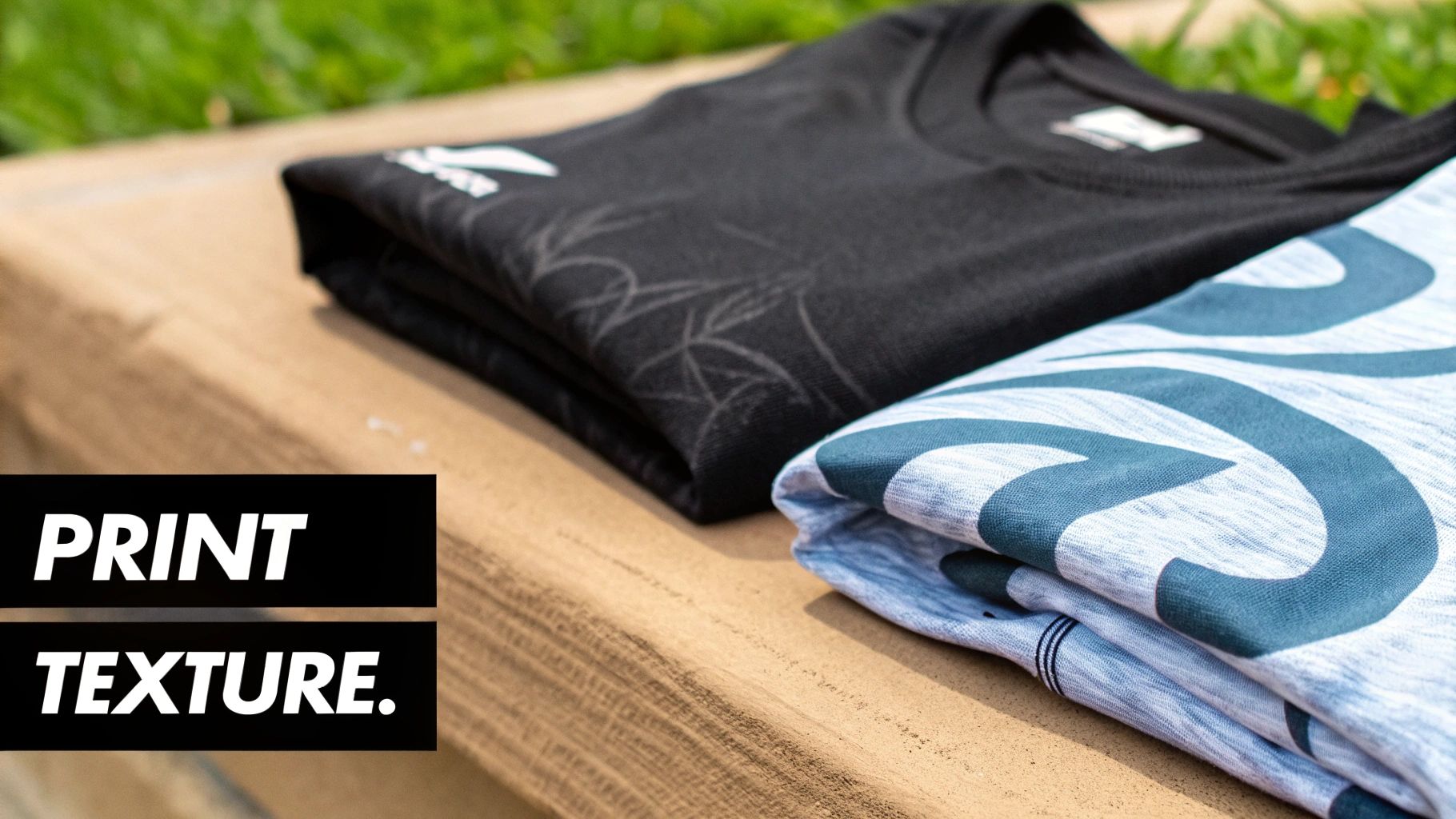
How a print feels is just as important as how it looks. It's a direct reflection of your brand's quality, and when you're choosing a print method, this is where the real differences between traditional screen printing and modern DTF transfers come to light. The texture, the detail, and the types of fabric you can use all play a huge role in how customers perceive your apparel.
Screen printing is legendary for its distinct, slightly raised texture. The process pushes a thick layer of plastisol ink through a mesh screen and onto the fabric. This creates a bold, vibrant finish you can feel—it’s the classic, durable print you’d find on high-quality band merch or streetwear.
That thick ink layer is what gives screen prints their incredible opacity, making colors pop, especially on dark garments. But this is also its biggest limitation. The ink can feel heavy on lightweight fabrics and isn't built for photorealistic designs full of smooth gradients or tiny details.
The Feel of the Final Print
The tactile experience of a printed shirt is a critical, often overlooked, part of its appeal. Screen printing and DTF offer two completely different textures, each suited to different aesthetics and customer expectations.
Screen Printing’s Tactile Finish
A classic screen print sits on top of the fabric. You can feel it. This creates a durable, slightly rubbery hand-feel that’s perfect for bold logos on heavyweight cotton hoodies. While the durability is top-notch, this thickness can sometimes lead to cracking over years of wear and tear, especially if the garment is stretched often.
DTF’s Soft-Hand Flexibility
A high-quality DTF transfer, on the other hand, feels much softer and more flexible. The ink layer is incredibly thin and engineered to stretch right along with the fabric, becoming part of the garment itself. The result is a modern, lightweight finish that’s barely perceptible to the touch and highly resistant to cracking or peeling, even on stretchy performance wear.
For brands that put a premium on comfort and a modern feel, DTF has a clear edge. It maintains the natural drape and softness of the fabric, making it a better choice for fashion-forward apparel where a heavy, stiff print just wouldn't work.
Mastering Fabric Compatibility
Your creative vision shouldn't be boxed in by your printing method. Being able to print on a wide range of materials is key to building a cohesive product line, and this is where DTF really shines.
Screen printing is most at home on 100% cotton and some cotton-poly blends. While special inks exist for synthetics like polyester, they often demand different chemistries and curing methods, which adds complexity and cost to a print run. Trying to screen print on difficult materials like nylon or water-resistant jackets can be a real headache, often with inconsistent results.
In contrast, DTF was designed from the ground up for versatility. Its advanced adhesive technology works exceptionally well on a huge range of fabrics, including many that are off-limits for screen printers.
- Cotton and Blends: DTF bonds perfectly with natural fibers while maintaining a soft feel.
- Polyester and Performance Wear: It adheres flawlessly to synthetic athletic fabrics without affecting their stretch or moisture-wicking properties.
- Nylon and Leather: The powerful adhesive allows for durable prints on bags, jackets, and even accessories.
- Denim and Canvas: DTF handles tough, textured fabrics like denim and canvas with no problem.
This flexibility is a game-changer for modern apparel brands. Think about it: you could launch a collection that includes cotton tees, polyester hoodies, and nylon gym bags, all featuring the same intricate, full-color design. With DTF, that’s easy. Trying to pull that off with screen printing would be a logistical nightmare of multiple ink types and specialized setups.
Our guide on choosing the best t-shirt materials dives deeper into how fabrics react to different print methods. Ultimately, the silk printing vs. screen printing debate often comes down to what you plan on printing on.
The Money Talk: A Complete Cost Breakdown for Apparel Brands
When you're deciding between screen printing and a digital method like DTF, money is almost always the tie-breaker. The way each method is priced is completely different, and figuring that out is key to protecting your profit margins. One approach is a classic bulk-buy model that saves you a ton on large orders, while the other is all about staying lean and flexible for small, on-demand jobs.
This isn't just about one being "cheaper." Screen printing is an economy-of-scale game. You invest more upfront, but that investment pays off big time when you're printing hundreds of items. On the flip side, Direct-to-Film (DTF) is built for agility, completely ditching setup costs to make even a single-shirt order make financial sense.
The Screen Printing Cost Model
The first thing to understand about screen printing is the high initial setup cost. This isn't for your design file; it's for the very real, physical work of getting the job ready. Every single color in your design needs its own screen that has to be prepped, coated with emulsion, burned with the image, and then perfectly aligned on the press.
These setup fees can stack up fast and make small orders a non-starter. Got a cool five-color design? That’s five separate screen setups, which could easily run you several hundred dollars before you’ve even printed a single tee. It's exactly why screen printing is a terrible choice for one-off samples or just testing an idea.
But once you're past that setup hurdle, the cost per shirt plummets. This is where screen printing truly dominates. For big jobs—think 500+ pieces—the per-unit cost efficiency is unmatched, and it's far faster than digital printing at that scale. While the setup fee makes it a poor fit for small runs, it’s the undisputed king for high-volume savings, especially for any design needing 100 or more units. You can discover more insights about digital and screen printing costs on HPRT.com.
The DTF Cost Model: Zero Setup Fees
DTF throws that entire cost structure out the window. Since it's a totally digital process, there are zero setup fees. Period. You can print one shirt with a full-color, photorealistic design for the same per-unit price as you would for an order of 20.
This is a massive advantage for small businesses, startups, and designers who can't afford to be locked into big inventory orders. It takes all the financial risk out of launching new products. Want to test a dozen new designs? Go for it. You won't spend a dime on screens. This makes it the perfect solution for:
- Print-on-demand: Sell your designs online without buying any inventory first.
- Small batch drops: Release limited-edition collections without getting stuck with unsold stock.
- Market testing: See what actually sells before you commit to a big screen printing run.
For a new brand, being able to launch with minimal financial risk is everything. DTF's zero-setup-fee model lets you be creative and react to what your customers want without the heavy financial burden of traditional screen printing.
A Practical Cost Scenario
Let’s make this real. Imagine you have two different t-shirt orders you need to place.
Scenario 1: Small, Colorful Order
- The Job: 30 shirts
- The Design: A photorealistic graphic with 8+ colors
In this situation, DTF is the hands-down winner. To screen print this, you'd be looking at setup costs for at least eight screens, which could easily top $300-$400 before you even pay for the shirts themselves. With DTF, you just pay a flat price for each transfer. No setup fees, no drama—just a final cost that makes sense for a small run.
Scenario 2: Large, Simple Order
- The Job: 300 shirts
- The Design: A two-color company logo
Now, screen printing gets to shine. You’ll still have a small setup fee for those two screens (maybe $50-$80 total), but your per-shirt printing cost will be incredibly low—we’re talking just a couple of dollars each. Spread across 300 units, those savings will easily erase the initial setup cost, making screen printing far more profitable than DTF for this kind of volume.
For an even deeper dive, our detailed guide comparing heat transfer vs screen printing breaks down more of these financial trade-offs. Ultimately, the right choice always comes down to your specific order volume and how complex your design is.
Looks and feel are only part of the story. For any apparel brand, the real test comes down to three things: How long does the print last? How fast can you get it? And what’s the impact on the planet? These aren't just details; they're core to your brand's reputation and your ability to keep up with a fast-moving market.
Durability and Real-World Wear
Traditional screen printing is famous for being tough. That thick layer of plastisol ink creates a durable, almost bulletproof finish that can handle a lot of abuse in the wash. But that strength can also be a weakness. Because the ink sits on top of the fabric like a sheet of plastic, it doesn't stretch well. Over time, on flexible garments, that can lead to cracking and flaking.
This is where modern Direct-to-Film (DTF) transfers really shine. They're built for flexibility. The ink layer is incredibly thin and engineered to stretch right along with the fabric, so it resists cracking and peeling, wash after wash. For performance wear, athletic gear, or anything designed to move with the body, DTF is simply the better long-term choice.
Production Speed and Turnaround Time
When you compare screen printing and DTF on speed, it’s not even a close race. Screen printing is a deliberate, hands-on process that takes time. Just preparing, exposing, and aligning the screens for a multi-color design can eat up days before a single shirt is ever printed.
DTF, however, runs on a digital clock. There are no screens to prep. You can go from a finished design file to a transfer that's ready to press in a matter of minutes. That efficiency completely changes the game for turnaround times.
- Screen Printing: You’re typically looking at a turnaround time measured in days or even weeks, especially if the design is complex or the print shop is busy.
- DTF Printing: Turnaround can be as quick as 24 hours. Many services even offer next-day shipping.
This kind of speed gives brands an incredible advantage. You could see something trending online, design a shirt for it, and have it in your customers' hands almost immediately. That's a level of responsiveness that's just not possible with screen printing's long setup times.
The ability to go from concept to customer in under 48 hours is a game-changer for small brands. DTF removes the production bottleneck, allowing for real-time market testing and rapid fulfillment.
Environmental Impact and Sustainability
For a growing number of shoppers, sustainability isn't a bonus—it's a requirement. The contrast between the two methods here is pretty clear. Screen printing has a heavy footprint. The process requires chemical solvents to clean screens, relies on plastisol inks that aren't biodegradable, and uses a tremendous amount of water to wash out screens between jobs.
DTF is a much cleaner, more sustainable option. The printing process is almost entirely waterless, and the water-based inks are far more eco-friendly. Better yet, since transfers are printed on-demand, you drastically cut down on the waste from overproduction—one of the biggest environmental problems in the fashion industry. This shift is a major reason why the digital printing market is booming. Valued at $33.5 billion in 2024, the global digital sector is projected to reach $57.08 billion by 2033, largely thanks to its efficiency and smaller environmental footprint. You can read the full analysis on digital printing's growth to see where the market is headed. For any brand building an eco-conscious identity, DTF is the obvious choice.
How to Choose the Right Printing Method
So, how do you make the final call? Choosing between screen printing and its digital rival, DTF, isn't about finding a single "best" method. It’s about matching the right tool to the job at hand. The decision really boils down to three critical questions about your project: What's your order volume, how complex is the design, and what fabric are you using?
Answering these questions helps you cut through the noise and make a smart, strategic choice. You're not just getting a shirt printed; you’re building a product that aligns perfectly with your brand's vision and your business goals.
This flowchart lays out the core strengths of each method, focusing on things like durability, speed, and environmental impact.
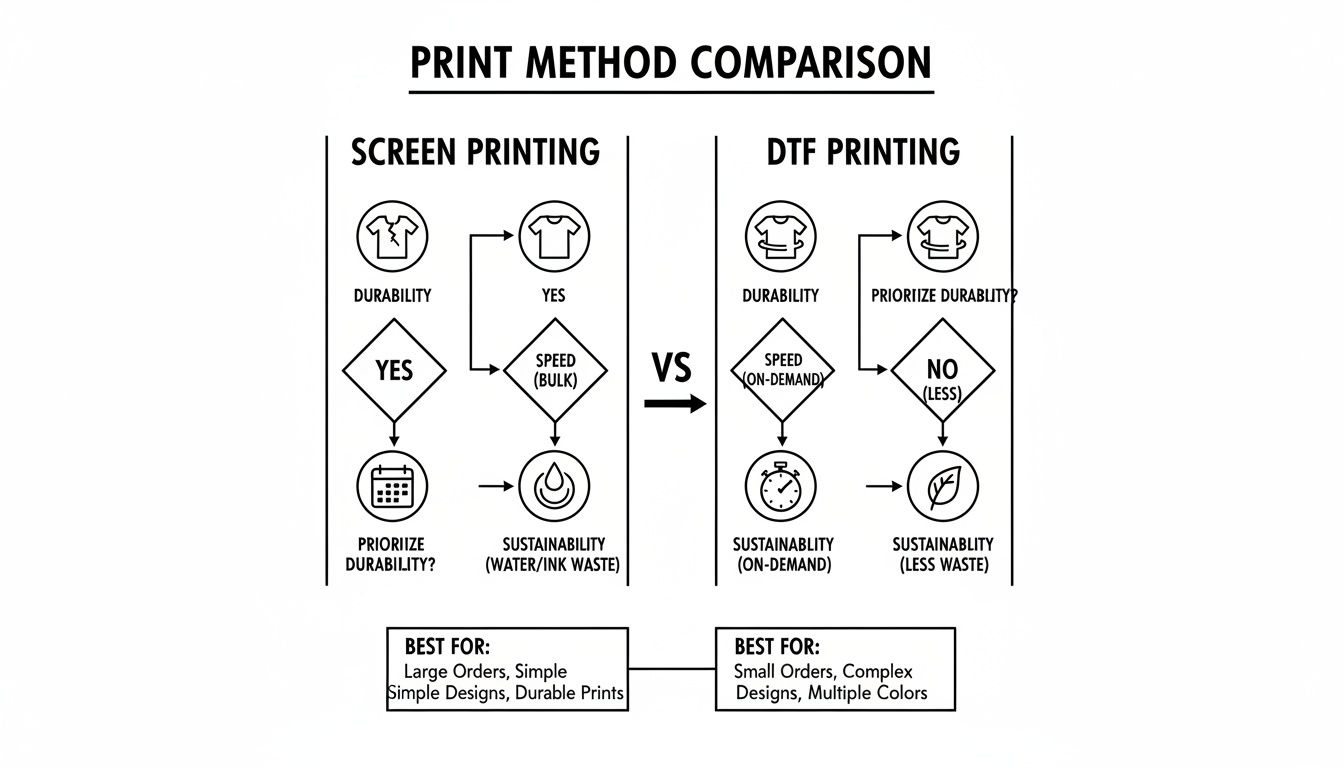
As you can see, screen printing’s legendary durability sometimes means less flexibility. On the other hand, DTF brings a modern balance of speed, sustainability, and surprisingly resilient quality to the table.
When to Choose Screen Printing
Screen printing is still the undisputed king of high-volume production, and for good reason. Once you get past the initial setup fees, the cost-per-item is tough to beat.
Go with screen printing when:
- You're ordering in bulk. Think 100 or more identical pieces. The setup cost gets spread so thin across the run that each unit becomes incredibly affordable.
- Your design is straightforward. If your artwork uses four or fewer solid colors, screen printing is a perfect fit. Fewer colors mean fewer screens, which keeps those setup costs down.
- You’re printing on cotton. It’s the ideal method for 100% cotton or high-cotton blends where classic plastisol inks really shine.
If your business is built on selling large runs of a few core designs—like best-selling tees, staff uniforms, or event merch—screen printing is your most direct path to better profit margins.
When to Choose DTF Transfers
DTF is the nimble, modern answer for brands that prioritize flexibility, speed, and creative freedom. With virtually zero setup costs, it tears down the financial barriers that used to keep new and growing businesses from getting started.
Opt for DTF when:
- Your order is small to medium. Whether you need a single prototype or a run of up to 100 pieces, DTF is perfect for testing new products and launching limited-edition drops.
- Your design is complex. Got a photorealistic image, unlimited colors, or super fine details? DTF handles it all beautifully.
- You need to print on different fabrics. This is where DTF truly excels. You can press designs onto polyester, nylon, performance wear, and tricky blends with consistent results.
- You run a print-on-demand store. Since you can fulfill orders one by one, DTF lets you operate with zero inventory risk.
Frequently Asked Questions
When you're trying to get your designs onto a shirt, figuring out the best printing method can feel overwhelming. Let's tackle some of the most common questions we hear from brands weighing screen printing against modern alternatives like DTF.
Which Method Feels Softer on the Shirt?
This one usually goes to DTF. Modern DTF transfers have a remarkably soft and flexible feel. Think about a classic screen print—it often lays down a fairly thick layer of plastisol ink that sits right on top of the fabric. On bigger designs, this can feel a bit heavy or stiff.
A quality DTF transfer, on the other hand, is engineered to be lightweight. It's designed to stretch right along with the fabric, which not only feels more comfortable but also preserves the natural drape of the shirt and is far less likely to crack.
Is DTF Better for Small Businesses?
For most small businesses, startups, and independent designers, DTF is a game-changer. The biggest hurdle with screen printing has always been the setup costs and minimum order quantities. DTF completely sidesteps that problem.
This means you can launch new designs, offer a wider range of products, or test out an idea without a huge financial gamble. That kind of agility is exactly what a growing brand needs to react to trends and figure out what sells, all without being locked into a massive, costly print run.
The real win for a startup is risk reduction. DTF lets you test the market with zero screen setup costs, so you can make smart, data-backed decisions about which designs are worth scaling up later.
Can Screen Printing Handle Complex Colors?
Honestly, this is screen printing's weak spot. It’s not built for photorealistic images or smooth color gradients. Every single color in your design needs its own dedicated screen, which makes reproducing designs with lots of subtle color shifts incredibly complex and expensive.
This is where digital methods like DTF really shine. They can print the full color spectrum, including tiny details and perfect gradients, all in a single pass directly from your digital file. It opens up a ton of creative freedom.
How Does Durability Compare After Many Washes?
Both methods are tough, but they wear differently over time. A well-cured screen print is known for being super wash-resistant, but because the ink is thick, it can start to crack after a lot of wear and stretching.
Premium DTF transfers are built for both longevity and flexibility. The adhesive creates a powerful bond with the fabric fibers to prevent peeling, while the thin ink layer moves with the material. This helps the design maintain its original look and feel for much longer, even through countless wash cycles.
Ready to see how fast and versatile modern printing can be for your apparel brand? At Raccoon Transfers, we're all about premium, easy-to-apply DTF transfers with a guaranteed 24-hour turnaround. Upload your designs today and see the difference for yourself.