
Types of Shirt Fabric for DTF Transfers
The popular advice is simple: choose 100% cotton because it feels premium, prints well, and suits almost everyone. That advice breaks down as soon as a shirt has to survive a heat press, repeated washing, athletic use, or a detailed DTF transfer. The best fabric isn't decided by the fiber label alone. It depends on the finished garment, the transfer adhesive, the surface construction, and the way your customer will wear and wash it.
A soft ringspun cotton shirt can produce beautifully sharp artwork, yet a textured or unstable blank may distort fine edges. A polyester performance shirt can retain its shape and dry quickly, but excessive heat can create dye migration or damage a sensitive finish. A cotton-polyester blend often sits between those extremes, giving a decorator a more forgiving production surface and a customer a practical everyday garment.
For independent apparel brands, the useful question isn't “Which fabric is best?” It's “Which fabric gives this design the right combination of print clarity, hand feel, heat tolerance, and wash life?”
Rethinking Fabric Selection for Custom Apparel
Fiber content is only the starting point
Cotton deserves its reputation. Evidence indicates that people grew, spun, and wove cotton in the Indus River Valley by about 3000 BCE, while cultivation and fabric use may extend back at least 7,000 years. Industrial machinery later turned cotton from a regional craft into a mass-market textile. Cotton was first spun by machinery in England in 1730, and innovations such as the flying shuttle increased weaving speed and cloth width. The history of cotton from Cotton Counts explains why this fiber became so adaptable across shirts, workwear, and everyday apparel.
That history doesn't make cotton the automatic winner for decorated garments. DTF printing adds a second material system to the shirt. The printed film, ink layer, and adhesive powder must bond to a surface that may stretch, absorb moisture, retain heat, or contain finishing residues. A blank that feels excellent before decoration can still produce poor results if its knit is loose, its surface is heavily brushed, or its dimensions change after pressing.
The decoration method changes the decision
Cotton usually gives decorators a forgiving base because the surface tolerates standard heat-press processes and accepts the adhesive into a fibrous structure. The risk is movement. If the shirt shrinks or the transfer stays rigid while the surrounding fabric changes, the print can pucker, crack, or develop stress at the edges.
Polyester presents the opposite production concern. It generally holds its dimensions better and handles repeated wear well, but high heat can trigger dye migration or alter the fabric's finish. A lower-temperature process, a reliable transfer specification, and a test press matter more than the phrase “performance fabric” on the supplier page.
Practical rule: Approve the decorated garment, not the undecorated blank. Press, wash, dry, stretch, and inspect the exact combination before committing to production.
A premium streetwear tee, a staff uniform, and a running shirt don't need the same fabric. A heavyweight cotton blank may be ideal for a structured graphic with a substantial hand. A polyester or blended shirt may work better for customers who sweat, travel, or wash garments frequently. The strongest brands choose the use case first, then select the fiber and construction that support it.
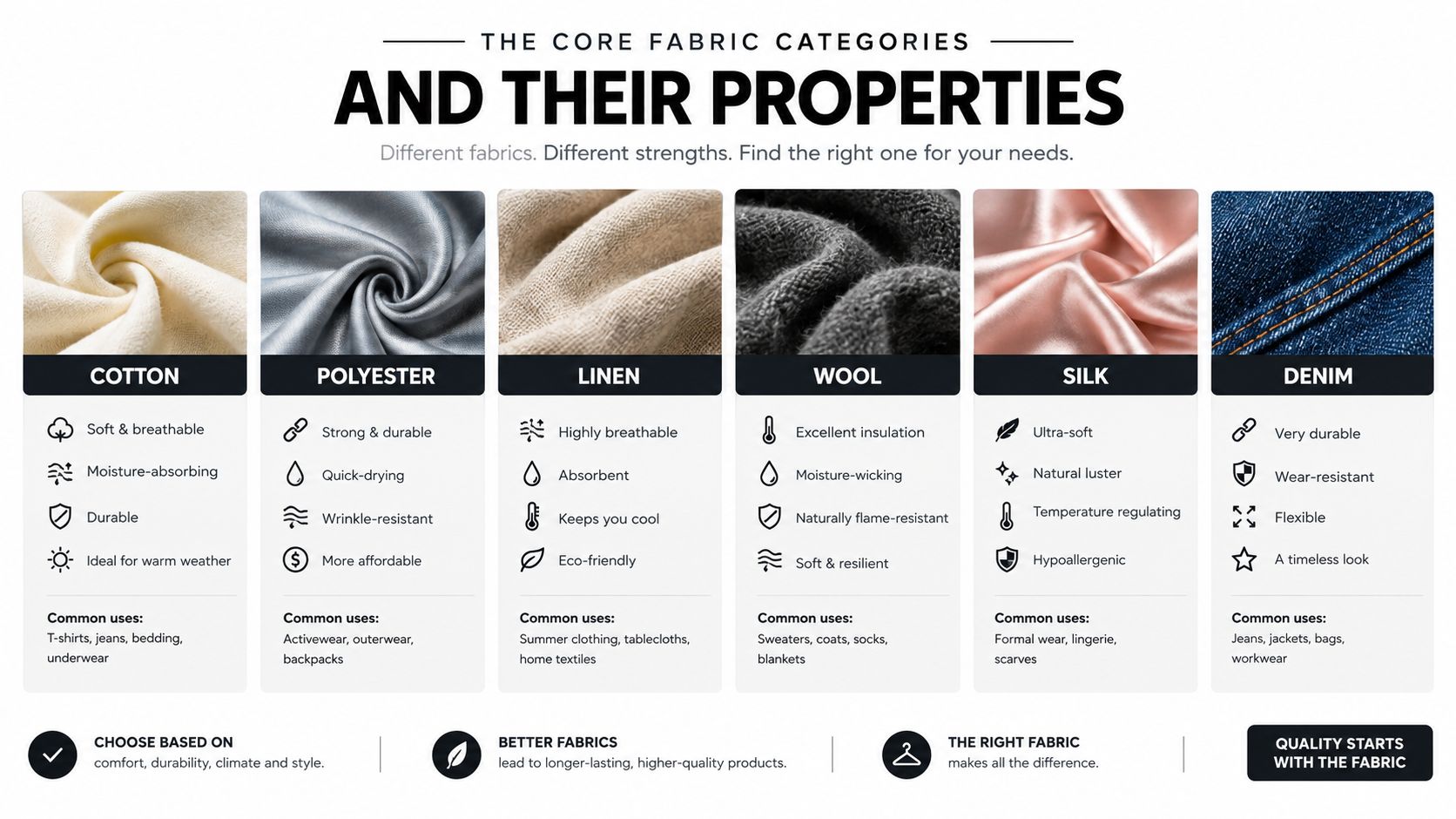
The Core Fabric Categories and Their Properties
Fiber labels help, but decorators live with the behavior of the actual shirt under heat, pressure, stretch, and washing. For most custom apparel programs, the three starting points are 100% cotton, 100% polyester, and cotton-polyester blends. From there, knit quality, finish, weight, and recovery determine whether a transfer looks clean on press day and still looks right after repeated wear.
Cotton
Cotton typically has about 7.5% moisture regain at standard textile-conditioning conditions of approximately 20°C and 65% relative humidity, while polyester has about 0.4%, according to comparative textile research published by SAGE Journals. That helps explain why cotton feels familiar and breathable in daily wear, but it also means the shirt can hold sweat and dry more slowly once it is fully wet.
For DTF, cotton is usually the easiest category to work with. A smooth cotton face accepts detail well, lays flatter under the transfer, and usually gives a softer overall result than rougher constructions. The trade-off shows up after pressing and laundering. Cotton can shrink, torque, or change hand, and those shifts can stress the print edge if the blank was not pretested.
Construction matters as much as fiber content. A compact ringspun jersey usually prints cleaner and washes better than a coarse open-end knit, even though both are labeled 100% cotton.
Polyester
Polyester earns its place because it dries fast, holds shape well, and performs reliably in uniforms, activewear, and frequently washed programs. That stability is useful in production, especially when a brand wants consistent sizing and less garment movement over time.
The print trade-off is heat sensitivity. Polyester can scorch, show press marks, or migrate dye into the adhesive layer if application settings run too hot or too long. I treat polyester blanks conservatively for that reason. Lower-temp transfers, shorter dwell, and a real test press on the exact color are safer than trusting the word “performance” on a product page.
Polyester also gets oversimplified in comfort discussions. Hydrophobic fiber alone does not guarantee moisture management. Wicking depends on yarn shape, knit structure, porosity, and finishing.
Blends and specialty fibers
A 50/50 cotton-polyester blend offers an intermediate moisture profile. The American Chemical Society lists approximately 4.45% moisture regain for the blend, between cotton at 8.5% and polyester at 0.4%, in the same comparative research. In practice, blends often reduce shrinkage and dry faster than all-cotton shirts while keeping a softer hand than pure polyester.
Tri-blends add drape and softness, and spandex adds stretch and recovery. Those upgrades can feel great on body, but they demand stricter testing for decoration. Stretch fabrics need transfers that can move without edge failure, and heat-sensitive components can change feel or shape if you press too aggressively.
Linen, silk, modal, and woven shirting fabrics each bring comfort advantages. For warm-weather construction, see why linen beats the heat.
Before ordering, compare construction as well as fiber content in this shirt materials guide. If you need ready-to-press artwork sized for different garments, Custom DTF Transfer by Size: Perfect Prints for Every Project is one catalog option that lists applications across cotton, polyester, blends, leather, and other materials. Treat those material claims as a starting point, then validate them on your selected blank.
Evaluating Surface Texture for DTF Printability
A DTF transfer doesn't bond to a fiber category in the abstract. It bonds to the actual topography of the shirt. Two cotton blanks can produce different results because one has a compact, smooth jersey surface and the other has raised fibers, open stitches, or a brushed finish.
Inspect the blank before pressing
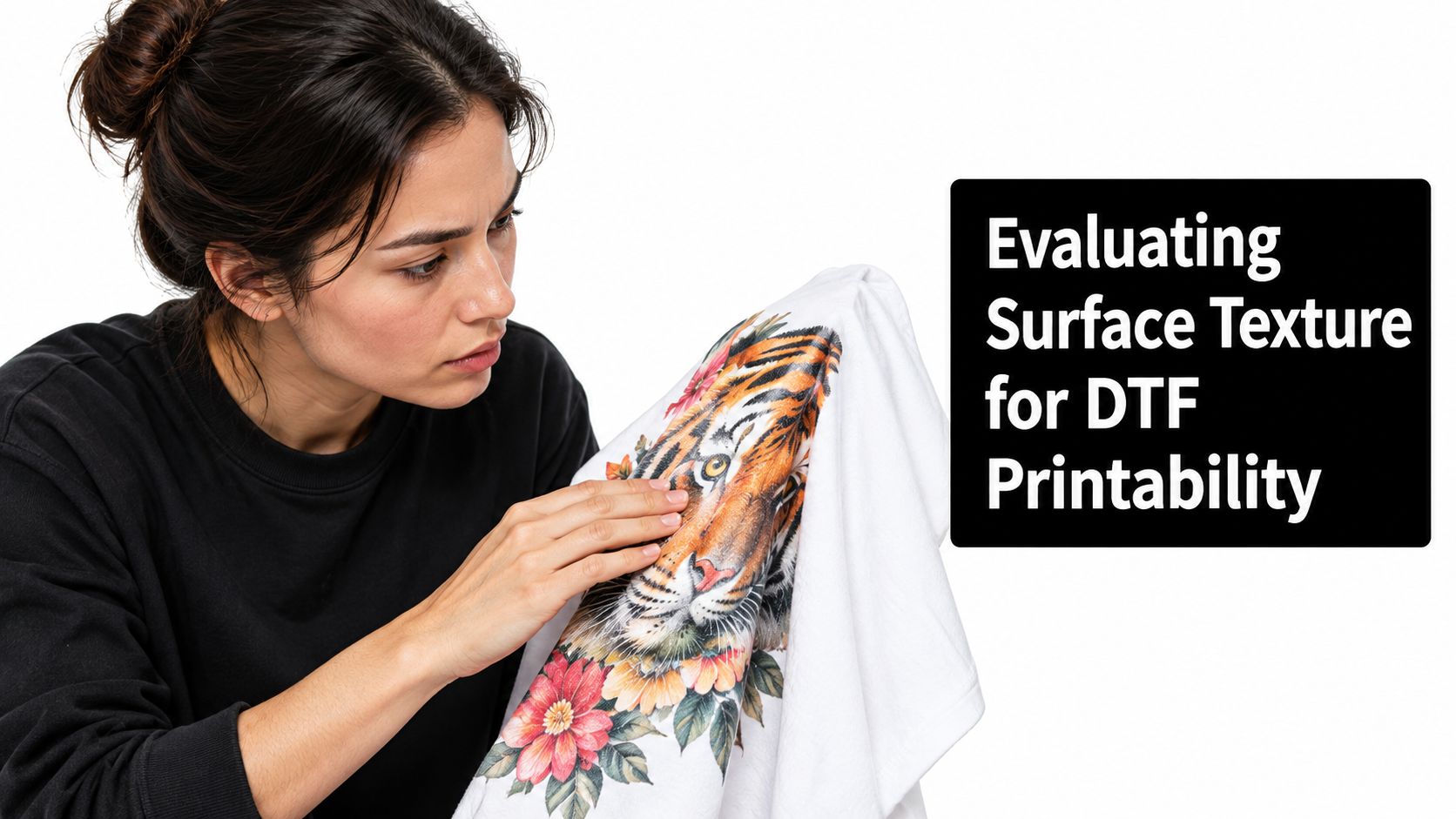
Start by laying the shirt flat under strong, even light. Run your fingers across the print area and look for fuzz, slubs, loops, raised seams, and visible gaps between stitches. A high-stitch-density ringspun shirt generally provides a cleaner platform for fine lettering than a rough, open-end carded blank because the transfer film has fewer deep valleys to bridge.
Next, stretch the fabric lightly in both directions. If the surface opens dramatically, a thin adhesive layer may not make consistent contact across the design. Stretch isn't automatically bad, especially for athletic garments, but the transfer must be selected and tested for that movement.
A smooth surface helps fine detail. A stable surface helps wash durability. You need both.
Watch for finishes and texture
Brushed fleece, slub jersey, heavy waffle knits, and aggressively textured fabrics can interrupt adhesive contact. The powder may sit across the peaks instead of anchoring evenly into the fabric structure. That can leave weak areas around fine lines, small counters in letters, or narrow graphic edges.
Manufacturing residues and silicone-based softeners also deserve attention. They can repel water-based inks or interfere with adhesive bonding, producing a print that looks acceptable immediately but peels after the first wash. If a blank feels unusually slick, waxy, or coated, press a test before buying a case.
Use a repeatable approval test
Keep a simple sample protocol:
- Record the construction: Note fiber content, knit type, weight, stretch, color, and surface finish.
- Press a detail-heavy design: Use small text, a thin outline, and a solid block so failures are easy to see.
- Inspect the edge: Look for lifting, incomplete contact, powder residue, or a visible halo.
- Stretch the print: Check whether the film fractures or pulls away from the knit.
- Wash and dry the sample: Follow the care routine you intend to place on the customer label.
A blank that passes only a visual inspection hasn't passed production. The transfer should remain bonded after the garment has experienced the same mechanical and thermal conditions your customer will use.
Comparing Popular Blank Styles for Decoration
Decorators usually make better decisions by comparing complete blank styles rather than shopping by fiber percentage alone. A structured heavy tee and a soft ringspun tee may both be cotton, but they serve different design languages, customer expectations, and press workflows.
| Blank Style | Fabric Composition | Surface Texture | Best DTF Application |
|---|---|---|---|
| Gildan 5000 style heavy tee | Heavy 100% cotton construction | Structured, comparatively firm jersey surface | Bold graphics, large logos, opaque artwork, streetwear silhouettes |
| Gildan SoftStyle 64000 style tee | Soft ringspun cotton construction | Smoother hand with a more refined print surface | Fine detail, full-color artwork, softer retail-style garments |
| 50/50 heather tee | Cotton-polyester blend | Heathered appearance with a mixed fiber surface | Promotional graphics, everyday uniforms, balanced comfort and stability |
| Performance polyester tee | 100% polyester construction | Often smooth, lightweight, and engineered for activity | Athletic graphics, team apparel, moisture-focused use cases |
| Tri-blend tee | Cotton, polyester, and rayon blend | Lightweight, drapey, and soft with possible surface variation | Fashion graphics, vintage-style artwork, premium casual products |
The Gildan 5000 style blank earns its place in production when you want opacity, structure, and a shirt that supports a substantial graphic. Its firmer body can make placement easier, but the surface may not deliver the same fine-detail clarity as a smoother ringspun blank. Large artwork often looks intentional on this silhouette, while very small lettering needs a test.
The Gildan SoftStyle 64000 style is a different proposition. Its ringspun construction offers a smoother hand and a more polished base for intricate DTF artwork. It can suit a brand that wants softer retail presentation, although lightweight garments may show more of the transfer's hand and may need careful pressure control.
Heather colors create another variable. Polyester content can affect how color appears through the garment and may increase the risk of dye migration under excessive heat. A heather blank isn't automatically difficult, but it deserves its own application test rather than being treated like a white cotton shirt.
Choose by customer expectation
A promotional event shirt usually benefits from a dependable, familiar blank and uncomplicated artwork. A premium fashion drop may justify a smoother ringspun or structured heavyweight style. A performance customer needs a fabric that manages activity first, with the transfer selected to respect that fabric's heat and stretch limits.
Don't compare only the purchase price. Compare print rejection risk, placement consistency, wash complaints, and the time required to retest each colorway. A slightly different blank can be cheaper overall if it removes repeated application failures.
Heat Press Settings and Application Techniques
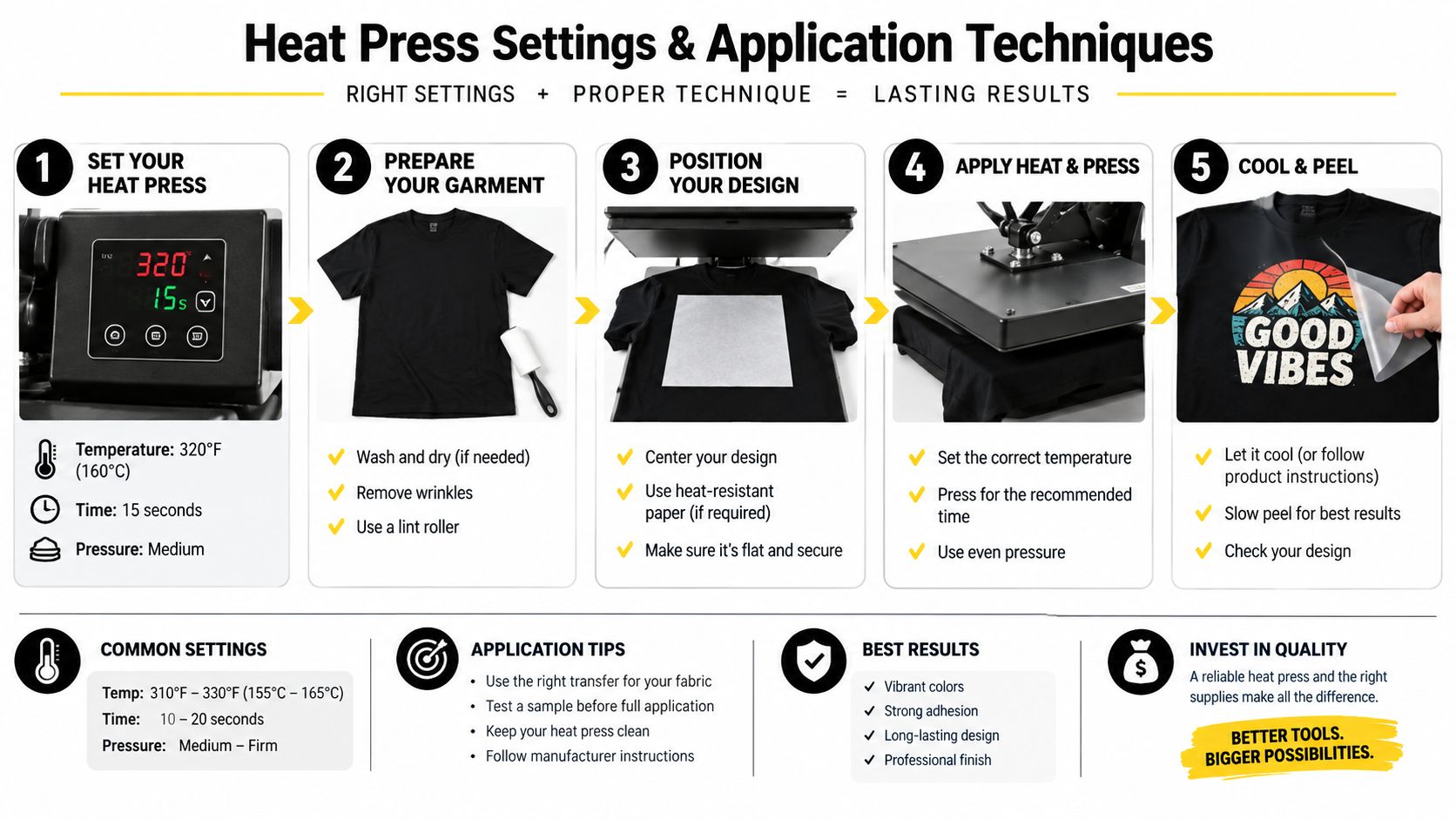
There isn't one universal DTF setting that works across every shirt. The transfer supplier's specification should control the starting point, and the blank manufacturer may impose additional limits. Exact temperature, dwell time, pressure, and peel method vary with the adhesive powder, film, press calibration, fabric dye, and garment finish.
Prepare the garment
Pre-press the shirt briefly to remove surface moisture and flatten the knit. This also reveals seams, folds, and pressure inconsistencies before you place the transfer. Use a firm, level platen and position the garment so the application area isn't sitting over a collar seam, pocket ridge, or thick side seam.
Cotton typically gives you more thermal latitude, but don't compensate for poor contact with excessive heat. Polyester and polyester-rich blends require a cautious process because high heat can cause scorching, dye migration, shine, or shrinkage. Rayon-containing tri-blends need particular care because their soft drape can respond poorly to aggressive pressure and temperature.
Build a controlled application routine
- Check the supplier specification. Start with the recommended temperature, dwell time, pressure, and peel instruction rather than copying a setting from another transfer.
- Press the test blank. Use the actual shirt color and construction. White polyester and dark heather polyester may behave differently under the same press.
- Apply consistent pressure. Too little pressure leaves incomplete contact. Too much pressure can flatten texture, distort the garment, or spread adhesive beyond the design.
- Peel as directed. Hot peel, warm peel, and cold peel films are not interchangeable. If the film resists release, stop rather than pulling the design from the fabric.
- Finish the surface. A short finishing press through the recommended protective sheet can improve contact and reduce unwanted gloss, but it should follow the transfer instructions.
Parchment or a Teflon sheet can protect the transfer during a finishing press, but a cover sheet won't correct a wrong temperature or a contaminated surface. For a fuller process reference, compare your supplier's instructions with this guide to DTF heat press settings.
Calibrate before production
Heat presses can display a temperature that differs from the platen's actual surface temperature. Check pressure and temperature consistency across the platen, especially if you produce large graphics. Record the approved setting for each fabric family, then retest when you change transfer supplier, film, powder, garment color, or press.
Wash Durability and Garment Care Instructions
The laundry is where a good decoration earns its place. A transfer can look perfect at the counter and still fail if the garment shrinks around it, the adhesive receives excessive dryer heat, or the customer uses a harsh cycle that stresses the print.
Cotton's higher absorption and tendency toward dimensional change make prewashing and stabilization important for production blanks. If the shirt changes shape while the transfer remains comparatively stable, the graphic may pucker at the edges or feel stiffer than expected. Polyester generally resists shrinkage more effectively, but heat can still affect the adhesive, surface finish, and color stability.
Write care instructions that match the blank
Give customers practical directions rather than a generic “wash cold” label. A useful care routine usually includes turning the shirt inside out, using a moderate wash temperature, avoiding harsh bleaching products, and choosing a drying method that doesn't expose the print to unnecessary heat. Air drying or a lower-heat setting can help preserve both the garment and the transfer.
Your DTF washing instructions should align with the exact transfer and blank combination. Test the finished shirt under the routine you recommend. If you sell a polyester performance shirt, don't approve the care copy using a cotton sample.
Laundry affects shedding as well as lifespan
Recent research complicates simplistic environmental advice about natural and synthetic fibers. A 2026 study reported that detergent choice and wash duration strongly affected microfiber release, with cotton averaging 617.34 ± 85.2 mg/kg per wash and nylon averaging 225.12 ± 30 mg/kg. The same research reported that adding a laundry ball increased shedding by 10–60% across tested fabrics. Read the findings in the KCI article on washing conditions and microfiber release.
A separate 2026 study found that lower wash speeds reduced shedding but lengthened drying time, while a higher speed combined with regular textile redistribution produced the lowest shedding with little drying-time penalty. The practical conclusion isn't that one fiber always wins. It's that wash duration, detergent, load movement, spin behavior, and drying all influence the result.
Customer-care principle: The most sustainable decorated shirt is often the one that stays wearable and attractive longer. Good care instructions protect the transfer, the blank, and the relationship with the buyer.
Matching the Right Fabric to Your Brand Use-Case
A useful fabric decision begins with the customer, not the transfer printer. Ask what the shirt must feel like, where it will be worn, how much movement it will experience, and which failure would hurt the brand most. Then select the blank and run a decorated wash test before you order production quantities.
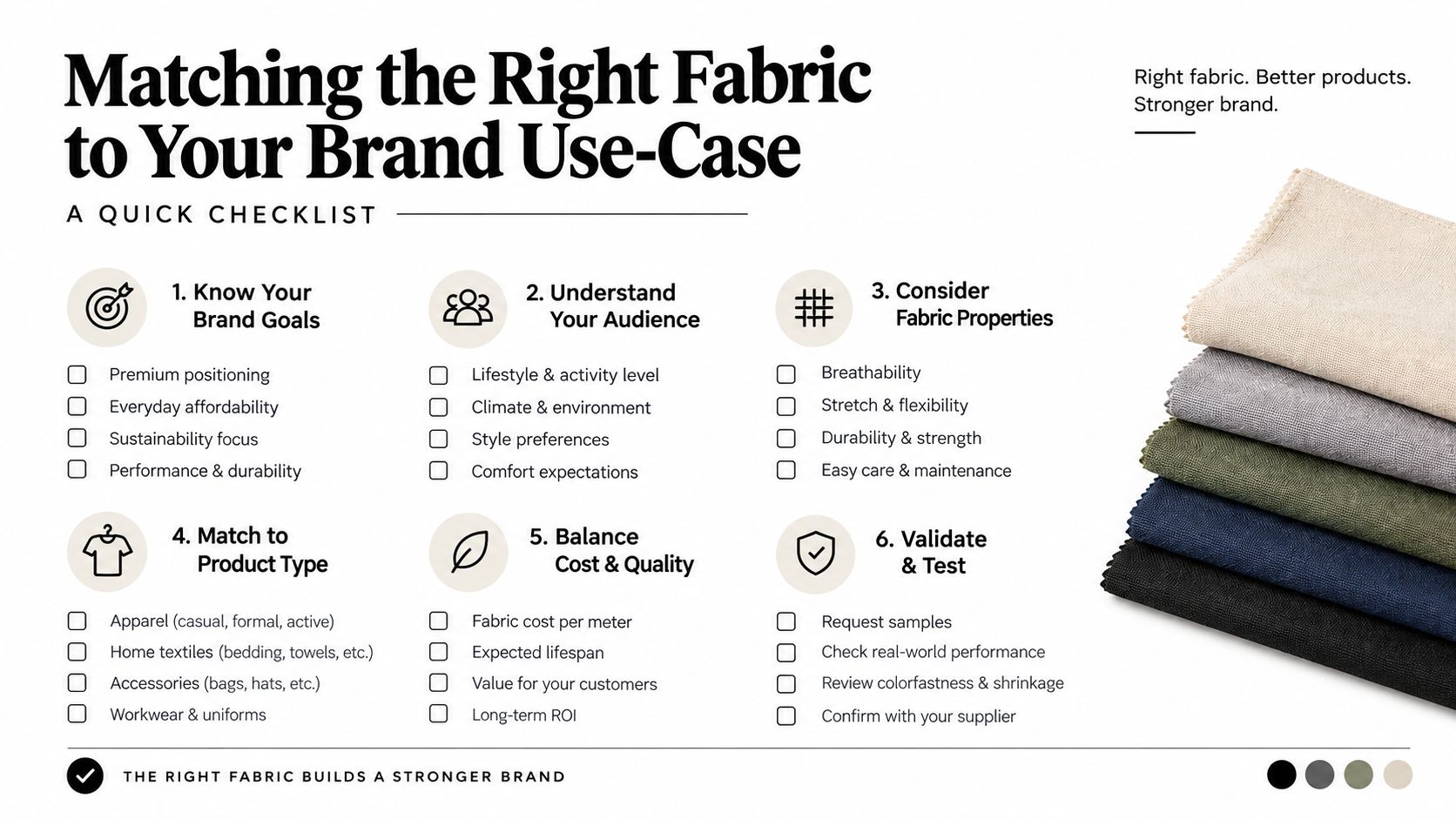
A practical selection matrix
High-volume promotional shirts need predictable sizing, clear logos, and a process that new operators can repeat. A conventional cotton or cotton-poly blank with a smooth enough surface is often easier to standardize than an unusually textured fashion blank. Keep the artwork bold, verify adhesion on the chosen color, and document the press routine.
Premium streetwear benefits from a deliberate silhouette. Heavy cotton can provide the structured body that supports oversized graphics, while a smooth ringspun blank can suit finer artwork and a softer hand. The right choice depends on whether the brand wants visual weight, tactile softness, or both.
Athletic and outdoor apparel should prioritize moisture behavior, stretch recovery, and dimensional stability. Polyester or engineered blends can make sense, but the application must respect heat sensitivity and dye migration risk. Test the transfer while stretching the garment, then repeat the wash and dry routine expected by the customer.
Fashion tri-blends offer drape and softness, but they can be less forgiving under the press. Use a smaller test run, avoid assuming that a cotton setting will transfer safely, and check whether the design remains comfortable when the fabric moves.
Test the product customers will receive
Fabric composition influences performance, but recent evidence shows that construction matters just as much. A 2025 durability study of 47 T-shirts found that price did not reliably predict physical durability, while fiber composition did influence performance, according to the University of Leeds repository record. The same body of evidence also shows that microfiber release can vary within polyester according to fabric openness, yarn density, weave, compactness, and mechanical behavior, rather than polymer type alone.
Use a small approval batch to compare blank, transfer, color, and care routine together. For visualizing garments before production, WearView can help teams review apparel presentation, but the final decision still belongs to the physical sample. Check print edges, surface feel, stretch recovery, wash appearance, shrinkage, and customer-facing care instructions.
The strongest custom apparel brands don't ask which of the types of shirt fabric is universally superior. They ask which construction supports the design, the wearer, and the production process with the fewest compromises.
Raccoon Transfers provides ready-to-press DTF transfers for cotton, polyester, blends, leather, and other listed materials, with artwork options that support bold color, fine detail, and different transfer sizes. Review your approved blank, application routine, and wash requirements, then visit Raccoon Transfers to prepare transfers for your next custom apparel run.