
A Guide to Finding Cheap Bulk Hoodies for Printing
Sourcing the right bulk hoodies for your print shop isn't just about finding the lowest price—it's about striking that perfect sweet spot between cost, quality, and what your project actually needs. After years in this business, I can tell you the smartest starting point is almost always a mid-weight 50/50 cotton/polyester blend. Why? It's durable, feels soft, and works beautifully with modern printing methods like DTF transfers, all without blowing up your budget.
This approach shifts your thinking from "what's cheapest?" to "what's most profitable?" for your brand.
Finding The Right Bulk Hoodies For Your Brand
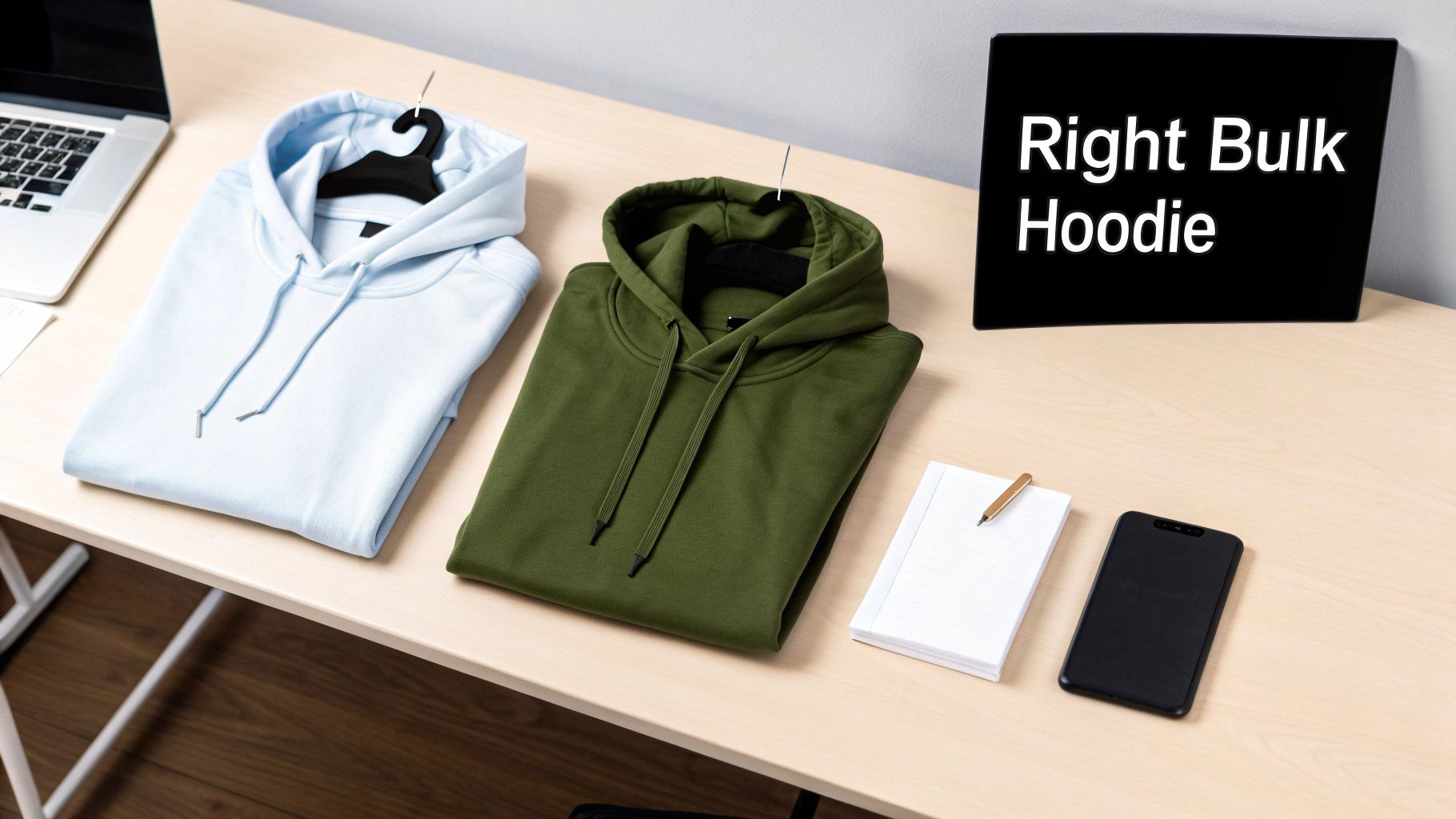
Honestly, picking the right blank hoodie is the foundation of your entire project. Get this wrong, and nothing else matters. Before you even think about price tags, you need to nail down a few key details to avoid headaches and wasted money later.
First things first: who are these hoodies for? The answer changes everything.
- Streetwear Brands? You'll probably need a heavier, more premium-feeling garment. Think oversized fits and a substantial feel that justifies a higher retail price.
- Corporate Apparel? Comfort and durability are king. The goal is a clean, professional look that holds up wash after wash and fits a wide range of body types.
- Promotional Events? Here, the focus often shifts to the most budget-friendly option that still looks presentable for a giveaway or one-time use.
Aligning Your Budget and Print Method
Once you know your audience, you can map out a realistic budget. The game isn't just about finding cheap bulk hoodies; it's about sourcing blanks that protect your profit margins without making you look bad. This is where your print method becomes a huge part of the conversation.
Old-school screen printing can be picky about fabrics and gets expensive fast with multi-color designs due to setup costs. But with newer tech like Direct-to-Film (DTF) transfers, the game completely changes. DTF works great on cotton, polyester, and pretty much any blend you can throw at it.
Suddenly, you're free to choose a hoodie based on its feel, fit, and price, not just whether your print method can handle it.
Key Takeaway: Stop thinking about your hoodie and print method separately. A cheap blank is only a good deal if it presses perfectly with your transfers and lives up to what your customers expect.
Here’s a quick rundown to keep the most important factors top of mind while you're shopping around.
Key Hoodie Factors at a Glance
| Factor | Why It Matters for Cost | Best For DTF/UV-DTF |
|---|---|---|
| Fabric Blend | 100% cotton is often pricier. 50/50 blends offer a great balance of feel and affordability. | Blends (50/50 or 80/20) and 100% cotton are both excellent. DTF is very forgiving. |
| Weight (GSM/oz) | Heavier hoodies cost more. A mid-weight (8-9 oz) is the sweet spot for value. | Mid-weight (8-10 oz) provides a stable, smooth surface for perfect transfer adhesion. |
| Construction | Features like double-needle stitching or metal eyelets increase cost but also perceived value. | A smooth, tight-knit fleece surface is ideal. Avoid overly textured or loose-knit fabrics. |
| Brand Name | Premium brands command higher prices. Lesser-known but reliable brands offer big savings. | Brand doesn't matter for compatibility, but a quality garment prevents dye migration issues. |
Ultimately, this table is your cheat sheet for balancing what you pay against what you get. A slightly more expensive hoodie might be worth it if it feels better and takes a print flawlessly.
Sourcing Your Hoodies Effectively
With your criteria locked in, it's time to find a supplier. This often means looking at both domestic wholesalers and global marketplaces. If you're exploring overseas options for competitive pricing, a good modern guide on how to buy on Alibaba is invaluable for navigating that process.
For finding reliable partners closer to home, our guide on the top wholesale blank apparel suppliers is a great place to start.
The demand for this stuff is no joke. The global market for custom hoodies and sweatshirts hit USD 3,519.1 million in 2024 and is expected to climb to over USD 6.1 billion by 2030. Thanks to better supply chains, the per-unit costs have dropped, making it a fantastic time to be in this business.
Getting the Feel Right: Materials and Weights
The fabric of a hoodie is everything. It's the first thing your customer notices, defining how it feels, its perceived quality, and—most importantly for us—how well your designs will print and last. Don't just pick the cheapest option on the list; getting a handle on the fabric is the secret to sourcing affordable bulk hoodies that feel anything but cheap.
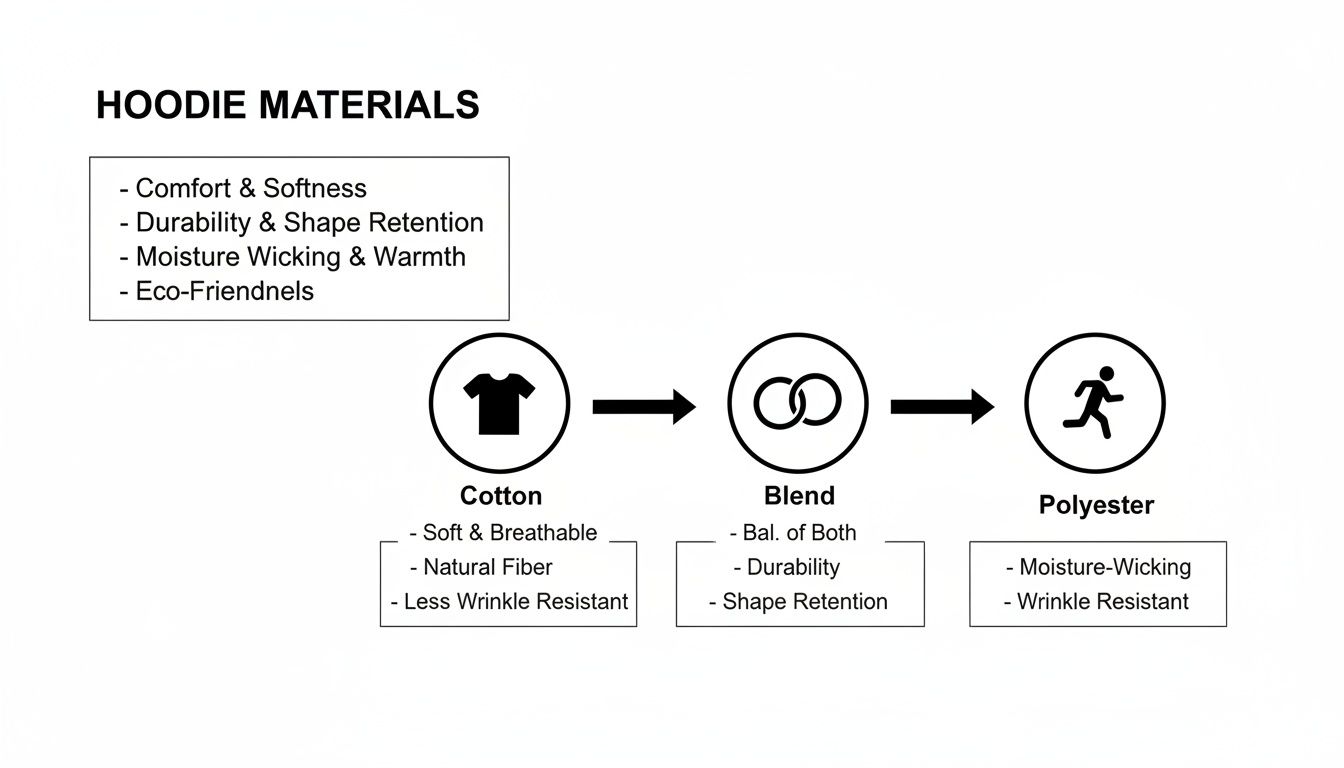
You'll mainly run into three options: 100% cotton, polyester, and the ever-popular cotton/poly blends. Each one serves a different purpose.
- 100% Cotton: This is the classic choice for a premium, breathable feel. People love the natural softness, but it often comes with a higher price tag and can shrink if it's not pre-treated.
- 100% Polyester: Think of this as the workhorse fabric. It’s incredibly durable, wicks moisture, and fights off wrinkles and shrinking. It's the go-to for athletic apparel or work uniforms where performance is key.
- Cotton/Poly Blends (50/50, 80/20): Here’s the sweet spot. You get the best of both worlds—the soft touch of cotton combined with the resilience and easy care of polyester. For most clothing brands, an 80/20 or 50/50 blend strikes the perfect balance of quality, feel, and cost.
We go much deeper into how fabrics behave in our complete guide to t-shirt materials. The same principles are a perfect roadmap for hoodies, too.
Decoding Fabric Weight
Once you've settled on a material, the next big decision is fabric weight. You'll see this measured in ounces per square yard (oz) or grams per square meter (GSM). This number basically tells you how thick and substantial the hoodie is going to feel in hand.
- Lightweight (Under 8 oz / <270 GSM): These are great for layering or for brands targeting customers in warmer climates. They're usually more affordable but can sometimes feel a bit thin.
- Mid-weight (8-10 oz / 270-340 GSM): This is the industry standard for a reason. It feels high-quality, holds up well, and gives you a fantastic, stable surface for printing without being too bulky or expensive.
- Heavyweight (10+ oz / >340 GSM): Reserved for premium streetwear or rugged workwear lines. These hoodies have a luxurious, weighty feel but expect the price to match.
The demand for hoodies is absolutely massive—it hit USD 227.31 billion in 2024 and is on track to reach a staggering USD 381.40 billion by 2032. A lot of that growth is in synthetics and blends because of their durability and stretch, which happen to be perfect for modern printing. You can dig into more of the data on this booming apparel market on fortunebusinessinsights.com.
This chart really puts the opportunity into perspective, showing just how much of that global market is right here in North America.
With a market value of USD 91.68 billion in 2024, North America is the biggest player, which is fantastic news for any US-based brand.
Make Sure Your Material and Print Method Match
Finally, you have to make sure your hoodie fabric plays nice with your chosen print method. Some techniques, like screen printing, can be notoriously picky about materials. This is one area where DTF transfers really pull ahead of the pack.
Why DTF Wins: Raccoon Transfers' DTF technology is designed to work on pretty much any fabric you can throw at it—100% cotton, polyester, and any blend in between. This gives you total freedom. You can pick your hoodies based on the vibe and budget of your brand, not the limitations of your printer. It means you can source affordable bulk hoodies without ever worrying if your design will come out looking vibrant and durable.
Comparing Print Methods For Your Bulk Order
Once you've nailed down the right hoodie, your next big decision is how you're going to print on it. This isn't just about aesthetics; it directly impacts your costs, the complexity of the designs you can offer, and how nimble your business can be. Let's walk through the main options from a real-world, small-business perspective.
Traditional Screen Printing: High Costs And Design Limits
Screen printing is the old guard of the apparel world. For decades, it's been the go-to for durable, vibrant prints. The process involves creating a custom mesh screen for each color in your design and then pushing ink through it onto the garment.
It sounds simple enough, but the setup is where things get tricky. Each screen costs money to create. So, if your design has five colors, you're paying for five separate screens before a single hoodie is even printed. This makes it a great choice for a massive run of one or two-color logos, but the costs quickly become prohibitive for intricate, multi-color designs or smaller batches.
DTG Printing: Great For Cotton, But That's About It
Direct-to-Garment (DTG) is essentially a specialized inkjet printer for t-shirts. It's fantastic for creating full-color, photorealistic images with incredible detail, and best of all, there are no screen setup fees.
Here’s the catch: DTG printers are picky. They really only work well on 100% cotton. The ink just doesn't bond properly to polyester or poly-blends, often resulting in faded, washed-out prints. Since many affordable bulk hoodies are 50/50 cotton/poly blends to keep costs down, DTG is often a non-starter. Our guide on DTF vs. DTG printing dives even deeper into this.
DTF Transfers: The Modern, Do-It-All Solution
This is where Direct-to-Film (DTF) transfers come in and completely change the game. DTF works by printing your design onto a sheet of transfer film, which you then heat press onto literally any garment. It neatly sidesteps the limitations of both screen printing and DTG.
For anyone ordering bulk hoodies, the advantages are impossible to ignore:
- No Per-Color Fees: A design with one color costs the same as a design with a hundred. Gradients, photos, and fine details are no problem.
- Zero Setup Costs: You aren't paying for screens to be made. This makes small runs and one-off samples just as affordable as large orders.
- Works on Anything: This is the biggest win. DTF transfers adhere perfectly to cotton, polyester, blends, tri-blends, and even materials like leather or nylon. You can pick the best-priced hoodie you can find, regardless of its material.
This material freedom is huge. You can focus on the fabric weight, feel, and price of your hoodies without ever having to worry if your design will print correctly.
Print Method Comparison for Bulk Hoodies
To make it even clearer, here's a side-by-side look at how these three popular methods stack up when you're ordering hoodies in bulk.
| Feature | DTF Transfers | Traditional Screen Printing | Direct-to-Garment (DTG) |
|---|---|---|---|
| Best For | Complex, multi-color designs on any fabric type. | Simple, low-color designs on very large bulk orders. | Detailed, full-color designs on 100% cotton garments. |
| Fabric Compatibility | Excellent (Cotton, Polyester, Blends, Tri-blends, etc.) | Good (Primarily cotton and blends). | Poor (Best on cotton; struggles with poly/blends). |
| Color/Detail | Unlimited colors and photorealistic detail at no extra cost. | Limited. Each color adds significant cost and setup time. | Excellent full-color detail, but can fade on non-cottons. |
| Setup Costs | None. | High. A new screen is needed for every color in the design. | None. |
| Cost at Low Volume | Very low and affordable. | Extremely high; not practical for small runs. | Moderate, but limited by garment choice. |
| Feel of Print | Soft, flexible, and durable. | Can be thick and heavy depending on ink layers. | Very soft, as ink soaks into the fabric. |
As you can see, DTF transfers offer the most flexibility and cost-effectiveness for modern apparel businesses, especially when dealing with the varied materials found in affordable bulk hoodies. It lets you say "yes" to more designs and more garment types without blowing your budget.
How to Place Your Bulk Order Like a Pro
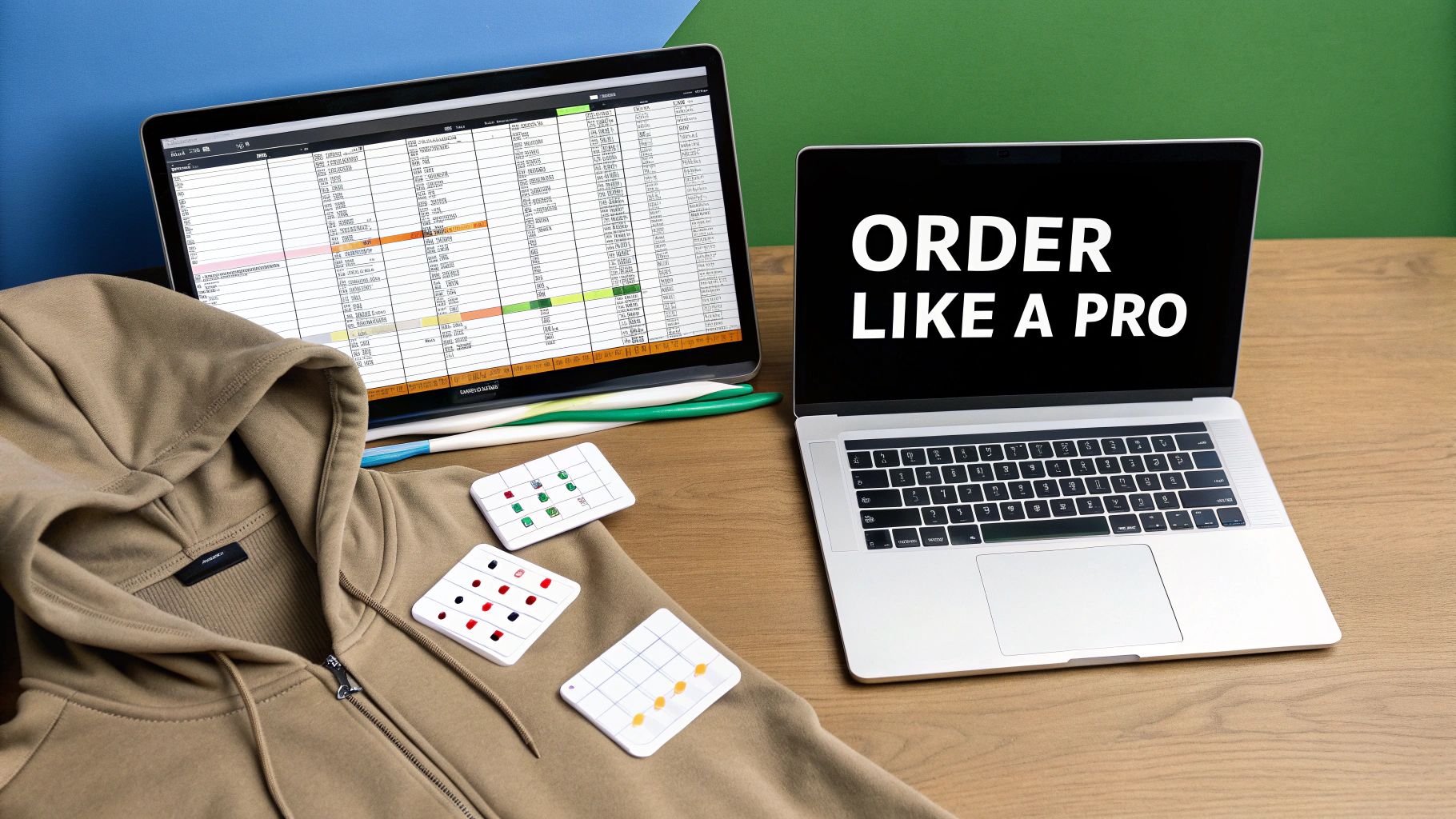
Okay, you’ve picked your hoodie style and know your print method. Now comes the moment of truth: actually buying the blanks. Pulling the trigger on a big order for the first time can be intimidating, but a little bit of strategy goes a long way in protecting your cash and avoiding rookie mistakes.
Your first move is to vet your wholesale suppliers. You’re looking for more than just a good price; you need clear communication and a solid track record. The most important detail to nail down is their Minimum Order Quantity (MOQ). Some suppliers might lock you into buying 50 or 100 pieces of the exact same style and color. Others are way more flexible, letting you mix and match sizes and colors to hit that minimum. That flexibility is gold when you're starting out.
If you’re sourcing internationally to get the absolute best prices, logistics become a big part of the game. Knowing how to track packages from China is a skill that will save you a ton of headaches and keep your production on schedule.
Plan Your Sizes and Colors Strategically
One of the costliest mistakes I see new brands make is just guessing their size and color splits. Don’t do it. Base your order on actual data. If you have any past sales history, dig into those numbers and see what sizes and colors your customers actually bought.
No sales data yet? No problem. A safe bet is to follow a classic bell curve distribution. It looks something like this:
- Small: 10%
- Medium: 25%
- Large: 30%
- X-Large: 25%
- XX-Large: 10%
This simple ratio helps you avoid getting stuck with a pile of 3XL hoodies in a weird color nobody wants. For your first big run, stick to the heavy hitters—black, heather gray, navy—to make sure you can sell through your entire stock.
Pro Tip: Never, ever place a bulk order without getting a sample first. Photos can be deceiving. You need to touch the fabric, check the stitching, and see how it fits in person before committing hundreds or thousands of dollars.
Integrating Your Prints for Maximum Efficiency
While you’re waiting for those hoodie samples to land on your doorstep, you can be getting your prints dialed in. This is where you can unlock some serious savings. Instead of paying for a bunch of individual transfers, you can group them all together using an online gang sheet builder, like the one we have at Raccoon Transfers.
A gang sheet is exactly what it sounds like: you arrange multiple graphics onto a single, large transfer sheet. Think of it as Tetris for your designs.
On just one sheet, you could easily fit:
- Four large chest logos for your main hoodie designs.
- Eight smaller left-chest logos for a corporate client's order.
- Ten sleeve graphics for some extra branding flair.
- Twenty neck tag labels to give your hoodies a truly professional finish.
The beauty of this is that you pay for the sheet, not for each individual design on it. This move absolutely crushes your per-print cost across the entire run of cheap bulk hoodies for printing. When your blank hoodies arrive, your DTF transfers are already printed and waiting, letting you move straight to pressing. It’s a seamless and incredibly cost-effective workflow.
Squeezing Every Drop of Profit from Your Hoodie Order
Getting a good deal on your blank hoodies is a great first step, but it's not where the real money is made. The smartest brands know that true savings come from the clever, strategic moves you make after the purchase. This is how you turn a decent deal into a wildly profitable venture.
Think about timing and relationships. A lot of suppliers will cut you a deal during their slow months—usually spring and summer when nobody's thinking about fleece. Placing a big order then can knock a surprising amount off your invoice. At the same time, don't underestimate the power of simply being a good, repeat customer. Loyalty often leads to better pricing and more flexible payment terms down the road.
Don't Pay for Empty Space: The Gang Sheet Strategy
Here's a pro-tip that can fundamentally change your cost structure: gang sheets. This is the single biggest secret weapon for slashing your per-item print cost. The idea is simple: you pay for the entire transfer sheet, so you should use every last inch of it.
Let's say you're printing a massive design for the back of a hoodie. That's fine, but look at all that empty space left on the sheet. That's wasted money. Instead, use a gang sheet builder to pack that space with other valuable graphics.
Here's how it plays out in the real world: On just one 22x60 inch DTF gang sheet, we’ve easily fit four huge back designs, ten smaller chest logos for another job, and a full run of twenty custom neck tag labels. By ganging them all up, the print cost for those extra logos and tags drops to practically zero. Your profit margin on every single hoodie just shot through the roof.
The In-House vs. Outsourcing Debate: A Clear Winner for Profit
Now, you have to decide who will actually press the transfers onto the hoodies. You can do it yourself or pay a fulfillment company to handle it. While outsourcing sounds convenient, those service fees are a silent killer of your profit margin.
Bringing the work in-house puts you in complete control and dramatically cuts your production costs. And with modern transfers like the DTF and UV-DTF options from Raccoon Transfers, the application process is incredibly simple. You don't need a giant factory—just a reliable heat press. It's a one-time investment that pays for itself faster than you'd think.
Let's break it down:
- In-House Pressing: You set the schedule. You do quality control on the spot. Your only real costs are the blank hoodie and the transfer. This is how you maximize your margins, period.
- Outsourced Fulfillment: You're paying for someone else's labor, their facility's overhead, and their profit. This can easily tack on several dollars to your cost per hoodie, making it tough to offer competitive pricing.
For any brand serious about its bottom line, bringing that final pressing step in-house isn't just an option; it's a critical business decision. You get to control the quality and keep the profit that you earned.
Got Questions About Bulk Hoodies? We’ve Got Answers.
When you're diving into the world of bulk hoodies, a few questions always pop up. You're trying to find that sweet spot between affordable prices and print-ready quality, and it's easy to get turned around. Let's clear up some of the most common questions we hear from printers just like you.
What’s The Best Material To Print On?
Honestly, the "best" material depends entirely on what you're making and who you're making it for.
The go-to workhorse for most print shops is a solid 50/50 cotton/polyester blend. It's the best of both worlds—you get the soft, natural feel of cotton and the durability and color-fastness of polyester. It’s a fantastic canvas for DTF transfers and hits a great price point.
If you’re chasing a more premium, "retail" vibe, nothing beats 100% cotton for its breathability and soft hand-feel. On the other end of the spectrum, for athletic apparel or workwear, 100% polyester is king because it wicks moisture and holds up to a beating. The great news? With modern DTF transfers, you don't have to stress about compatibility. They adhere beautifully to all three.
How Do I Actually Get The Best Price?
Scoring the best deal isn't just about finding the lowest sticker price online. The real savings come from buying smarter, not just cheaper.
- Play the long game with suppliers. Don't just jump from vendor to vendor chasing a sale. Building a relationship with a trusted supplier can unlock better pricing and more flexibility down the road. They'll start to look out for you.
- Buy when no one else is. Think ahead. Stock up on fleece and hoodies in the spring and summer. Demand is low, and suppliers are often eager to clear out inventory, which means better deals for you.
- Go big (but less often). Instead of placing a bunch of small orders, consolidate them. Larger, less frequent orders almost always qualify for better volume discounts and slash your shipping costs per piece.
Should I Pre-Wash Hoodies Before Pressing?
This one comes up all the time. The short answer is no, you almost never need to pre-wash brand-new hoodies before applying your DTF transfers. They come from the manufacturer ready to press.
In fact, washing them can sometimes cause more harm than good by introducing fabric softeners or moisture that can mess with the transfer's adhesive.
The only time you should do anything beforehand is if a hoodie is super wrinkled from shipping. A quick pre-press with your heat press for 5-10 seconds will knock out the wrinkles and any ambient moisture, giving you a perfectly flat, dry surface for the transfer. It’s a tiny step that makes a huge difference.
A Pro Tip We Swear By: Never, ever commit to a huge order without getting a physical sample in your hands first. A hoodie can look amazing in a product photo but feel cheap or fit weirdly in person. That small investment in a sample can save you from a very expensive headache.
Ready to match those perfect hoodies with a print that won't let you down? At Raccoon Transfers, we specialize in top-quality, hassle-free DTF transfers. You can build your own gang sheet online in minutes and see the savings pile up.