
How to Start a Custom T Shirt Business A Founder's Guide
So, you've got an idea for a T-shirt business. That’s the easy part. The real work is turning that spark into a genuine brand that people actually want to buy from and wear. This guide is your no-nonsense playbook for doing just that, breaking down the entire process into clear, manageable steps.
We'll skip the fluff and focus on what really moves the needle: finding a profitable niche, sketching out a lean business plan, picking a smart production method like Direct to Film (DTF), and rolling out a marketing plan that gets you seen.
Your Blueprint for a Modern T-Shirt Brand
Building a T-shirt business today is about more than just slapping a cool graphic on a blank tee. It’s about creating a brand that resonates with a specific community and tells a story people want to be a part of. This guide is designed to be your roadmap, cutting through the noise to show you how real founders get from idea to a profitable online store.
And your timing is perfect. The hunger for unique, personalized apparel is absolutely booming. The custom T-shirt printing market was valued at a massive $8.17 billion in 2024 and is expected to climb to nearly $9 billion in 2025.
This isn't just a trend; it's a fundamental shift in how people shop. Forecasts show the market rocketing to an incredible $13.55 billion by 2029. You can dive deeper into the numbers by exploring this custom apparel industry growth report.
Startup Action Plan At a Glance
To give you a clear picture of the journey ahead, this table breaks down the core phases we'll be covering. Think of it as our high-level game plan for getting your brand off the ground.
| Phase | Key Actions | Primary Goal |
|---|---|---|
| 1. Foundation & Strategy | Niche selection, brand identity, business plan, legal setup. | To build a solid strategic foundation and a clear brand direction. |
| 2. Design & Production | Artwork creation, sourcing blanks, choosing a print method (DTF). | To establish an efficient workflow for creating high-quality products. |
| 3. Sourcing & Setup | Finding suppliers, ordering samples, setting up your heat press station. | To assemble the physical tools and materials needed for production. |
| 4. Sales & Marketing | Building an online store, photography, launching marketing campaigns. | To attract your target audience and generate your first sales. |
| 5. Operations & Growth | Order fulfillment, customer service, scaling your marketing efforts. | To create a repeatable process for growth and customer satisfaction. |
Each of these phases contains critical decisions that will shape your business. We’ll walk through all of them, step-by-step.
What You'll Learn in This Guide
Forget theory. This is a hands-on playbook packed with the practical, actionable advice you need to navigate the exciting—and sometimes tricky—world of custom apparel. We're zeroing in on a modern, lean approach that prioritizes efficiency and minimizes startup costs.
Here’s a quick look at what’s inside:
- Finding a Niche With Real Customers: I'll show you how to pinpoint and validate a target audience that is already searching for the kinds of designs you want to create.
- Creating a Lean Business Plan: We're not writing a 50-page novel. We’ll build a simple, one-page roadmap that keeps you focused on what matters.
- Choosing Your Production Method: We'll break down the pros and cons of screen printing, Direct-to-Garment (DTG), and Direct-to-Film (DTF), with a deep dive into why DTF is such a game-changer for new brands.
- Launching a Smart Marketing Strategy: You don't need a huge budget to make a splash. I'll share proven tactics to get your brand noticed and drive those crucial first sales.
Consider this guide your experienced partner in this venture. It's here to give you the clarity and confidence to launch a brand that doesn't just look great, but is built to be profitable and sustainable. Let’s get to work.
Finding Your Niche and Crafting Your Business Plan
The most successful T-shirt brands I’ve seen don't try to be everything to everyone. They thrive by building real connections with very specific communities—they speak their language, get their inside jokes, and reflect their passions. This is the magic of a niche, and figuring out yours is the first real step toward building a business that actually lasts.
Trying to appeal to the masses is a fast track to getting lost in the noise. My advice? Think smaller. Go deeper. A niche isn't just a category; it's a tribe of people brought together by a shared interest, a quirky hobby, or a common identity. These are your people.
Brainstorming a Profitable Niche
Your best ideas usually show up at the intersection of what you're passionate about, what you know well, and what people are actually willing to spend money on. Don't get stuck in analysis paralysis here. Just grab a notebook and start a running list.
- Your Hobbies and Passions: Are you obsessed with vintage cars, run a Dungeons & Dragons campaign, or spend your weekends gardening? Maybe you're part of a local hiking club. All of these are fantastic starting points.
- Your Profession or Expertise: Think about it—a hilarious T-shirt for nurses on a long shift, a clever design for software developers, or an inside joke for electricians. These create an instant bond.
- Subcultures and Communities: What about skaters, book club members, urban explorers, or vegan home cooks? These groups have their own unique vibes and values you can tap into.
- Emerging Trends: Keep an eye on what's buzzing on TikTok, in movies, or in the gaming world. A well-timed design can catch a wave of excitement.
A great niche makes marketing feel less like marketing and more like a conversation. When you truly get your audience's pain points and triumphs, you can create designs that make them feel seen. Suddenly, it’s not just a T-shirt; it’s a badge of identity.
Validating Your T-Shirt Business Idea
Okay, so you have a few solid ideas. Now it's time to do some digging to see if they have legs. A brilliant concept is only brilliant if there’s an audience ready to pull out their wallets.
Start your sleuthing on marketplaces like Etsy and Amazon. Search for terms like "funny fishing t-shirt" or "retro gaming apparel." If you find a bunch of products with thousands of glowing reviews, that's a huge green flag. It means people are actively buying.
Next, jump over to social media. Search for hashtags related to your niche on Instagram and TikTok. Are there active communities? Are people sharing posts about their passion? A lively online presence is your confirmation that you can actually reach these customers.
Building Your Lean Business Plan
Forget that 50-page formal document you might be picturing. For a nimble T-shirt business like this, all you need is a simple, one-page roadmap to keep you pointed in the right direction. Its only job is to define your goals and sketch out how you’ll get there, without getting bogged down.
Your lean plan should just answer a few core questions:
- What's my brand's mission? (e.g., "To create witty, high-quality apparel for rock climbing enthusiasts.")
- Who is my ideal customer? (Jot down a quick profile: their age, interests, and where they hang out online.)
- What makes my brand different? (Is it your unique artistic style, your sense of humor, or maybe you use eco-friendly materials?)
- How will I price my products? (Figure out your costs for a blank tee, the DTF transfer, and shipping, then add your profit margin.)
- How will I actually reach my customers? (e.g., "Through targeted Instagram ads and by collaborating with climbing influencers.")
This simple framework becomes your North Star, guiding every decision you make, from design choices to your marketing budget. For a more detailed look at a similar business model, check out our guide on how to start a print on demand business.
Defining Your Legal and Financial Foundation
Before you sell that first shirt, you need to get your legal house in order. This isn't just about bureaucracy; it's about protecting yourself and operating above board. The two most common paths for new entrepreneurs are a sole proprietorship or a Limited Liability Company (LLC). A sole proprietorship is dead simple to set up, but an LLC provides a crucial layer of liability protection by separating your personal assets from your business assets.
Choosing the right legal structure is a key part of your business plan. It's a good idea to explore the different business types in Canada to see what might fit you best. Keep in mind that requirements can vary quite a bit depending on where you live, so always do your homework on local regulations.
The custom apparel world is massive. We're talking about a global T-shirt market where around 2 billion shirts are sold annually. Zooming in, the custom screen printing industry in the United States alone is made up of over 15,427 businesses and has seen some serious growth. You can see more on this in this report on the custom T-shirt printing market. Having a solid plan and the right legal setup from the start means you're ready to claim your piece of this exciting market.
Mastering Your Designs and Production Methods
Your designs are the soul of your brand, but your production method is the engine that actually brings them to life. Getting these two right is where the magic happens in a T-shirt business. This is the point where your creative ideas meet the nuts and bolts of making a real, physical product people will be excited to wear.
Let's talk about the creative side first. Whether you're a Photoshop pro or can't draw a stick figure to save your life, you've got options for creating great T-shirt graphics. The goal isn't just making something that looks cool, but something that’s properly formatted for printing.
This simple workflow gives you a birds-eye view of how to connect your niche to your design ideas.
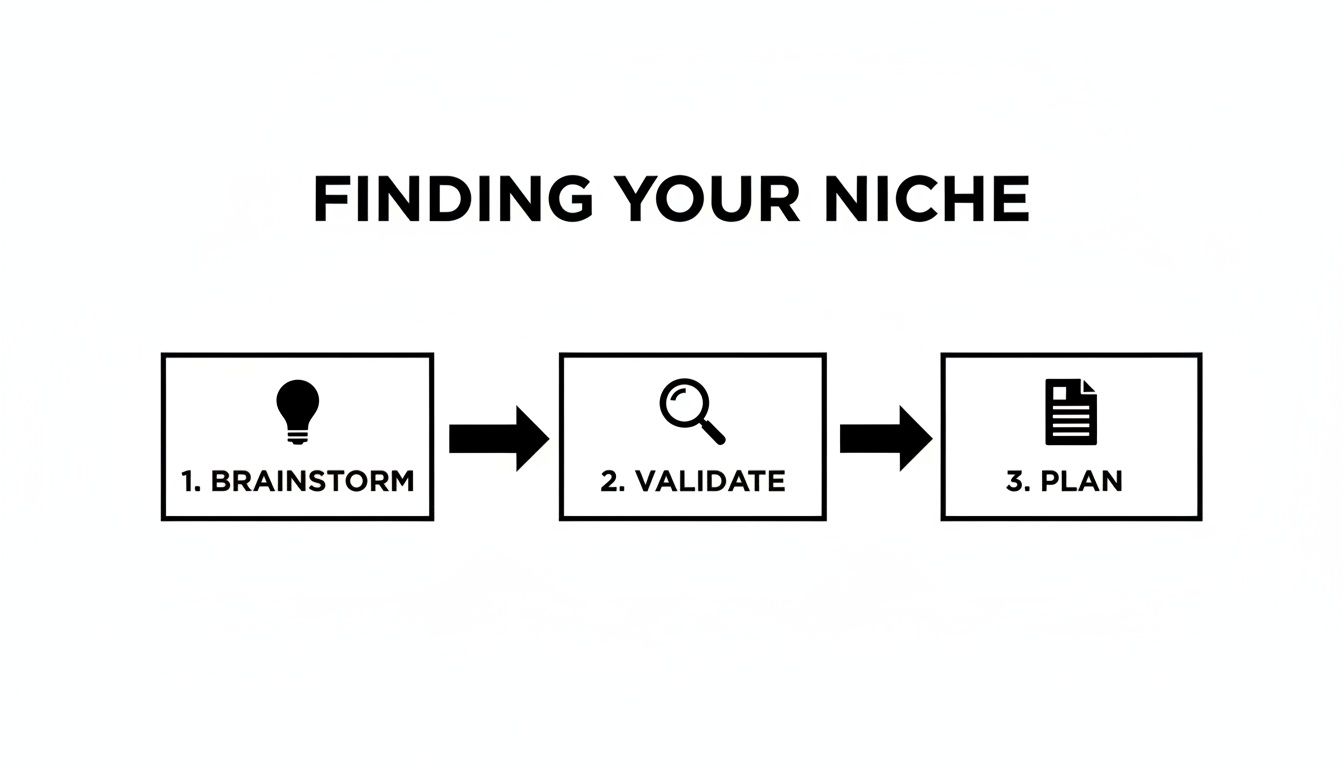
Following a process like this stops you from wasting time and money designing for an audience that doesn't exist. It grounds your creativity in a real market need.
Creating Print-Ready Designs
If you have some design chops, tools like Adobe Illustrator or Affinity Designer are your best friends. They're built for creating vector graphics, which is the gold standard. Vectors can be scaled to any size—from a small pocket logo to a giant back piece—without getting blurry.
No design skills? No sweat. Modern platforms have made design accessible to everyone. Canva is fantastic for beginners, with tons of templates and easy-to-use tools. For something more custom, you can always hire a pro from a freelance marketplace.
- Fiverr: This is my go-to for quick, affordable projects. It’s perfect when you need a simple graphic or want to test a few different design concepts without breaking the bank.
- Upwork: If you need something more involved, like building out a whole brand identity, Upwork is where you'll find more experienced, long-term freelance partners.
No matter how you create the artwork, the final files must be "print-ready." This is a non-negotiable step that ensures your printer can produce a clean, sharp final product.
A print-ready file is your ticket to a professional-looking shirt. You'll typically need a high-resolution (300 DPI) PNG file with a transparent background. This specific format is crucial—it prevents that ugly colored box from printing around your design and keeps everything looking crisp.
Comparing T-Shirt Production Methods
With your designs ready to go, the next big decision is how you're going to print your shirts. There are three main ways to do it, and the right choice really boils down to your budget, how many shirts you plan to make, and how complex your designs are.
Choosing the right production method is a foundational decision for your T-shirt business. This table breaks down the big three—Screen Printing, Direct-to-Garment (DTG), and Direct-to-Film (DTF)—so you can see how they stack up against each other.
Comparing T-Shirt Production Methods
| Method | Best For | Startup Cost | Durability | Per-Unit Cost |
|---|---|---|---|---|
| Screen Printing | Large batches (100+) of simple, low-color designs. | High | Excellent | Low (at scale) |
| Direct-to-Garment (DTG) | Small batches and one-offs with complex, full-color designs. | High (for machine) | Good | High (for one-offs) |
| Direct-to-Film (DTF) | Small to medium batches, full-color designs, versatile fabrics. | Low (with supplier) | Excellent | Moderate |
The biggest takeaway here is the startup cost. For most people just starting out, the high price of screen printing equipment or a professional DTG machine is a massive hurdle. This is exactly why the third option has become such a game-changer.
Why DTF Transfers Are Ideal for Startups
Direct-to-Film (DTF) transfers have completely changed the game for new T-shirt brands. Here’s how it works: you partner with a supplier who prints your designs onto a special film. They ship you the printed transfers, and all you have to do is use a heat press to apply them to your blank T-shirts.
This approach gives you the best of both worlds.
You get the vibrant, full-color quality of a high-end DTG print combined with the incredible durability of screen printing, but without spending thousands of dollars on equipment. The only big piece of hardware you need to buy is a quality heat press, which is a fraction of the cost of a commercial printer.
Working with a DTF transfer supplier makes your whole operation incredibly simple:
- First, you create your design.
- Next, you upload the print-ready file to your supplier.
- They print and ship the transfers straight to your door.
- Finally, you press the transfers onto blank shirts as the orders roll in.
This print-on-demand model means you don't have to guess which designs will be a hit. You can hold zero inventory of finished shirts, eliminating the risk of getting stuck with a pile of duds that never sold.
Maximizing Value With Gang Sheets
Here's a pro-tip for keeping your costs low with DTF: use gang sheets. A gang sheet is just a large sheet of transfer film that you can fill up with as many different designs as you can fit. Instead of paying for each individual transfer, you pay for the entire sheet.
For instance, you could cram two big front-of-shirt designs, four smaller pocket logos, and a handful of sleeve graphics all onto one 22" x 60" gang sheet. This trick drastically lowers your cost per individual design, which pads your profit margin on every single shirt you sell.
Most suppliers (including us at Raccoon Transfers) have an online builder that makes this super easy—you just drag and drop your artwork to arrange it on the sheet. It's a simple strategy, but it has a huge impact on your bottom line.
Getting Your Operations and Supply Chain in Order
This is the part where your brand vision gets real. It's time to figure out how you'll actually make and sell physical products. Don't worry, this isn't about complex logistics software. It’s about making smart, straightforward choices on your materials and suppliers to set yourself up for quality and profit. The goal here is a reliable system for turning your designs into awesome T-shirts people will be excited to wear.
The foundation of any great T-shirt is, of course, the shirt itself. Finding the right blank apparel is one of the most critical decisions you'll make. It’s what directly affects how happy your customers are, what they think of your brand, and how much money you make.
Sourcing High-Quality Blank T-Shirts
Resist the temptation to just grab the cheapest tees you can find. The feel, fit, and how well the shirt holds up after a few washes are what will bring customers back again and again. A killer design on a scratchy, poorly-fitting shirt is a fast track to a one-star review.
When you're looking at blank shirts, zoom in on a few key things:
- Fabric Blends: A 100% ringspun cotton tee feels soft and premium, making it a perfect canvas for most designs. If you're going for a more athletic or vintage look, a 50/50 cotton/polyester blend adds a little stretch and is super durable.
- Fit and Style: Are you picturing a modern, slim-fit look or a more classic, relaxed fit? Think about who you're selling to. A streetwear brand might want a heavyweight, boxy-fit shirt, while a brand focused on yoga or wellness would probably lean towards softer, more fitted styles.
- Ethical Sourcing: Shoppers today genuinely care about where their stuff comes from. Try to find suppliers that are transparent about ethical manufacturing and sustainability.
My best advice? Always order samples before you place a big wholesale order. Wear them. Wash them. See how they hold up. This small investment upfront can save you from a massive quality control headache later on.
To get started, you'll need to work with wholesale suppliers that offer bulk pricing. Big names like SanMar, S&S Activewear, and AlphaBoder are industry standards for a reason. We've actually put together a detailed guide on the best wholesale blank apparel suppliers that can help you find the perfect partner for your brand.
Choosing Your Essential Equipment
If you're going with the Direct-to-Film (DTF) model we've been talking about, the good news is your equipment list is refreshingly short. You don't need a giant, expensive printer taking up your entire garage. Your whole production setup really just comes down to one crucial machine.
Your most important investment will be a quality heat press. This is the heart of your operation—it's what permanently bonds your DTF transfer to the fabric. It can be tempting to snag a cheap press off Amazon, but trust me, this is not the place to cut corners.
An unreliable press often means inconsistent pressure and spotty heat, which leads to transfers that peel, crack, or fade after just a couple of washes. Look for a clamshell or swing-away press that gives you solid temperature control and even pressure across the whole platen. A 16" x 20" press is a really versatile size that can handle everything from standard T-shirts to oversized hoodies.
Calculating Your Cost of Goods Sold
You absolutely have to know your numbers to run a profitable business. Before you can even think about a retail price, you need to know exactly what it costs you to produce one finished shirt. This is your Cost of Goods Sold (COGS).
Let's walk through a real-world example to make it crystal clear.
Real-World Cost Breakdown
| Item | Description | Estimated Cost |
|---|---|---|
| Blank T-Shirt | A premium, mid-weight tee from a wholesaler. | $4.50 |
| DTF Transfer | One chest-sized design from a gang sheet. | $1.75 |
| Shipping Supplies | A poly mailer, thank you card, and shipping label. | $1.25 |
| Transaction Fees | Standard processing fees from Shopify or Etsy. | $0.75 |
| Total COGS | Your total cost to produce and ship one shirt. | $8.25 |
With a COGS of $8.25, you have a solid baseline. Now, if you decide to sell this T-shirt for $28.00, your gross profit on every sale is $19.75. This kind of data is gold because it empowers you to make smart decisions on pricing, sales, and how much you can afford to spend on ads.
Setting Up Your Online Storefront
Okay, with your supply chain and production costs figured out, it's time to build the place where you'll actually make sales. Your online store is your digital real estate, and it needs to be welcoming and easy for people to use.
For most people just starting out, platforms like Shopify or Etsy are the best places to begin.
- Etsy: This is perfect for beginners. Etsy drops you into a massive, built-in marketplace full of buyers who are actively searching for unique items. The barrier to entry is lower, but you have less control over your branding.
- Shopify: This is the gold standard for building your own branded e-commerce site. Shopify gives you total control over your store's design and experience, but you're responsible for bringing in every single visitor yourself.
No matter which platform you choose, your product listings are what will turn a browser into a buyer. High-quality product photos are completely non-negotiable. The great news is you don't need a professional studio. A decent smartphone camera, good natural light from a window, and a clean background are all you need to get photos that sell. Make sure to capture the design details, the fabric texture, and a few shots of someone wearing the shirt to show off the fit.
Spreading the Word and Landing Your First Sales
Alright, you've got killer designs and a solid production setup. Now for the fun part: getting your shirts into the hands of people who will love them. Marketing isn't just about blasting ads into the void; it's about connecting with your tribe and building a brand people are excited to wear.
Let's skip the textbook stuff and get into what actually works for a new apparel brand trying to make its first sales and build some real momentum.
Build Your World on Social Media
For any T-shirt brand, platforms like Instagram and TikTok aren't just marketing channels—they're your virtual hangout spot. This is where your niche audience lives, and your goal is to become a welcome part of their daily scroll.
Think of your feed less like a catalog and more like a behind-the-scenes pass to your brand. You need to mix your polished product photos with content that tells a story and shows off your brand's personality.
A few content ideas that consistently hit the mark:
- Show Your Process: People love seeing how things are made. Quick videos of you unboxing blank tees, lining up a new gang sheet, or peeling back the film after a perfect press are pure gold. It builds trust and makes the final product feel more special.
- Embrace User-Generated Content (UGC): Encourage your first customers to post photos wearing your gear. You can kick this off with a small contest or simply by featuring their posts (always ask permission first!). Nothing sells a shirt better than seeing a real person looking great in it.
- Speak Their Language: If your niche is rock climbers, post memes about chalk bags or ask followers to share their favorite climbing spots. This creates a community that sticks around for the conversation, not just the products.
A good rule of thumb is to make your social media 80% community and content and only 20% direct sales pitches. When people feel like they're part of something, the sales come naturally.
Find Your Voice with Micro-Influencers
You don't need a huge budget or a celebrity endorsement. Micro-influencers, who typically have between 10,000 and 100,000 followers, are often the secret weapon for new brands. Their audiences are hyper-engaged and genuinely trust their recommendations.
Look for a handful of creators whose vibe is a perfect match for your brand. Instead of just offering to pay for a post, focus on building a real relationship. Send them a package with a few of your best shirts and let them work their creative magic. A single, authentic post from the right person can be more powerful than a massive, expensive ad campaign.
To really get the ball rolling, you'll need a solid online strategy. This guide on digital marketing for small businesses is a great starting point for building a well-rounded plan.
Get Found for Free with Basic SEO
SEO sounds complex, but for an ecommerce store, it starts with one simple idea: use the words your customers are actually searching for. Getting your product page SEO right can create a steady stream of highly motivated, free traffic from Google.
When you're writing product descriptions, put yourself in your customer's shoes. What would they type into the search bar?
- Instead of "Cool Wolf T-Shirt," try something like "Vintage-Style Wolf Graphic Tee for Hikers."
- Instead of "Funny Cat Shirt," try "Sarcastic Cat Mom T-Shirt for Women."
Weave these descriptive keywords into your product titles, your detailed descriptions, and even the alt text on your images. This simple habit helps search engines understand what you're selling and who to show it to.
Turn First-Time Buyers into Raving Fans
Making that first sale feels amazing. But getting that same customer to come back for a second, third, or fourth time is how you build a sustainable business. Email marketing is your best friend here.
From day one, start collecting email addresses on your site. The easiest way is to offer a small incentive, like 10% off their first order, in exchange for their email.
Once someone subscribes, you can start building a real relationship.
- The Welcome: Set up an automated welcome email that shares a bit of your brand story and, of course, delivers their discount code.
- The Inside Scoop: Give your email list the first look at new designs before you drop them on social media. This makes them feel like VIPs.
- The Exclusive Deal: Reward your loyal subscribers with special sales or early access to limited-run products that no one else can get.
These marketing fundamentals will give you a powerful engine for growth. For a deeper dive, check out our complete guide to clothing brand marketing strategies.
Scaling Your Business and Planning for Growth
Getting those first few sales feels incredible, but the real work begins when you start thinking about the long game. Turning a handful of orders into a sustainable brand requires a plan that goes beyond your launch day excitement. You have to start thinking like a business owner now, even if your entire operation is running out of your spare bedroom.
The first move? Let your sales data be your guide. Your analytics aren't just numbers on a screen; they're a direct line to what your customers actually want. Dig into your reports and see which designs are flying off the shelves and which ones are just sitting there. Be honest with yourself—it's far better to cut a design that isn't selling to free up resources for your next potential hit.
Expanding Your Product Line Strategically
Once you’ve identified a few winning T-shirt designs, the temptation to add a dozen new products is real. Resist it. Instead of just throwing random items at the wall, use your best-sellers as a roadmap.
Let's say your "Vintage National Park" tee is a runaway success. The logical next step isn't to suddenly start selling phone cases. It's to put that same winning design on a cozy hoodie or a crewneck sweater just in time for fall.
This way, you're building on proven demand. Here are a few smart ways to expand your catalog:
- Complementary Apparel: Hoodies, tank tops, and hats are easy additions that your current audience will likely appreciate.
- Accessories: Think tote bags, stickers, or mugs featuring your most popular graphics. These are fantastic for bumping up the average cart value with minimal effort.
Pro Tip: Create a customer feedback loop. Pay close attention to your product reviews and social media comments. If you see a dozen people asking for your designs on kids' T-shirts, you've just been handed a clear signal for your next product launch. This isn't just about listening; it's about building your brand with your community.
Managing Inventory as You Grow
Most new brands wisely start with a print-on-demand model to keep risk low. But as you grow, you might hit a common snag: longer shipping times. Once you’re consistently selling dozens of a specific design every week, it might be time to consider holding a small amount of inventory.
This hybrid model lets you ship your best-sellers almost instantly, which is a massive win for customer experience. You could pre-order a batch of 50 blank tees and a gang sheet of your top-selling DTF transfers. With those on hand, you can press and ship an order in less than 24 hours, all while keeping your less popular designs on a print-on-demand basis.
Building a Scalable Operation
More growth means more of everything—more customer service emails, more packages to ship, and more supplies to keep track of. The trick is to build systems that can handle the increased volume without losing the quality and personal touch that got you here in the first place.
You don't need complex software to get started. A simple spreadsheet can track your inventory of blank T-shirts and shipping mailers. Setting up a few email templates for common questions ("Where is my order?") can save you hours every week. Building a business that can scale isn't about one massive overhaul; it's about a series of small, smart improvements that let you grow without the chaos.
Got Questions? We’ve Got Answers.
Jumping into the custom apparel world can feel like a maze. How much money do you really need? What about all that legal stuff? Let's clear up some of the most common questions that pop up when you're just getting started with a T-shirt business.
How Much Cash Do I Need to Start?
One of the biggest misconceptions out there is that you need a huge pile of money to get a clothing brand off the ground. That might have been true years ago, but modern printing methods have completely changed the game.
If you go with the Direct-to-Film (DTF) transfer model we've been talking about, your startup costs are surprisingly low. Forget about dropping $15,000 on a commercial printer or tying up thousands in blank shirt inventory. Your real costs are a good heat press, a few blank shirts for samples, your first order of DTF transfers, and your ecommerce store subscription.
Honestly, most people can get everything they need to make their first sale for well under $1,000. This lean approach means you can test your designs and find your audience without taking a massive financial risk.
The print-on-demand model, especially with DTF transfers, is the most cost-effective way to sell custom T-shirts. It completely removes the biggest financial barriers for new businesses—inventory and expensive equipment—allowing you to start lean and scale smart.
Do I Really Need an LLC Right Away?
This is a classic "it depends" question, but the simple answer is no. You absolutely do not need a Limited Liability Company (LLC) just to sell your first T-shirt.
Most founders kick things off as a sole proprietorship. It’s the easiest business structure to get going—there’s almost no paperwork, and it treats you and your business as one and the same for tax purposes.
However, once you start seeing consistent sales and real momentum, forming an LLC is a brilliant move. Why? It creates a legal wall between your personal assets (your house, your car) and your business. If anything goes wrong with the business, that liability protection is a crucial safety net. My advice? Start simple as a sole proprietor, and then level up to an LLC once your brand starts taking off.
What T-Shirt Designs Actually Sell?
There's no secret formula, but the designs that crush it almost always have one thing in common: they connect deeply with a specific audience. Broad, generic stuff just gets lost in the noise.
The shirts that consistently fly off the shelves are the ones that make a particular group of people feel understood.
- Niche Humor & Inside Jokes: Think funny sayings for D&D players, clever graphics for nurses, or witty phrases only book lovers would get.
- Minimalist Typography: Clean, well-designed text-based shirts are huge. They can be inspiring, sarcastic, or just plain relatable.
- Retro & Vintage Vibes: People love nostalgia. Designs that capture the aesthetic of the 70s, 80s, or 90s have a massive and dedicated following.
- Hyper-Specific Hobbies: This is where you can really shine. Detailed illustrations of a specific motorcycle model, a type of fishing lure, or a particular dog breed—these are the designs that people feel an instant connection with.
The trick is to stop thinking generic and start creating something that feels like it was made just for them. A great way to get ideas is to spend some time on marketplaces like Etsy to see what's trending and what real customers are actually buying.
Ready to bring your designs to life without the high startup costs? At Raccoon Transfers, we specialize in high-quality, durable DTF transfers that make launching your brand easier than ever. Get next-day shipping and the vibrant, full-color prints you need to stand out. Build your first gang sheet today