
A Creator's Guide to Digital Printing in Textile
Digital textile printing is exactly what it sounds like: using specialized inkjet technology to print a design from a computer file directly onto fabric. Think of it less like old-school textile production and more like your desktop printer, just on a much larger and more sophisticated scale. This approach gets rid of the complicated, time-consuming setup of traditional methods like screen printing, making it a fantastic option for custom orders, one-offs, and small-batch production.
Welcome to the Future of Fabric Creation
If you've ever felt held back by the limitations of traditional fabric printing, you're in the right place. Digital printing is completely changing the game for designers, artists, and brands.
Let’s break it down with an analogy. Traditional screen printing is a lot like using a rubber stamp. You have to create a separate, physical screen (the "stamp") for every single color in your design. This is slow, expensive, and really only makes sense when you're printing thousands of the exact same thing.
Digital printing, on the other hand, is like using a high-end photo printer, but for fabric. It can recreate any image you throw at it—no matter how many colors or intricate details it has—in one smooth pass. This completely opens up the creative possibilities for small fashion brands, independent designers, and crafters who need flexibility and top-notch quality without being forced to order in massive quantities. It’s a real shift in how we think about creating textiles, putting speed, creative freedom, and sustainability first.
A New Era for Textile Design
This isn't just a small, niche trend; it's a full-blown movement. The global digital textile printing market was valued at around US$5.0 billion in 2025 and is on track to more than double, hitting a projected US$11.3 billion by 2032. This incredible growth is being driven by the whole industry moving toward more sustainable, on-demand manufacturing that cuts down on the massive waste that comes with older printing techniques. You can find more insights about this market surge and what it means for creators.
Digital printing empowers creators by removing the barriers of high setup costs and large minimum orders. It democratizes the design process, allowing anyone with an idea to produce professional-quality custom textiles efficiently and responsibly.
To really see why this technology is taking over, it helps to put it side-by-side with the old guard.
Digital vs Traditional Textile Printing at a Glance
Here’s a quick look at how modern digital methods stack up against classic screen printing.
| Feature | Digital Printing | Traditional Screen Printing |
|---|---|---|
| Setup Cost | Very low to none | High (requires new screens per color) |
| Color Complexity | Unlimited colors at no extra cost | Cost increases with each additional color |
| Best for Volume | Small to medium runs (1-500 pieces) | Very large bulk orders (500+ pieces) |
| Turnaround Time | Fast (hours or days) | Slow (days or weeks) |
| Detail & Photos | Excellent for photorealistic detail | Limited to simpler, block-color designs |
| Waste | Minimal water and ink usage | High water, ink, and chemical waste |
As you can see, the choice often comes down to the complexity of your design and the size of your production run. For flexibility, speed, and vibrant detail, digital is hard to beat.
Understanding The Core Printing Technologies
Dipping your toes into the world of digital textile printing means getting to know the main players—the technologies that bring your designs to life on fabric. While they all live under the "digital" umbrella, each one has its own unique process and is built for specific jobs. Think of them like different tools in a workshop; you wouldn't grab a sledgehammer when you need a finishing nailer.
To really get a feel for how we got here, it helps to see where these modern methods came from. This diagram lays out the family tree, showing the split between traditional and digital printing.
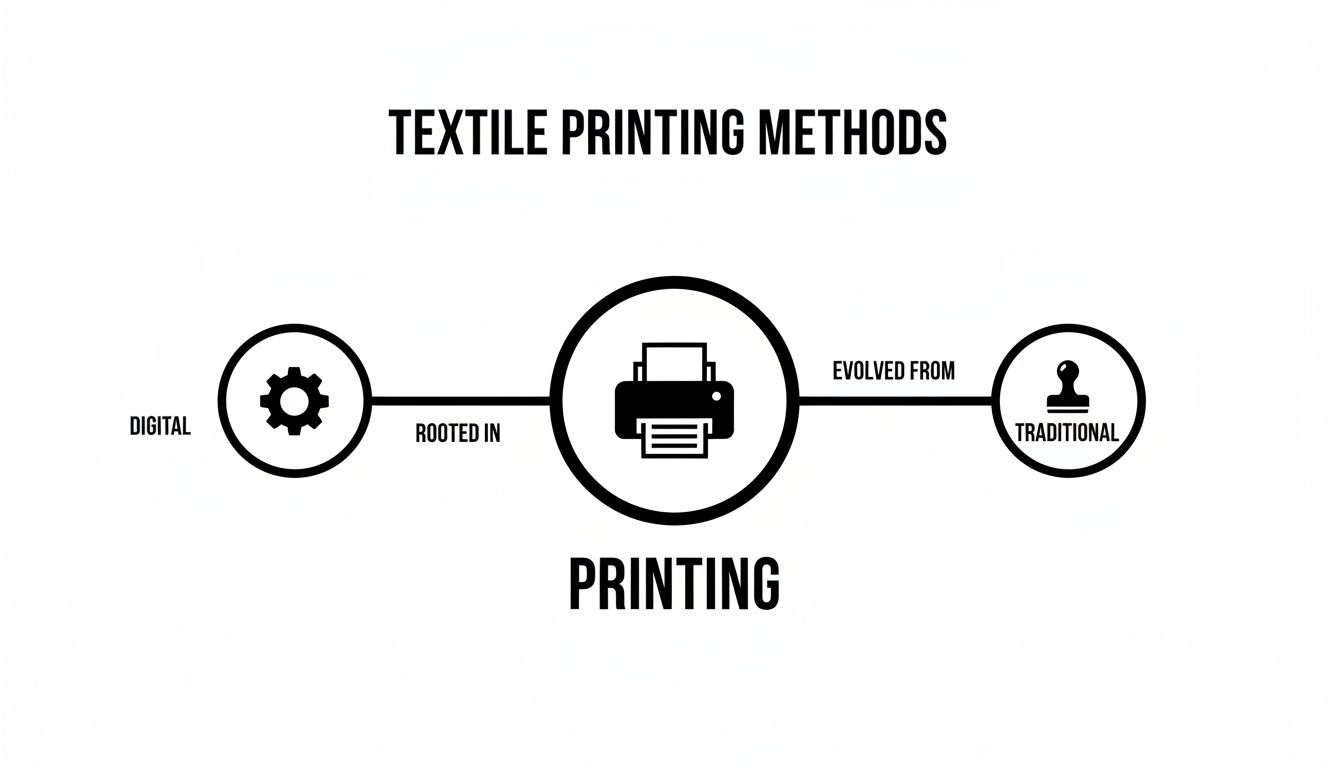
You can see that digital printing evolved directly from, well, printing, while screen printing and other classic methods have their own separate history. This context is key to understanding why digital printing offers such incredible flexibility and detail.
H3: Which Digital Printing Method Is Right for You?
Choosing the right technology can feel overwhelming at first. Each method has its own strengths and is tailored for different materials and end products. This table breaks down the four main players to help you decide which one best fits your project.
| Technology | Best For Materials | Common Applications | Key Feature |
|---|---|---|---|
| Direct-to-Garment (DTG) | Natural fibers, especially 100% cotton | Detailed, full-color t-shirt designs, photorealistic prints | Super-soft feel as the ink soaks directly into the fabric |
| Direct-to-Film (DTF) | Cotton, polyester, blends, leather, nylon | T-shirts, hoodies, team uniforms, hats, bags, promotional items | Extremely versatile; works on almost any fabric and color |
| Dye Sublimation | 100% polyester or polymer-coated items | All-over print apparel, performance sportswear, mugs, mousepads | Vibrant, permanent print that becomes part of the material |
| Roll-to-Roll Printing | Large rolls of cotton, polyester, silk, etc. | Fabric for fashion collections, home decor, upholstery | Industrial-scale printing for producing raw, printed textiles |
Ultimately, the best choice comes down to what you're making. Are you printing a single, photorealistic tee? DTG might be your answer. Need to decorate a whole batch of polyester jerseys? That’s a job for dye-sublimation. But for all-around flexibility on a huge range of items, DTF is often the go-to solution.
Let's dig a little deeper into how each of these actually works.
H3: Direct to Garment (DTG): The Fabric Inkjet
Direct-to-Garment, or DTG, is pretty much what it sounds like. It works just like your home inkjet printer, but instead of paper, it prints directly onto a finished garment like a t-shirt or hoodie.
The printer holds the clothing flat while a print head sprays special water-based inks onto it. These inks soak right into the fibers. If you're printing on a dark shirt, the machine first lays down a layer of white ink to act as a primer, ensuring the colors pop.
- Best For: Natural fibers, especially 100% cotton.
- Common Applications: Highly detailed, multi-color t-shirt designs, photorealistic prints, and small-batch apparel orders.
- Key Feature: The print has an incredibly soft feel (what we call "hand") because the ink becomes part of the fabric itself. It’s breathable and comfy.
H3: Direct to Film (DTF): The Ultimate Transfer
Direct-to-Film (DTF) has become a massive favorite for its sheer versatility. Instead of printing on the garment, the design is printed onto a special sheet of transfer film. A fine adhesive powder is sprinkled over the wet ink and then melted with heat.
This process creates a tough, flexible transfer that’s ready to go. You just place it on the garment and use a heat press to permanently bond the design to the fabric.
DTF is the great equalizer for fabrics. It sticks to just about anything—cotton, polyester, blends, leather, even hard surfaces. That adaptability makes it one of the most useful digital decoration methods out there.
DTF really shines where other methods struggle, especially on synthetic fabrics or awkwardly shaped items that can't be printed directly. If you want to see how it stacks up against other options, check out this detailed guide to various fabric printing techniques.
H3: Dye Sublimation: The Molecular Bond
Dye-sublimation is a process that feels a bit like science magic. First, a design is printed with special inks onto transfer paper. When that paper is heated against a polyester item, the ink goes from a solid straight to a gas, completely skipping the liquid phase.
This gas then penetrates the polyester fibers, and as it cools, it turns back into a solid—becoming a permanent part of the material itself. You get a print with absolutely zero feel. It can't be scratched off, and it will never crack, peel, or fade.
- Best For: 100% polyester or items with a special polymer coating.
- Common Applications: Performance sportswear, jerseys, all-over print apparel, mugs, and mousepads.
- Key Feature: The vibrancy and permanence are second to none. The color is literally infused into the material, not just sitting on top.
H3: Roll-to-Roll: The Industrial Powerhouse
While the other methods are great for finished items, Roll-to-Roll printing is the heavy-duty workhorse of the digital textile world. This process involves printing directly onto massive rolls of fabric—sometimes hundreds of feet long—much like a newspaper press prints on paper.
These huge systems are built for high-volume production. They are what big brands and fabric designers use to create the custom textiles that are later cut and sewn into clothing, furniture, and more. It’s the engine behind everything from fast fashion to bespoke interior design fabrics.
Choosing Your Method Wisely
Knowing how each printing technology works is one thing, but the real trick is picking the right one for your job. Every method has its own set of pros and cons, and weighing these trade-offs is crucial to avoid expensive mistakes and make sure your final product looks and feels exactly how you envisioned.
Making the right call means looking past the print itself. You have to think about the fabric, the feel you're going for, how durable it needs to be, and of course, the cost. Let's break down the main contenders to help you figure it out.
The Soft Hand of Direct to Garment (DTG)
Direct-to-Garment (DTG) printing is famous for its incredibly soft finish, or "hand." The ink soaks right into the fabric's fibers, making the print feel like it's part of the shirt. This gives it fantastic breathability and comfort, making it a go-to for high-end fashion or any design where a premium feel is a must.
But DTG isn't perfect. Its biggest weakness is its reliance on natural fibers. It really struggles with polyester and synthetic blends, which can lead to faded, blotchy prints. So while it’s a champ on cotton, its performance on other materials can be a major letdown.
Even with these limitations, DTG holds a huge piece of the market because it's so good at printing on cotton, the backbone of the apparel world. In fact, projections show Direct-to-Garment printing leading with a 60.4% market share in 2025, which tells you just how popular it is in fashion circles.
The Unmatched Versatility of Direct to Film (DTF)
Think of Direct-to-Film (DTF) as the jack-of-all-trades in the printing world. Its greatest strength is its incredible material compatibility. DTF transfers stick beautifully to almost anything—cotton, polyester, leather, nylon, you name it. This opens up a massive range of possibilities for clothes, accessories, and promo gear.
DTF prints are also known for their punchy, vibrant colors and crisp details that hold up great in the wash. The main trade-off is the feel. Since the design is a thin layer sitting on top of the fabric, it’s not quite as breathable as a DTG print. That said, modern DTF transfers are super flexible and light, feeling a lot like a high-quality screen print.
Key Takeaway: DTF is all about flexibility. If you work with a ton of different materials or need knockout colors on both light and dark garments, DTF is usually the most reliable and budget-friendly choice.
Still on the fence? Our complete guide comparing DTF vs. DTG printing gets into the nitty-gritty of what each one does best.
The Permanent Brilliance of Dye Sublimation
When you need prints that are insanely vibrant and will absolutely never fade, nothing beats dye-sublimation. In this process, the ink turns into a gas and fuses directly into the polyester fibers at a molecular level. The result? A design with zero feel that will never crack, peel, or fade, no matter how many times you wash it.
This makes dye-sub the undisputed king for performance sportswear, activewear, and anything else that needs to be tough as nails. The amazing all-over, edge-to-edge prints it can produce are a huge hit in the athletic apparel industry.
So what's the catch? Dye-sublimation only works on 100% polyester or hard surfaces with a special polymer coating. It’s completely useless on natural fibers like cotton because the ink has nothing to bond with. This specialization is both its greatest superpower and its biggest weakness.
Making the Final Decision
Picking the right printing method really boils down to balancing three things: the fabric you're using, the look and feel you want, and what the final product will be used for.
- For soft, breathable prints on cotton: DTG is your best bet.
- For maximum versatility across many fabrics: DTF is the clear winner.
- For permanent, vibrant prints on polyester: Dye-sublimation is unmatched.
By matching your project’s needs with the strengths of each technology, you can confidently pick the perfect method to bring your ideas to life with professional, stunning results.
How to Prepare Your Artwork for Flawless Prints
The secret to a fantastic print isn't just in the printer—it's locked inside the digital file you create. Getting your artwork ready is easily the most important step to make sure your design looks as stunning on a t-shirt as it does on your screen.
Think of it as a pre-flight checklist for perfect prints.
Your artwork is the blueprint. If the blueprint is flawed, it doesn't matter how fancy the printing press is; the final product will have issues. Nailing these fundamentals from the get-go saves you a ton of time, money, and the headache of a botched order.
Vector Versus Raster: The Building Blocks of Your Design
First things first, let's talk about the difference between vector and raster graphics. These are the two main ways digital images are built, and picking the right one is crucial for getting those crisp, clean lines everyone wants.
A raster graphic is basically a grid of tiny colored squares called pixels. Think of a photograph—if you zoom in far enough, you'll see the little squares. This is why enlarging a raster image too much makes it look blurry and "pixelated." You're just making the squares bigger, not adding more detail.
On the other hand, a vector graphic is made from mathematical equations that define points, lines, and curves. Because it's based on math instead of pixels, you can scale it up to the size of a billboard or down to a postage stamp, and it will stay perfectly sharp.
Key Takeaway: For most logos, text-based designs, and illustrations headed for apparel, vector is the gold standard. It guarantees a sharp print at any size. Stick to raster formats only when you're working with photographs.
Mastering Color and Resolution
Ever notice how the colors on your screen look a bit different once they're printed? That's because screens and printers speak different color languages. Your monitor uses RGB (Red, Green, Blue) light to create images, but printers use CMYK (Cyan, Magenta, Yellow, Black) ink to put them on fabric.
To get the colors right, your artwork should be designed in, or converted to, the CMYK color space. This gives you a much more accurate preview of how the final print will look. To really get this right, print shops use color profiles. If you want to go down that rabbit hole, our guide explains what an ICC file is and how it keeps colors consistent.
Resolution is just as important. For digital textile printing, you absolutely need your artwork to be at least 300 DPI (dots per inch) at the size it will be printed. Anything less, and you're asking for a blurry, pixelated mess.
Your Final Artwork Checklist
Before you hit that "export" button, give your file one last look-over. Running through this quick checklist can save you from common mistakes that can totally derail a print job. And if you're getting into all sorts of textile decoration, it's also helpful to learn how to digitize embroidery designs, as many of the same prep principles apply.
Here are the must-do steps:
- Choose the Right File Format: PNG is your best friend for any design needing a transparent background. For vector files, you can't go wrong with AI, EPS, or SVG. Steer clear of low-quality JPEGs, which can add weird, fuzzy artifacts around your design.
- Outline All Fonts: This is a big one. Convert all your text into shapes or outlines. It locks the font into the design, so you won't have any surprises if your printer doesn't have the exact font you used.
- Embed All Images: If you've placed any photos or other raster images into your vector design, make sure they are fully embedded. If they're just linked, they'll show up as a missing box when the printer opens the file.
- Check for Stray Elements: Zoom way in and scan your artboard. Look for any stray points, hidden layers, or accidental background shapes that could sneak their way into the final print.
The Greener and Smarter Way to Print
Beyond the sharp details and stunning colors, digital printing brings something far more important to the table: a smarter, more responsible way to create textiles. It’s a direct answer to some of the oldest problems in the fabric industry, offering real environmental and financial wins for creators big and small.
The biggest game-changer is how it tackles waste. The traditional fashion world has a well-known overproduction problem, leading to mountains of unsold clothes in landfills. Digital printing completely flips that script by making on-demand production a reality. Forget guessing what will sell and ordering thousands of items; now, you can print exactly what you need, right when you need it.
This "create, test, then sell" model cuts down on inventory risk and waste by locking production directly to what customers are actually buying. It's a nimble, efficient way of working that's just impossible with the high setup costs and minimum orders of old-school screen printing.
Slashing Water and Energy Consumption
The environmental benefits really shine when you look at resource consumption. Traditional dyeing and printing are incredibly thirsty processes, guzzling massive amounts of water for treating fabrics and washing them afterward. This creates a huge volume of chemical-filled wastewater that's difficult and expensive to manage.
Digital printing, especially with modern pigment inks, practically takes water out of the picture. The whole process is much more direct. It often cuts out the need for pre-treating fabric and gets rid of post-print steps like steaming and rinsing altogether. This isn't just a small tweak—it's a huge step forward for conservation.
By eliminating the need for extensive washing and steaming cycles, digital textile printing can slash water consumption by up to 90% and cut energy use by over 30% compared to traditional rotary screen printing.
This kind of efficiency means a much smaller carbon footprint, making it the go-to choice for brands and customers who care about the planet.
Empowering a New Generation of Creators
Financially, digital printing has leveled the playing field. It tears down the massive cost barriers that used to lock small businesses and independent designers out of the custom fabric market. Without needing to invest in screens or commit to massive bulk orders, anyone with a good idea can now produce professional-quality textiles.
This newfound accessibility sparks creativity and lets smaller brands compete with their designs, not just their production volume. It takes a lot of the financial risk out of launching a new collection, giving designers the freedom to experiment without the fear of getting stuck with piles of unsold inventory. This has opened the door for a whole new wave of sustainable fashion startups, bespoke home decor brands, and independent artists to build their businesses.
And people are noticing. A huge 94.6% of consumers in recent surveys said they’d gladly pay more for products made with eco-friendly textiles. This demand is pushing more companies to adopt waterless digital inks, which can reduce water usage by an incredible 95% compared to old-school dyeing methods. You can discover more insights about these consumer trends and see how they're shaping the market.
Inspiring Applications Beyond the T-Shirt
Custom t-shirts are a great entry point, but the real magic of digital printing in textile happens when you start thinking bigger. This technology opens up a whole world of possibilities for indie brands, designers, and entrepreneurs, letting them create unique, professional-quality products without the traditional headaches.
For example, picture an independent fashion designer dreaming up a collection of hoodies and leggings with complex, all-over patterns. In the past, this would've meant huge minimum orders and a massive financial gamble. With digital printing, they can run a small batch, test the market, and react to trends in real-time. It’s a game-changer for building a brand on creativity and limited-edition drops.
Transforming Spaces with Custom Decor
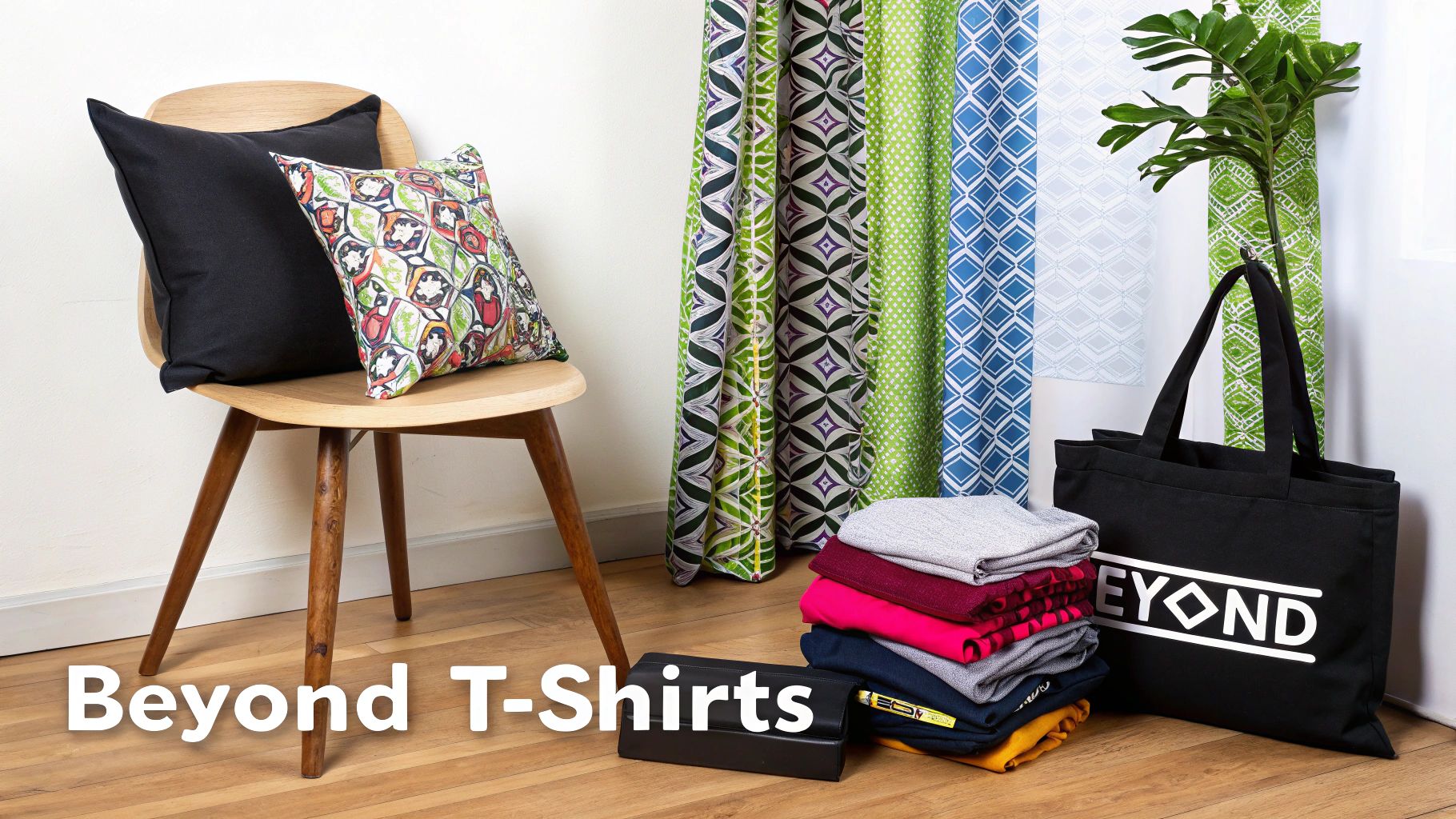
The creative canvas extends far beyond our closets and right into our living rooms. Interior designers can now craft truly one-of-a-kind spaces by printing custom fabrics for almost anything.
- Personalized Soft Furnishings: Imagine creating bespoke cushions, curtains, and throw blankets that perfectly match a room's aesthetic with your own art or photos.
- Bespoke Upholstery: Why settle for stock fabrics? Designers can now print custom textiles to cover chairs, sofas, and headboards, turning standard furniture into stunning statement pieces.
- Unique Wall Art: Fabric tapestries and canvas prints offer a rich, modern alternative to posters, allowing for photorealistic detail and texture.
This on-demand capability blows the doors wide open for creativity, enabling perfect color coordination and deep personalization for any interior design project.
Capturing Niche Markets
Digital printing really shines in specialized markets where customization, vibrant color, and durability are non-negotiable. Take performance sportswear, for instance. It’s almost entirely built on dye-sublimation, which produces those brilliant, full-coverage team jerseys that never crack, peel, or fade, no matter how many times they're washed.
The promotional goods industry is another perfect fit. Businesses can create memorable, full-color tote bags and banners that actually get noticed. This demand for personalized gear has been a huge driver of growth in the industry. Back in 2018, fashion items already commanded a 65.7% volume share as people clamored for custom-printed clothes, bags, and shoes. And cotton is still a favorite—it's projected to hold a 44.9% volume share by 2025 thanks to its fantastic ink absorption and natural feel.
Digital printing isn't just a production method; it's a creative toolkit. It gives creators the freedom to experiment, personalize, and build businesses around unique products that were once out of reach for small-scale operations.
This technology is also fueling the next wave of fashion tech. For example, it’s a key component for innovative AI-powered virtual fashion stylists that can generate endless unique designs, all ready to be printed on demand.
Your Top Questions About Digital Textile Printing, Answered
Jumping into the world of digital printing for textiles is exciting, but it definitely brings up some practical questions. It's one thing to imagine all the creative possibilities, but it's another to nail down the details that will affect your final product and, of course, your budget.
Let's cut through the noise and tackle the most common questions head-on. We'll cover everything from durability and cost to what the prints actually feel like, giving you the confidence to make the right choice for your project.
How Durable Are Digital Prints Compared to Screen Prints?
This is a big one, and the short answer is yes—modern digital prints are incredibly tough. When done correctly, they can easily match, and sometimes even beat, the longevity of traditional screen prints. But the real key to durability lies in which digital method you're using.
- Dye-Sublimation: When it comes to permanence, dye-sub is the undisputed champion. The process actually infuses the ink into the polyester fibers, so the design becomes a permanent part of the fabric. It will absolutely not crack, peel, or fade, lasting as long as the garment itself.
- Direct-to-Film (DTF): A good DTF transfer is built to last. These prints are engineered to handle dozens and dozens of washes without cracking or losing their color. This makes them a super reliable choice for everything from durable workwear to everyday fashion.
- Direct-to-Garment (DTG): A high-quality DTG print can easily hold up for 50+ washes, as long as you treat it right. The secret is in the care instructions: always wash inside out, stick to cold water, and steer clear of the high-heat setting on your dryer.
Bottom line? A quality digital print is made to last.
Is Digital Printing Expensive for Bulk Orders?
This is where things get interesting, because it really depends on your order size and the complexity of your artwork. For small to medium-sized runs—think anything from a single piece up to around 100 items—digital printing is almost always the more budget-friendly option. Why? Because there are no screen setup fees, which can easily add a few hundred dollars to a screen printing job before you've even printed a single shirt.
Now, if you're printing a massive run of 500+ shirts with a very simple, one-color logo, traditional screen printing might start to look cheaper per piece. But here's the kicker: if your design is packed with colors, digital printing often stays the more economical choice, even at high volumes. With digital, adding ten more colors to your design costs you absolutely nothing extra.
Key Insight: Digital printing's cost is tied to the print itself, not the number of colors. This is a game-changer for complex, photorealistic designs at any quantity. Screen printing, on the other hand, gets more expensive with every color you add.
What Does a DTG or DTF Print Feel Like on a Shirt?
The feel of the print—what we call its "hand" in the industry—is a huge part of the final product's appeal. It’s one of those things you don't think about until you touch it, and it varies quite a bit between the different digital methods.
A DTG print feels incredibly soft and breathable. Because the water-based ink soaks right into the cotton fibers, the design feels like it’s truly part of the fabric. This is especially true on light-colored garments, where the hand is almost undetectable.
A DTF print feels a bit different. It’s more like a very thin, super-flexible layer that sits on top of the fabric. It's smooth to the touch and has a nice bit of stretch, much like what you'd expect from a high-quality modern screen print. While it’s not quite as breathable as DTG, its vibrant look and feel are top-notch.
Ready to bring your vibrant, durable designs to life on any fabric? Raccoon Transfers makes it easy with premium, next-day DTF transfers. Upload your art, build a gang sheet, and get professional results with a super-fast turnaround. Start your custom print order now at Raccoon Transfers